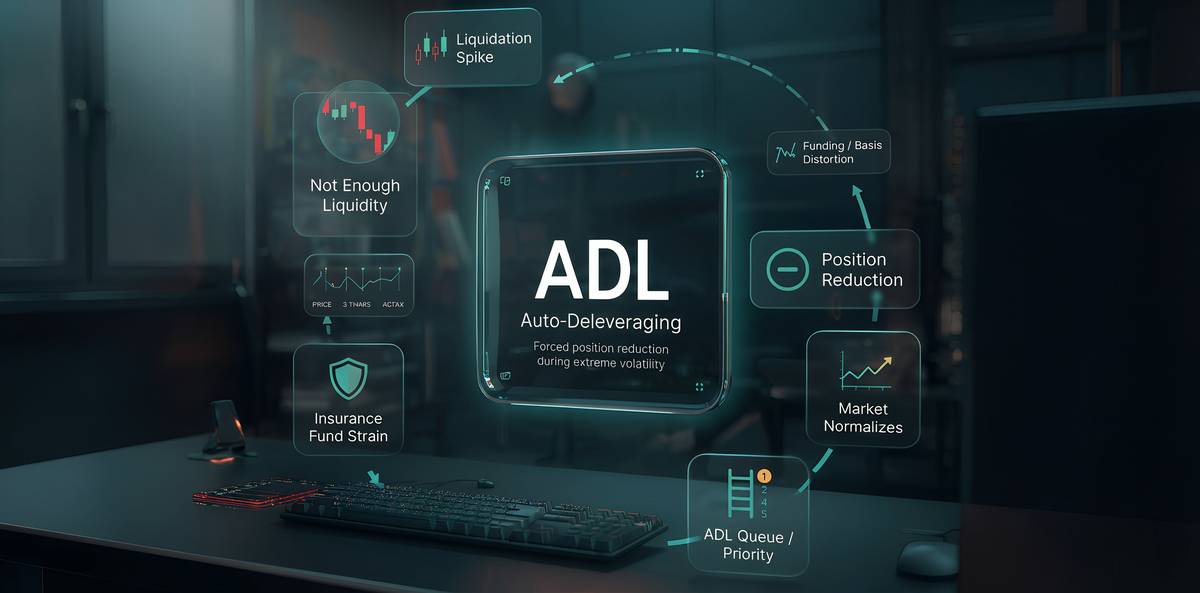
ADL (Auto-Deleveraging) on OKX is the forced reduction of profitable positions in a specific derivatives contract, carried out by the exchange to cover a negative clearing balance that appeared after losing positions were liquidated.
A clearing deficit appears when a position is liquidated at a market price worse than its bankruptcy price, and the combined margin of the liquidated positions together with the insurance fund is not enough to cover the contract obligations.
ADL on OKX is not tied to an individual trader's margin level and is not a form of liquidation; the position reduction is performed by the exchange's clearing system to redistribute the loss inside one derivatives contract and remove an unfulfilled obligation.
⚙️ When a clearing deficit appears on OKX
A clearing deficit on OKX appears inside one derivatives contract when a liquidation is executed below the bankruptcy price and the insurance fund does not compensate the entire negative settlement difference.
Step 1: the deficit is recorded during liquidation
A clearing deficit appears if a derivatives position is liquidated at a market price below the pre-calculated bankruptcy price.
The actual execution lands below the calculated level because the liquidation volume slips through a thin order book.
Object: one derivatives contract.
Recording moment: the completed liquidation of the position.
Form: a negative price difference.
Execution below the bankruptcy price is recorded as a clearing deficit.
Step 2: the deficit becomes the basis for ADL
The negative price difference is first compensated from the insurance fund attached to the same derivatives contract.
Auto-deleveraging is applied if the total deficit is larger than the available size of the fund and remains uncovered.
Insurance fund: applied, but its size was not enough.
Deficit: remains inside the settlement of one contract.
Clearing: must close the remainder.
An uncovered clearing deficit activates the auto-deleveraging mechanism.
🔧 How OKX selects positions for auto-deleveraging
After an uncovered clearing deficit is recorded, OKX applies an auto-deleveraging algorithm that sorts open positions inside one derivatives contract by measurable clearing-risk parameters.
The auto-deleveraging algorithm is applied only inside the specific derivatives contract and does not affect the trader's positions on other markets or instruments, which reflects the isolated nature of derivatives clearing on OKX.
Each open position is evaluated by the clearing system according to parameters that directly affect the size of the obligations under the contract if the price continues to move.
| Position parameter | What the system records | Role in ADL |
|---|---|---|
| Unrealized profit | Positive PnL on the contract | Source for compensating the deficit |
| Leverage | Position-to-margin ratio | Assessment of clearing risk |
Positions with a larger unrealized profit and higher leverage are placed near the start of the auto-deleveraging queue and are reduced first.
📊 How ADL differs from liquidation and the insurance fund
Liquidation, the insurance fund and auto-deleveraging solve different tasks in the clearing of a derivatives contract and use different sources to cover obligations.
Liquidation
Liquidation is triggered for a specific position when its margin becomes insufficient to maintain the obligations under the derivatives contract.
The clearing system closes the position through market execution to stop the further accumulation of a negative balance on that position.
- Trigger: position margin falls below the maintenance level.
- Source of coverage: margin of the liquidated position.
- Result: the position is closed and the obligations are stopped.
Liquidation closes the position's risk using that position's own margin.
Insurance fund
The insurance fund is applied to the same contract if the liquidation is executed below the bankruptcy price and the position margin is not sufficient for settlement.
The clearing system uses the insurance-fund balance to cover the negative difference between the bankruptcy price and the actual execution price of the liquidation.
- Trigger: liquidation execution price is below the bankruptcy price.
- Source of coverage: assets of the contract's insurance fund.
- Result: the deficit is reduced or closed.
The insurance fund compensates the negative result of liquidation.
Auto-deleveraging is applied only when an uncovered clearing deficit remains on the contract after liquidations and after the insurance fund has been used.
Auto-deleveraging (ADL) differs because the clearing system closes the remaining deficit by forcibly reducing profitable positions inside the same derivatives contract.
With ADL, the source of coverage shifts from the position margin and the insurance fund to the profit of other positions, so the contract settlement can finish without unfulfilled obligations.
| Mechanism | Trigger | Source of coverage | What it closes |
|---|---|---|---|
| Liquidation | Insufficient position margin | Position margin | Obligations of that position |
| Insurance fund | Execution below bankruptcy price | Insurance fund | Negative execution difference |
| ADL | Deficit after the insurance fund | Profit of other positions | Remaining deficit on the contract |
📉 What the ADL indicator shows in the OKX interface
The ADL indicator on OKX shows the relative position of a trade in the auto-deleveraging queue inside one derivatives contract.
The ADL indicator is calculated separately for each contract and reflects the order of clearing reduction, not the market direction.
The indicator value is formed from the position parameters used by clearing when sorting positions for auto-deleveraging.
| ADL level | Position in the queue | What it does not show |
|---|---|---|
| Low | End of the ADL queue | Liquidation risk |
| High | Start of the ADL queue | Price forecast |
The ADL indicator reflects the clearing priority of the position and is not connected with price direction or order-book depth.
🛡️ Which position parameters affect the probability of ADL
The probability of auto-deleveraging is determined by measurable position parameters inside a derivatives contract and reflects the clearing priority of reducing that position when a deficit remains uncovered.
Leverage
Leverage records the ratio between the nominal size of the position and the margin posted, and it is used by the clearing system when evaluating risk.
Positions with higher leverage create a larger amount of potential obligations if a clearing deficit remains.
Parameter: leverage used by the position.
Effect: higher sensitivity of obligations.
Consequence: higher ADL priority.
High leverage increases the priority of reduction.
Unrealized profit
Unrealized profit records the positive PnL of the position, which clearing can use to close the deficit.
Positions with a larger unrealized profit provide a larger available amount for reduction.
Parameter: current unrealized PnL.
Effect: available compensation amount.
Consequence: higher ADL priority.
Profit growth raises the position in the ADL queue.
Position size
Position size defines the nominal volume of obligations under the derivatives contract during clearing settlement.
Large positions allow clearing to reduce the remaining deficit faster when they are cut.
Parameter: nominal position size.
Effect: scale of the clearing impact.
Consequence: faster reduction.
A large size strengthens the effect of the reduction.
Combined priority
The ADL queue is formed from the combined assessment of position parameters inside the derivatives contract.
The combination of leverage, profit and size determines the final clearing priority.
Parameter: combined assessment.
Effect: order of position reduction.
Consequence: place in the ADL queue.
ADL priority is determined by the combination of parameters.
🚪 Further mechanics of auto-deleveraging
Auto-deleveraging is applied by the clearing system as the final settlement stage of a derivatives contract after the position margin and the insurance fund have been exhausted.
The key elements of this stage are the ADL queue, the parameters used to sort profitable positions and the method for closing the uncovered clearing deficit inside one contract.
The mechanics of queue formation, priority calculation and deficit distribution between positions are explained in a separate guide at the clearing and algorithm level.
Auto-deleveraging is considered part of the settlement architecture of derivatives markets, where the deficit is closed through the forced reduction of profitable positions.