How payouts work in prop programs: limits and split
A prop program provides a trading account with a defined risk limit and pays a share of profits when the rules are followed.
Prop trading (proprietary trading) is a trading format governed by a program’s terms: risk limits and style restrictions are set, and the payout is calculated from profit via the profit split. Basic formula: payout = profit × split, if the limits are not breached.
Next are the main program models (challenge — evaluation stage, instant — immediate access), the rule parameters that determine outcomes, and payout calculation by the formula: account size × return × split.
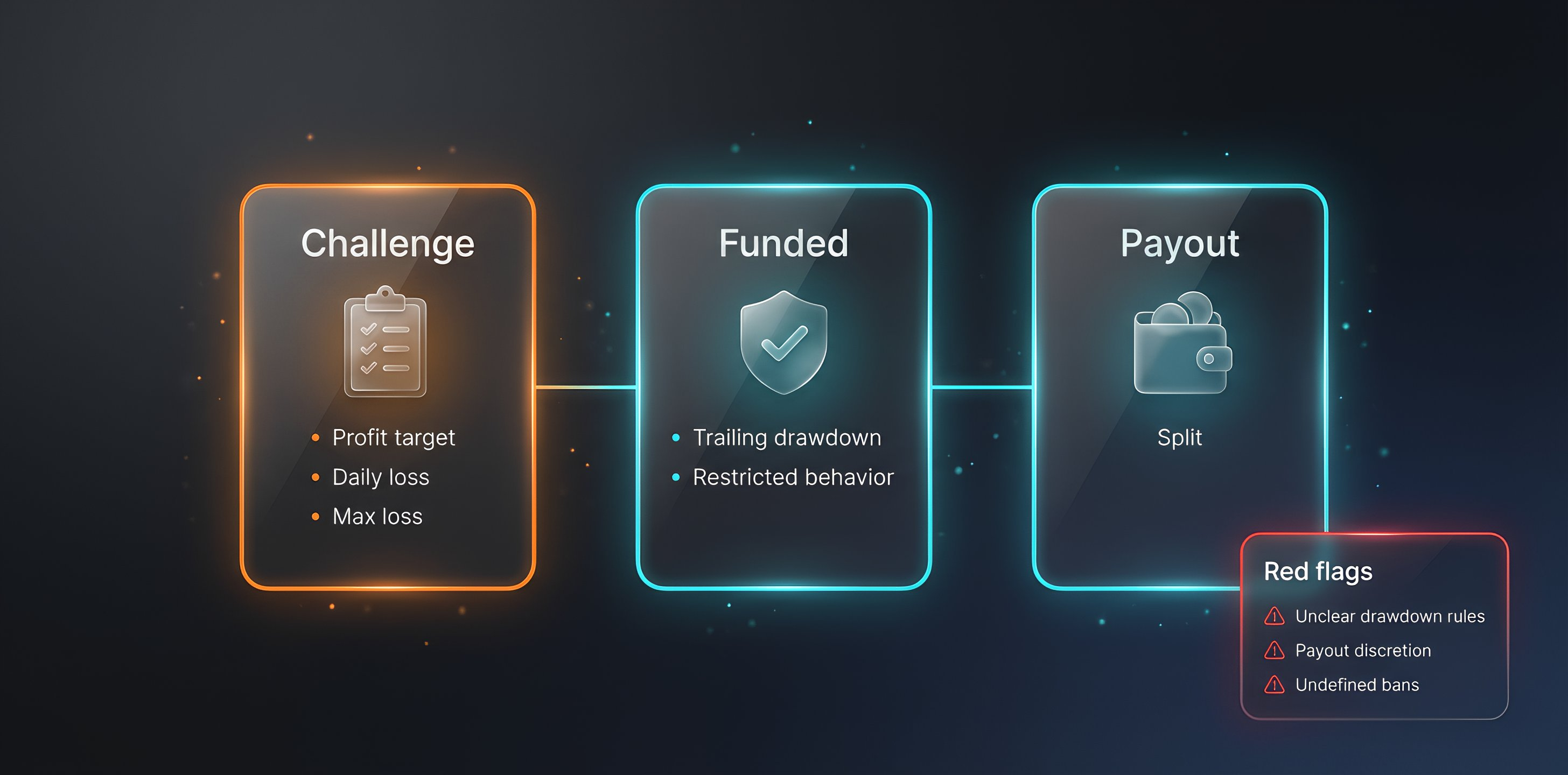
A prop firm in simple terms: limits and payout
A prop firm provides a trading account with a risk limit and rules, while payouts depend on the profit split and payout terms.
A prop firm is a company that provides a trading account with a set limit and a set of rules: risk limits (daily loss and max loss/max drawdown), possible trailing drawdown, style and infrastructure restrictions, plus payout terms and schedule. In many programs, the evaluation stage runs on a simulated account with real quotes.
A trader’s payout is a share of profit via the profit split. The firm’s revenue comes from the program participation fee (fee/subscription) and its share of profits.
How the process works
A typical flow: an evaluation stage with risk limits, then funded status and payouts on a schedule.
- Selecting a program and account size (profit target, risk limits, drawdown calculation basis, payout terms and frequency).
- Evaluation stage (challenge): the profit target must be reached without breaching daily loss and max loss/max drawdown.
- Second stage (if provided): targets and timelines change, while risk limits and restrictions remain the same or close.
- Funded status (eligibility for payouts under the rules): payout requests become available if conditions are met.
- Trading under the rules and requesting payouts on schedule after meeting the conditions (for example, a profit threshold and/or min trading days).
Main models: 1-step, 2-step, 3-step, instant
Formats differ by the number of stages, profit targets, drawdown limits, and when eligibility for the first payout appears.
- 1-step challenge — one evaluation stage: one profit target and one set of limits. The target is completed in one stage under daily loss and max loss/max drawdown constraints.
- 2-step challenge — two stages: first the main target, then a verification stage with a separate target. The second stage requires reaching the profit target again without breaching limits and restrictions.
- 3-step — three stages with intermediate targets. Targets are spread across stages, and the risk of breaching limits and restrictions exists at each stage.
- Instant funding — account access is granted immediately, without evaluation stages. Access cost is usually higher (fee/subscription) and restrictions on trading style or payout terms are stricter.
Typical parameters that are read first
The key in the rules is drawdown calculation: daily loss (daily loss limit) and max loss/max drawdown (overall limit), plus eligibility for the first payout and restrictions.
| Parameter | What it means | Typical ambiguity |
|---|---|---|
| Daily loss | Daily loss limit by equity or balance |
Different calculation base equity includes floating PnL (open positions) |
| Max loss / Max drawdown | Overall drawdown limit for the full period | Trailing drawdown the limit may “trail” upward as the account grows |
| Profit target | Profit target for the evaluation stage | High target with low max loss/max drawdown increases the chance of hitting the limit |
| Min trading days | Minimum number of trading days | Definition of a “day” a single trade does not always count as a trading day |
| Payout rules | When and how much can be withdrawn | First payout conditions profit threshold, waiting period, payout cap |
| Restricted behavior | Restrictions by style and infrastructure | News, HFT, copying, VPN/IP, bots, arbitrage as defined by the rules |
Simulation and funded: what these statuses mean in the rules
The evaluation stage runs in simulation, while funded status means eligibility for payouts under the program rules.
- Simulation — trading on an evaluation account with real quotes, where results are recorded under the program rules. At this stage, the firm usually does not bear a direct trading loss from executed trades.
- Funded — a status that opens access to payouts (payout) when limits and restrictions are followed. Funded does not mean mandatory execution of every trade through a real broker/exchange account of the firm: the rules describe risk limits, restrictions, and payout terms, not the execution scheme.
- Monetization — a combination of a participation fee (fee/subscription) and a share of profits via the profit split. First payout conditions and payout frequency are set separately.
Why traders join prop programs
The format provides a larger trading account, but fixes the cost of a mistake: the program fee and loss of access when limits are breached.
Pros
- Access to a larger trading limit than on a personal account.
- Rules set risk boundaries in advance: daily loss and max loss, style restrictions, payout terms.
- Payouts are defined by the program’s policy (frequency, thresholds, first payout conditions), not informal arrangements.
Constraints
- Style and infrastructure restrictions can be strict (news, HFT/arbitrage, copying, bots, VPN/IP).
- Breaching limits (daily loss/max loss, trailing drawdown) closes account access regardless of overall profitability.
- Definitions in the rules (equity vs balance, what counts as a “trading day,” how trailing works) can affect outcomes as much as trades.
How to estimate a payout on a prop account
The payout depends on account size, return, and split, and in practice is constrained by drawdown limits and payout thresholds.
Payout calculation: trader payout = account size × return for the payout period × trader share (profit split). Trading pace is constrained by risk rules: daily loss, max loss, and (sometimes) trailing drawdown.
| Example | Parameters | Payout math |
|---|---|---|
| Moderate pace | $100 000 account +3% for the period |
$3 000 profit with an 80/20 split → $2 400 |
| Higher return | $50 000 account +5% for the period |
$2 500 profit with an 80/20 split → $2 000 |
| Payout conditions | First payout and schedule min trading days / profit threshold |
Payout is possible only after conditions and within program limits |
Prop program requirements: limits, payouts, restrictions
Rules set boundaries for risk and behavior: what counts as a limit breach and under what conditions account access is closed.
Risk limits
- Daily loss and max loss with the calculation basis (equity or balance).
- Trailing drawdown (if specified): the limit moves upward as the account grows.
- Limit breach = account access is closed.
Activity and payouts
- Min trading days: minimum trading days before a stage or the first payout.
- First payout: profit threshold and waiting period (if specified).
- Payout schedule: weekly / biweekly / monthly.
Trading rules
- Restrictions on specific scenarios: news, HFT/frequent entries-exits (if defined that way in the rules), arbitrage (as defined by the program).
- Ban on copying trades and coordinated trading across accounts.
- If stated in the terms: order requirements (stop-loss/limit orders/position holding time).
Infrastructure and access
- IP/VPN policy and environment requirements (single device/geography — if stated).
- Ban on shared access: accounts must not be transferred to third parties.
- Restrictions on software/bots and platform technical behavior (if described in the rules).
Risks and red flags
Problems most often appear in three places: drawdown calculation, payout terms, and wording of restrictions.
Red flags in payouts
- Payout “at the company’s discretion” without clear criteria and refusal examples.
- First payout is not described: profit threshold, waiting period, payout cap, min trading days.
- No request procedure: review timelines and the list of checks/documents.
Red flags in rules and risk
- Unclear drawdown calculation: equity or balance, trailing drawdown, reset/rolling.
- High profit target with low max loss/max drawdown: required risk or trade frequency increases.
- Restrictions without definitions (for example, “arbitrage”): what exactly counts as a breach.
Legality and regulation
In many Terms/FAQ, prop programs are described as an evaluation/simulation service with payouts under internal rules, not as a licensed broker.
In public terms (Terms/FAQ), prop firms describe the service as access to a platform and an evaluation program: participation is paid (fee/subscription), trading follows the rules, and payout (payments) is made under the program’s terms. This differs from the model of a regulated broker, where licensing and formal dispute-resolution procedures typically exist within a brokerage service.
- Legal entity and jurisdiction: who provides the service and what is stated in the offer/Terms.
- Refusal grounds: what counts as a breach and how checks for “restricted behavior” are described.
- First payout conditions, request review timelines, payout caps, and payout frequency.
- Refund/cancellation policy (if applicable) and how the service payment is оформляется.
Questions and answers (FAQ)
Short answers to common questions that come up before joining a prop program.
What is a prop firm in trading?
How do 1-step and 2-step challenges differ?
What is trailing drawdown?
Why does equity vs balance matter in the rules?
Which restrictions are most common?
How to estimate payout on a prop account?
Can PnL be positive while payout is rejected?
What is instant funding and how does it differ from a challenge?
Summary: how to read prop terms without illusions
A prop program provides a trading account under risk rules and pays a share of profits only when those rules are followed.
A prop firm provides a trading account and sets boundaries through rules: how drawdown is calculated, what the profit target is, what is restricted, and when eligibility for payout opens. The model’s economics are built on a participation fee (fee/subscription) and the firm’s share of profits.
Before paying, drawdown calculation (equity/balance, trailing, reset/rolling), first payout conditions, and the list of restrictions matter most. These points determine what the program treats as a breach and when eligibility for payout arises.
A quick filter is three parameters: