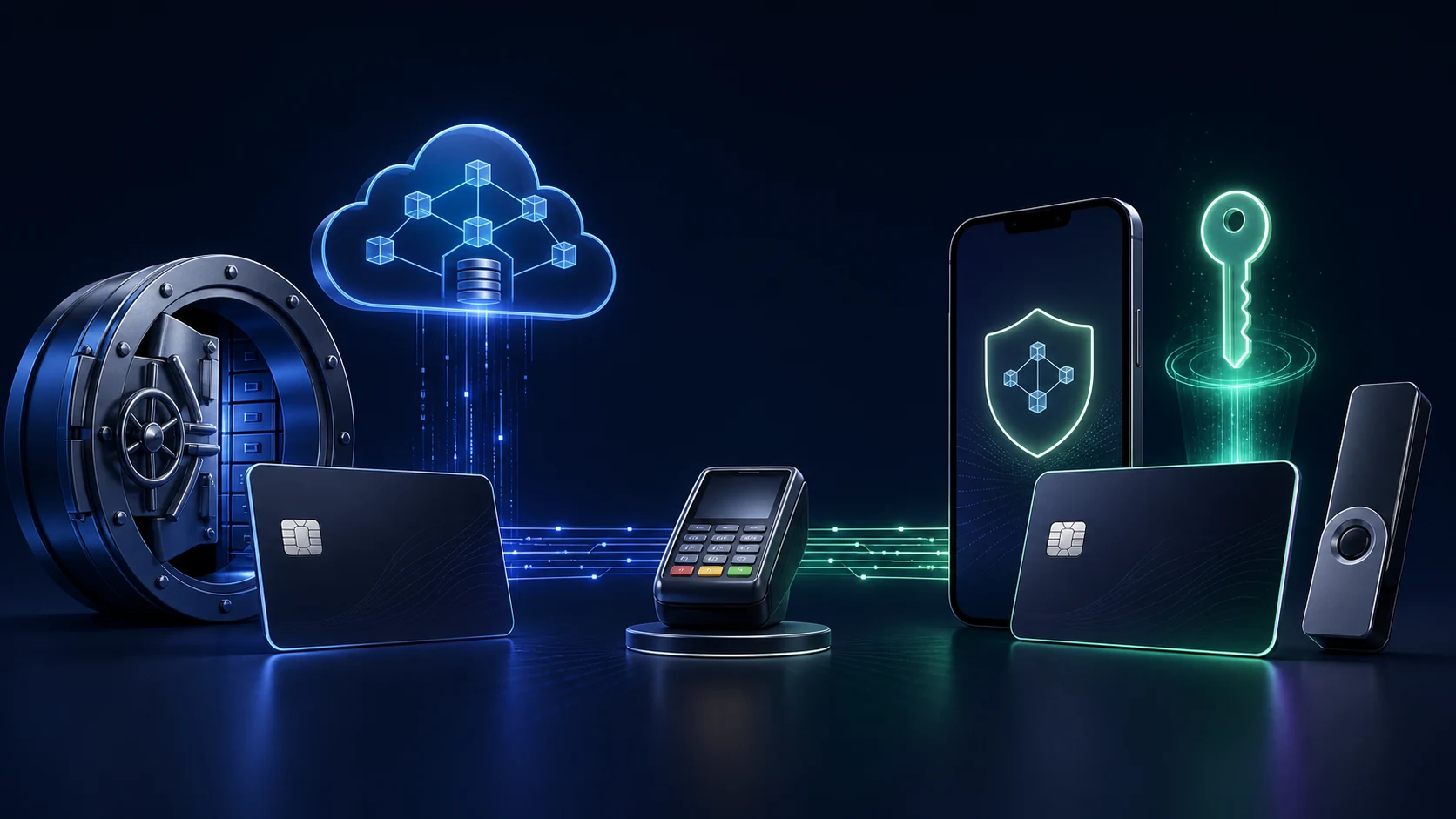
The main difference — who controls the funds
In a custodial model, the provider controls the cryptocurrency or card balance. In a non-custodial model, the assets remain in the user’s wallet and the card module receives limited permission to debit them.
A custodial model is generally easier to use and makes access easier to recover, but it requires entrusting custody of the funds to a service. A non-custodial model leaves control of the crypto assets with the user, while transferring responsibility for keys, smart contracts and on-chain actions to that user.
Important:self-custody does not remove the issuer, KYC, geographic restrictions or the possibility that the card itself may be stopped.
Custodial
Easier to get started:the service can restore access, but the funds depend on the provider.
Non-custodial
More control:the user holds the keys, but recovery and security are the user’s responsibility.
Compare the custody model, KYC, payment network and the issuer’s official terms.
Why a crypto card is almost always a hybrid product
The name “crypto card” can create the impression that a merchant receives cryptocurrency directly from a blockchain. In practice, the seller normally accepts a conventional card payment, while the provider’s infrastructure converts or debits crypto assets and settles with the issuer in a supported currency.
Several layers participate in a single transaction:
- Cryptocurrency balance— a provider account, a conventional wallet or a smart account.
- Debit rule— advance conversion, sale at the moment of purchase, direct debit of a stablecoin or a collateral-backed loan.
- Card issuer— issues the virtual or physical card and applies limits and compliance controls.
- Payment network— carries authorisation and settlement messages between the parties to the transaction.
The question “is the card custodial or not?” therefore needs to be asked more precisely:who controls the crypto assets before the purchase, who can initiate a debit and what happens to the money after authorisation.
Custodial and non-custodial cards: comparison
| Criterion | Custodial card | Non-custodial card |
|---|---|---|
| Control of keys | The provider controls the keys or the internal ledger | The user controls the wallet |
| Source of funds | Balance in an app, exchange or prepaid card | A connected wallet or a separate smart account |
| Recovery of access | Through support and identity verification | Through a seed phrase, passkey, Safe owners or a recovery mechanism |
| Provider risk | Higher: the service holds the balance and can restrict withdrawals | Lower for funds in the wallet, but the card service can still stop the card |
| Technical complexity | Usually lower | Higher: networks, tokens, permissions and blockchain fees |
| KYC and geography | Usually mandatory | Also usually mandatory in order to issue the card |
| User’s main risk | Account freeze, provider bankruptcy or provider compromise | Loss of access, an incorrect signature or a smart-contract vulnerability |
How a custodial crypto card works
In the custodial model, the user first transfers cryptocurrency or fiat currency to the service balance. The provider maintains an internal ledger, performs the conversion and funds the card balance. The user sees an amount in the app but does not control the private keys of the corresponding wallet.
A typical example of this mechanism is a prepaid card that can be funded from the app’s cryptocurrency balance. Crypto.com’s official help centre says that the selected cryptocurrency is converted into the card currency before it is credited to the card balance. A transfer from an external non-custodial wallet does not by itself make the card non-custodial: the funds first arrive in the internal Token Wallet and are then converted.
Advantages of the custodial model
- a familiar interface without the need to manage keys independently;
- recovery of access through support and KYC;
- straightforward funding, conversion and transaction history in one application;
- a clear process for freezing or replacing the card and disputing a card transaction.
Disadvantages of the custodial model
- the provider can suspend the account, the card or withdrawals;
- the balance depends on the company’s financial and operational resilience;
- the conversion rate and spread may be less transparent than an on-chain exchange;
- after the card balance has been funded, transferring the money back may be restricted by the product rules.
Practical approach:keep only the amount needed for upcoming expenses in this balance, rather than the entire long-term crypto portfolio.
How a non-custodial crypto card works
In a non-custodial model, the assets are held at an address controlled by the user. For card payments, the wallet can grant a smart contract or payment module strictly limited permission: a specific token, a daily limit and an authorised settlement address.
For example, Gnosis Pay creates a Safe Smart Account for the user. According to the official documentation, the funds in it are not held by Gnosis Pay, while card-debit rules are defined by the Roles Module. The Safe owner can change permissions, and the Delay Module adds a protective delay to outgoing transactions that are not card payments.
Another option is a card that directly debits a supported token or provides credit secured by crypto assets. ether.fi Cash describes Direct Pay as a debit of USDC or LiquidUSD from a Safe, while Borrow Mode is a loan backed by cryptocurrency collateral.
Advantages of the non-custodial model
- the assets remain at a verifiable on-chain address until they are debited;
- the user controls the wallet owners and permissions;
- a spending Safe can be separated from the main vault;
- movement of funds and smart-contract rules are easier to verify on-chain.
Disadvantages and additional risks
- losing the only key or seed phrase can mean losing access to the funds;
- an incorrect signature or malicious permission cannot be reversed by customer support;
- smart-contract, bridge, stablecoin and selected-network risks are introduced;
- credit mode introduces interest, LTV and the risk of collateral liquidation;
- refunds may be credited differently from the way the card debt is repaid.
ether.fi’s official help centre gives a separate warning: in Borrow Mode, interest accrues on the debt and a fall in the value of the collateral can move the position closer to liquidation. This is no longer merely “paying with crypto”; it is a DeFi credit product.
What self-custody does not remove
Non-custodial architecture protects against some custody risks, but it does not turn the card into a completely independent payment instrument.
- KYC remains.Gnosis Card requires identity and address verification for issuance, even though the funds are held in the user’s Safe.
- Geographic restrictions remain.The issuer only issues the card in supported countries and can change that list.
- Card restrictions remain.There may be limits, prohibited merchant categories, transaction reviews and declined payments.
- Refunds and chargebacks remain.They are processed under the rules of the card programme, rather than as the reversal of an on-chain transaction.
- The card can be stopped.The user will retain control of the wallet, but the issuer can disable the card interface itself.
Main conclusion:a non-custodial card reduces dependence on a provider for custody of the funds. It does not remove dependence on the issuer, payment network, compliance processes and correct operation of smart contracts.
How to choose a model for your use case
A custodial card is more likely to suit you if:
- you need a simple product for small, regular expenses;
- recovery of access through support is important;
- you do not want to work with networks, keys and permissions yourself;
- you are prepared to keep only a limited spending balance with the service.
A non-custodial card is more likely to suit you if:
- control of the keys is a fundamental requirement;
- you understand how Safe, passkeys, networks and tokens work;
- you want verifiable on-chain balances and debit restrictions;
- you are prepared to take responsibility for recovery and security yourself.
Seven questions to ask before applying
- At which address are the funds held before a purchase, and who controls the key?
- Can the remaining balance be withdrawn without the provider’s permission?
- Which token is debited, and at what point does conversion take place?
- Which permissions does the card module receive, and can they be revoked?
- Is there a credit mode, interest, LTV and liquidation?
- What happens if the card is frozen, the issuer becomes insolvent or the key is lost?
- Is issuance available for your country and residency?
After choosing a model, separately calculate issuance, servicing, FX, cash withdrawal and funding fees. A detailed checklist is available in“How to choose a crypto card: fees, limits and risks”. Additional restrictions apply to residents of the Russian Federation — see theregional guide.
Secure setup: regardless of the model
- keep only the amount you plan to spend in the card balance or spending Safe;
- enable separate daily and monthly limits;
- use a separate wallet for the card and do not connect your main vault;
- check the owners, signature threshold and recovery mechanisms of the Safe;
- do not approve unknown permissions and verify the application’s domain;
- freeze the card immediately after a suspicious transaction and retain the payment details;
- regularly review the issuer’s official country list, fees and terms.
Frequently asked questions
Is a non-custodial crypto card completely anonymous?
No. Self-custody does not remove customer identification. The card issuer usually verifies identity and country of residence, while transactions pass through regulated payment infrastructure.
Can the provider block a non-custodial card?
Yes. The provider can stop the card or decline transactions. The difference is that, in a correctly designed non-custodial architecture, the provider does not obtain full control of the funds in the user’s wallet.
Is an exchange card always custodial?
Most often it relies on the internal balance of an exchange or application, but a brand name is not sufficient evidence. You need to examine the path of the funds: the custody address, control of the keys, the conversion process and the ability to withdraw independently.
Is a non-custodial card always safer?
Not for every user. It reduces the risk of custody by a provider but adds the risks of lost keys, incorrect permissions, smart contracts and DeFi mechanisms. Security depends on the architecture and on your ability to manage it.
Official sources
The factual statements use documentation published by the providers themselves rather than promotional reviews.
- Gnosis Pay: architecture of the Safe Smart Account and card modules
- Gnosis: how card payments work while remaining self-custodial
- Gnosis: KYC and card issuance
- Crypto.com: conversion when funding the prepaid card
- ether.fi Cash: Direct Pay and Borrow Mode
- ether.fi Cash: monitoring collateral and liquidation risk
Card programme terms change. The sources and wording were checked in July 2026; before applying, verify current fees and availability on the issuer’s website.
Conclusion
A custodial cardis more convenient when simplicity and support are the priority and only a limited spending amount is held in the balance.A non-custodial cardbetter follows the principle of key control, but requires an understanding of permissions, wallet recovery and additional on-chain risks.
Compare the complete path of the money and the authority of each participant, rather than the label “custodial” or “non-custodial”.