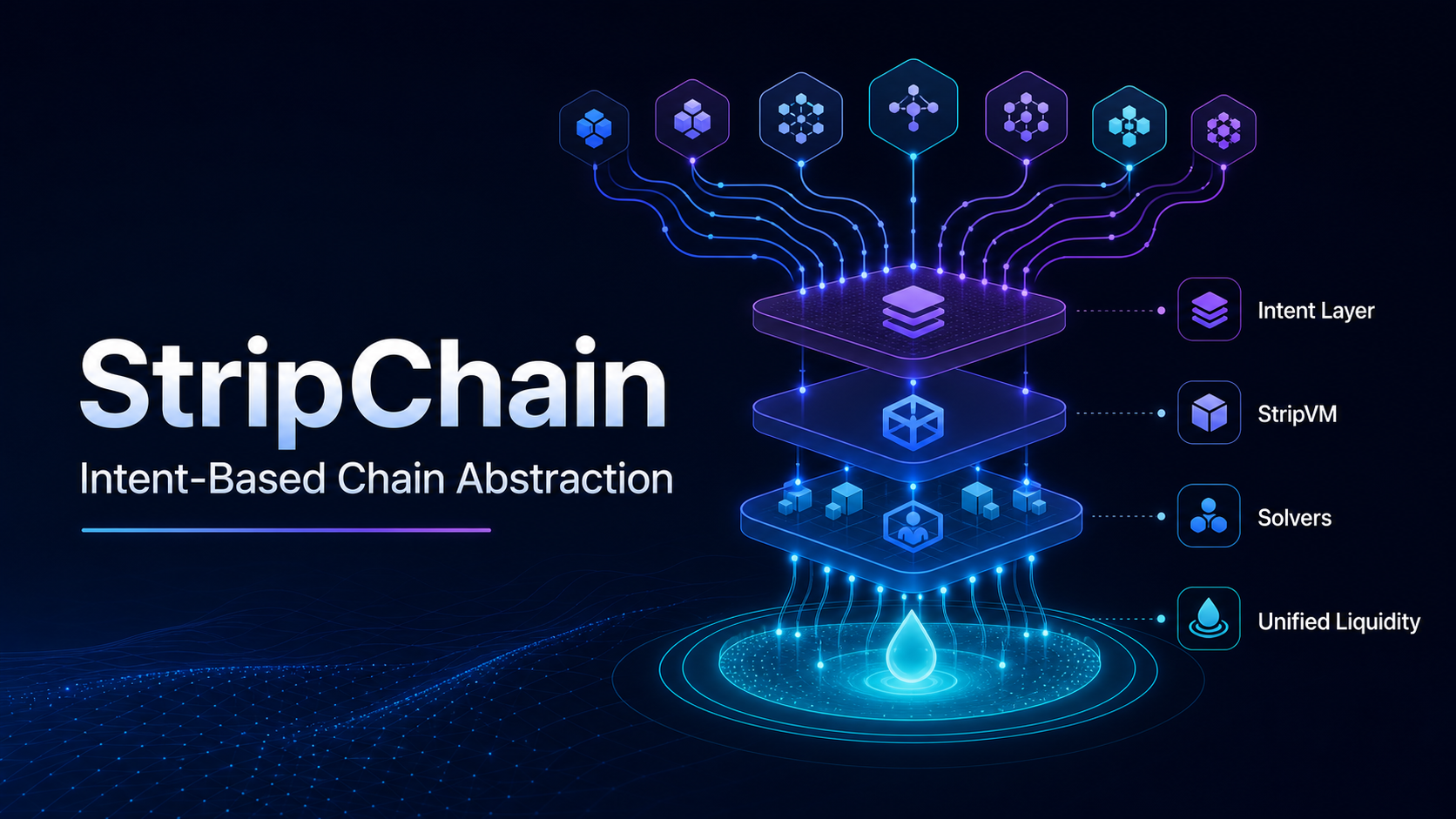
Multichain has become normal, but the user experience still feels like the market is split into separate islands. Assets sit across different networks, gas is required in different tokens, applications do not always understand each other's state, and moving between ecosystems often becomes a chain of bridge, swap, finality waiting and wallet reconnects.
StripChain proposes a different abstraction layer: instead of forcing every application to integrate bridges and general message passing on its own, it moves intent coordination, solver execution and liquidity into shared infrastructure. In one sentence: the user describes the desired outcome, and the network coordinates where and how it should be executed.
The main multichain problem is not the number of networks. It is that applications, assets and user actions often live in different states and require separate coordination.
Why ordinary bridges and message passing do not solve the whole UX
Bridges and GMP protocols solve important parts of the problem, but they do not always give applications a true "single action" model for the user. Chain abstraction requires not only message delivery, but also coordination of outcome, liquidity, state and execution permissions.
A classic bridge answers the question of how to move an asset or mint its representation on another network. General message passing adds the ability to pass data and trigger actions across domains. But in a real user scenario, more is usually required: checking state, executing several operations, finding liquidity, paying gas, returning the result to the application and handling a failure in one of the steps.
As a result, developers often get a bundle of integrations rather than a single logic layer. The user sees multiple confirmations and intermediate actions, while the application has to decide how to synchronize states across networks. StripChain positions itself as a layer that accepts not just a message, but an intent: a declaration of the desired result.
Risk of the old UX: the more manual steps there are between networks, the higher the chance of user error: wrong network, insufficient gas, wrong bridge, unclear transaction status or stuck liquidity.
StripChain describes itself as a full-stack intent-based interoperability protocol: unified execution layer, communication format, solver network, accounts and liquidity.
What StripChain is in simple terms
StripChain is infrastructure for omnichain applications where a user or application submits an intent request, and the protocol coordinates execution through StripVM, StripSolvers and other network components. The goal is to make applications "hyper-interoperable" so they can work with multiple blockchains and states without pushing all complexity onto the user.
The documentation emphasizes a shift from general message passing to general intent passing. That distinction matters. Message passing delivers a message; intent passing describes a desired state change or a set of actions that must be executed across several domains.
Working thesis
StripChain tries to turn multichain from a collection of separate networks into an environment where an application can request a result, while infrastructure chooses the route, executors and liquidity.
- For users: fewer manual bridge, swap and gas steps.
- For developers: a unified intent format and coordination layer.
- For applications: the ability to receive cross-domain calls through solver adapters.
StripChain architecture includes several layers: execution, intent format, solvers, accounts, liquidity and the validator/StripIO layer.
StripChain architecture: which components do what
From the top, StripChain is not only a bridge or only a message layer. It is a set of components that should close the full loop: user intent, coordination, execution, verification and result delivery back to the application.
| Component | Role | What it gives the application |
|---|---|---|
| StripVM | Unified execution layer for processing StripIntents | Coordination of cross-chain actions and statuses |
| StripIntents | Format for describing cross-domain actions | A shared language for multi-step requests |
| StripSolvers | Network of executors/adapters for applications | A way to make existing applications interoperable |
| Unified Liquidity Engine | Liquidity layer for cross-chain asset flow | Smoother swap and transfer scenarios across networks |
| StripAccounts | Unified account and unified balance UX | Abstraction of gas, networks and fragmented balances |
| StripIO / StripNode | Validation, authorization and execution support | Request verification and network-state security |
StripVM is the center of the model: it receives an intent, queues it, coordinates the solver network and returns execution state to the application.
StripVM: unified execution layer instead of separate integrations
In the documentation, StripVM is described as a unified execution layer for supported blockchains. Its job is not to replace every network, but to coordinate operations between different domains. An omnichain application sends a StripIntent, StripVM validates the request, passes it to the solver network, tracks processing and reports the result back to the application.
An important feature of the approach is parallel processing. StripVM does not have to linearly order every final action in every blockchain. Instead, it can coordinate several operations and their intermediate states through the solver layer. To the user, this should look like one scenario, even if internally it consists of several actions.
- The user or application creates an intent. The intent describes the desired result and the set of operations.
- The request enters StripVM. The coordination layer validates it and puts it into processing.
- StripSolvers execute parts of the operation. Different solver nodes can handle different domains, applications or action types.
- StripIO/validators confirm correctness. The network checks inputs, outputs and request state.
- The application receives the result. The user does not have to manually assemble the route.
The point of StripVM: move interchain coordination into a shared layer so each application does not build its own bridge, router and status handler.
StripIntents are not a transport protocol by themselves. They are a format that describes which cross-domain action should be understood and executed.
StripIntents: a language for multi-step omnichain actions
The intent approach changes the entry point: the user does not have to describe every low-level transaction. They describe the desired state, and infrastructure turns it into an executable sequence.
StripIntents are presented in the documentation as a messaging format for domain-aware execution traces. In other words, they describe a chain of actions that may touch different applications, contracts, bridges and networks. The format itself does not deliver the message; delivery, coordination and processing are handled by StripVM and the solver network.
- Asynchronous. The sender should not be blocked until every operation is fully complete.
- Absolute. The request should be interpreted according to the given intent and action order.
- Agnostic. The format should not depend on one specific chain, contract language or application.
- Composable. An intent can describe not one action, but a sequence of operations.
This is similar to moving from "bridge, then swap, then call a contract" to "reach the needed state in the needed application." For UX, that is fundamental: the user sees the goal, not the technical route map.
StripSolvers are the layer through which existing applications can accept interchain requests without directly rebuilding their whole contract architecture.
StripSolvers: how existing applications become interchain
One of StripChain's stronger theses is not only to build new omnichain applications, but also to give existing protocols a way to connect to interchain logic. StripSolvers are used for this: an endpoint/adapter layer that receives requests from the omnichain environment and executes the required actions in the target application.
This approach can be useful for applications that do not want to integrate a separate GMP protocol at the contract level every time. Instead of direct access to the underlying contract, the caller interacts with the solver layer, where access control, operation handling and compatibility with StripVM can be configured.
What the solver model can provide
- A faster path for existing applications to cross-chain scenarios.
- The ability to process intent requests without rebuilding the whole UX.
- Separation between application logic and interchain coordination.
What needs to be checked
- How solver incentives work and who is responsible for execution failure.
- What guarantees the user receives in fallback scenarios.
- How the application limits solver permissions and validates inputs.
Chain abstraction without liquidity remains incomplete: the user needs not only a message between networks, but also a real way to move value between domains.
Unified Liquidity Engine: why StripChain needs its own liquidity layer
StripChain materials put a separate focus on the Unified Liquidity Engine. Its task is to support cross-chain asset flow, large interchain swaps and scenarios where an application requests not only a contract call, but a balance change or movement of value.
This is important because many interoperability solutions run into liquidity. A message can be delivered, but if the needed asset or route is not available in the target network, the UX breaks again. StripChain tries to combine intent coordination and liquidity in one working loop.
| Scenario | What is usually difficult | How StripChain tries to address it |
|---|---|---|
| Cross-chain swap | Route, slippage, available liquidity and gas | Intent + solver + liquidity engine |
| Omnichain dApp | Application state across several networks | StripVM and domain-aware intent format |
| Unified account | Fragmented balances and different gas tokens | StripAccounts and user-entry abstraction |
A public testnet matters not as a marketing date, but as a way to check how the architecture behaves in real user and developer scenarios.
What the public testnet should prove
The memo says StripChain has already worked with Bitcoin, Ethereum, Sui and Solana at the demo/integration level, while the public testnet should be the next step for checking UX and technical coherence.
For this kind of project, testnet is especially important: the value of chain abstraction cannot be proven by diagrams alone. The project has to show that an intent passes through its full lifecycle: creation, validation, solver processing, liquidity, result return and fallback during failures.
- How quickly the user understands the scenario. Chain abstraction should reduce manual decisions, not add another layer of complexity.
- How operation status is displayed. For cross-domain actions, it is critical to know what has been completed and what is still pending.
- How solvers behave under load. Liveness, fallback and predictable execution matter.
- How developer experience feels. Developers need a clear StripIntent format and a verifiable integration path.
- How liquidity is routed. This is a key element for asset transfer and swap scenarios.
A good testnet signal: not only "the transaction went through", but a clear user path: what the user wanted to do, which networks were involved, how the system hid gas/routing, and where the result can be verified.
Every chain-abstraction infrastructure has to answer not only "how do we simplify UX", but also "which new trust and operational risks appear".
Open questions: what to check before serious use
StripChain's technical thesis is ambitious: intent-based interoperability, solver network, unified liquidity, accounts and execution layer. That is exactly why users, developers and integrators should look at implementation details, not only at the high-level narrative.
- Security model of StripIO/validators. How final state-change verification works and which assumptions the user needs.
- Solver-network economics. What incentives executors have, how errors are penalized and how route competition works.
- Fallback and partial execution. What happens if part of the operation is completed and the next solver is unavailable.
- Liquidity-engine limits. How the system handles large sizes, slippage and unstable liquidity.
- Developer tooling. How easy it is to write, test and debug StripIntents.
- User transparency. Whether the user can see which actions will be executed and which permissions they grant.
Practical frame: chain abstraction should not become blind abstraction. Good UX hides unnecessary steps, but keeps the route, permissions and result verifiable.
If StripChain proves that the model works, it will compete not only with bridges, but with the broader market for intent-based infrastructure.
Why this matters for the omnichain application market
The next phase of multichain will likely look less like "choose a network manually" and more like "choose an action." Users do not want to think about where gas sits, which bridge to use or which wrapped asset appears at the end. Developers also do not want to rebuild a separate compatibility map for every chain.
StripChain is trying to become an infrastructure layer for that transition. Its strongest positioning is the combination of three elements: intent format, execution coordination and liquidity layer. If those parts work together, StripChain can become not just a bridge, but a platform for applications that think in omnichain logic from the start.
Key idea: StripChain's value will not be defined by the number of supported networks alone, but by how reliably it turns a complex cross-chain route into a clear user result.
This article uses public StripChain materials and demo links available at the time of writing.
Materials and demos
The sources below are useful for checking terms and understanding the architecture. Before using the final version externally, the StripChain team should confirm that the wording is still current.
- GitBook: strip.stripchain.xyz
- Docs index: llms.txt
- Testnet: home.stripchain.xyz
- Demo: The Future of Apps: YouTube demo
FAQ: StripChain and chain abstraction
Is StripChain a bridge?
What is a StripIntent?
Why are StripSolvers needed?
Which networks are mentioned in the materials?
Conclusion
StripChain is an attempt to bring fragmented pieces of multichain infrastructure into one intent-based layer: the user or application describes the desired result, StripVM coordinates the request, StripSolvers execute operations, and the unified liquidity layer helps move value between domains.
The project's main bet is not "another bridge", but a new model for omnichain applications where interchain actions become part of normal UX. If the public testnet shows a stable intent lifecycle, clear developer experience and transparent security model, StripChain can become a notable player in chain abstraction.