Simple interest versus compound interest: how to read APR and APY in crypto yield products
APR is the annual rate without the effect of compounding; APY is the effective annual yield, meaning the result produced by the accrual model after compounding frequency is taken into account.
The same advertised “10% per year” can produce a different final result if interest is added back to the base through compounding, or if it remains a separate payout. That is why platforms show different metrics: APR for the nominal rate without compounding and APY for the effective yield.
In yield products, the difference appears in the amount of rewards accrued; in loans, it appears in the final cost of debt when interest is charged regularly and capitalized, if the accrued interest is added to the debt balance.
To compare rates correctly, you need one calculation basis. First define the accrual frequency (daily/weekly/monthly) and the reinvestment rule (automatic compounding or manual reinvestment). Then account for fees such as claim/reinvest fees and for whether the rate is variable rather than fixed over time.
- APR vs APY — what exactly each metric measures and where they are commonly confused.
- How to calculate the final result — using examples with different accrual frequencies and with or without reinvestment.
- How to read the terms — which parameters, including accrual frequency, auto-compounding, fees and fixed/variable rate type, change the final result more than the headline “percentage”.
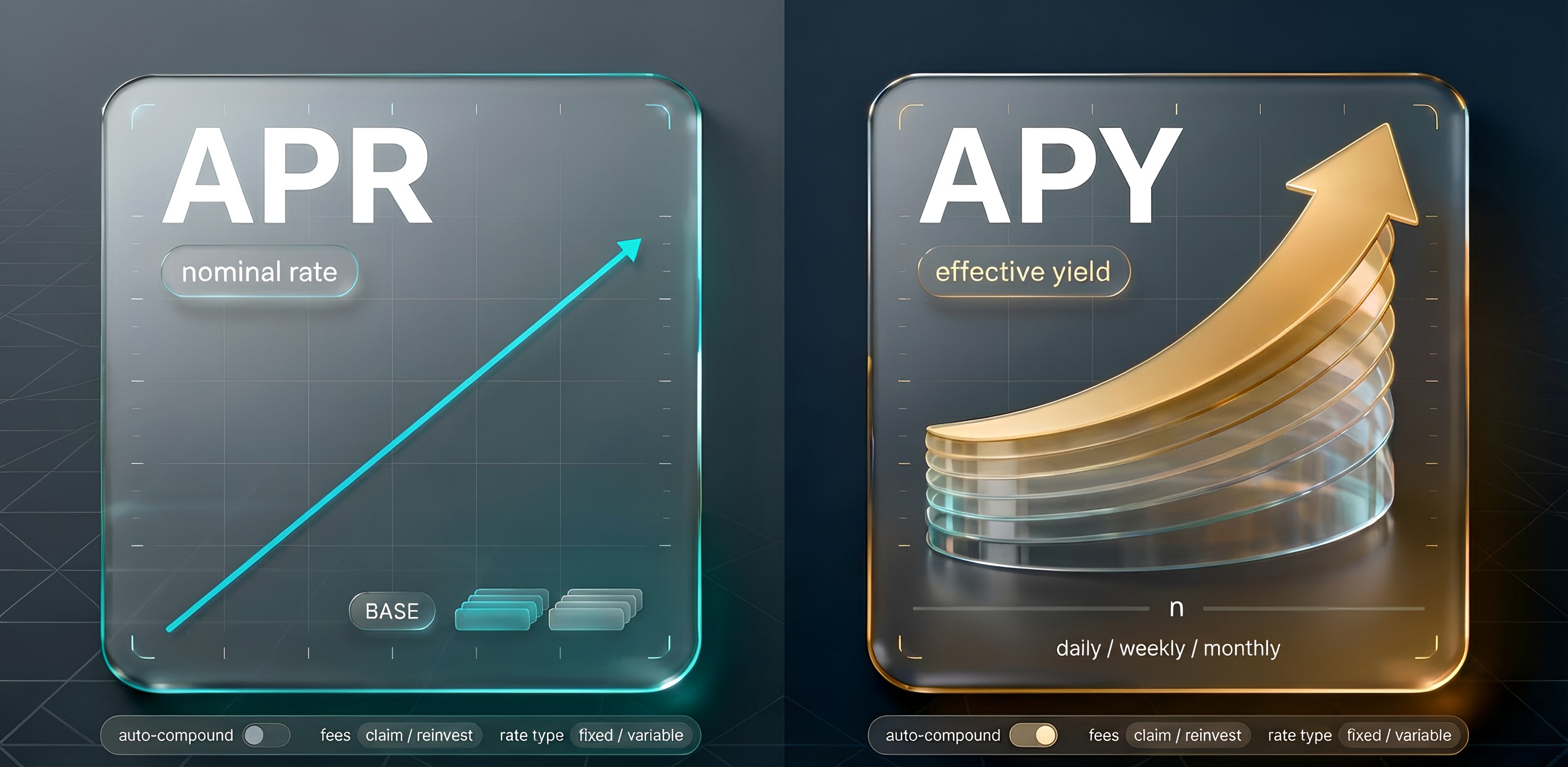
Material updated → the comparison basis for APR/APY and the assumptions of the calculation model have been clarified.
— What is included → accrual frequency (n), reinvestment mode (auto-compound/manual), fees and deductions, and rate type (fixed/variable).
— Why it matters → so values from different products are compared on one basis and it is clearer why the actual result can differ from the displayed percentage.
APR — the nominal rate: interest is calculated from the original base
APR (Annual Percentage Rate) shows the annual percentage without compounding: accruals do not automatically increase the base.
The meaning of APR in one line:
— Without reinvestment, annual yield under the simple-interest scheme equals APR. Interest is calculated from the initial amount.
— Compounding changes the metric. When rewards are reinvested, APR turns into an effective annual result, or APY, at the specified compounding frequency.
— A typical format for borrowing and lending. It gives the nominal cost of capital without the “interest on interest” effect.
Mini-formula: with simple interest, the final amount after 1 year at a fixed APR = base × (1 + APR). Here APR is expressed as a yearly fraction, for example 5% = 0.05.
Example: base of 100 tokens and 5% APR without reinvestment →
When APR is almost the same as APY: when there is no compounding, or compounding happens at a low frequency (small n), while rewards are withdrawn and not reinvested. In that case the effective annual result remains close to the nominal rate.
- Whether auto-compound exists — whether accruals are automatically added to the base or paid out separately.
- Accrual frequency — daily/weekly/monthly: it affects the result when rewards are reinvested.
- Fees and deductions — claim/reinvest fees, protocol or strategy fees, and possible limits.
- Rate type — fixed or variable: with a variable rate, APR changes over time.
APY — effective annual yield after compounding is included
APY (Annual Percentage Yield) is the effective annual yield result, expressed as a rate, if accruals are capitalized by being added back to the base at a specified frequency.
The meaning of APY in crypto products:
— It includes “interest on interest”. After each compounding period, the base becomes larger.
— It depends on frequency. Daily/weekly/monthly compounding produces different APY values even when APR is the same.
— A typical format for auto-compounding products. Staking, lending and other products with auto-compounding use it when rewards are reinvested automatically.
The link between APR and APY through compounding frequency: if APR is the nominal rate and compounding happens n times per year, then APY = (1 + APR / n)n − 1, where APR is entered as a fraction, for example 0.12 for 12%.
Interpretation example: a value of 5% APY means a final result of
When APY equals APR: when accruals are not added to the base. With compounding once per year (n = 1), APY = APR holds, and with more frequent compounding and a fixed nominal rate, APY ≥ APR holds.
- Compounding frequency — how many times per year accruals are added to the base (n).
- Auto-compound — whether compounding is built into the product or requires manual reinvestment.
- Fees and deductions — claim/reinvest fees, protocol fees, and minimum-amount restrictions.
- Rate behavior — fixed or variable: with a variable rate, APY describes a calculation under assumptions, not a locked-in final result.
Calculating APR and APY: formulas and two examples
With a fixed rate and no deductions, the difference between APR and APY is determined by compounding frequency: the larger n, the higher the effective annual yield (APY).
Calculation notation:
— r — APR as a fraction (12% → 0.12).
— n — the number of compounding periods per year (12/52/365).
— APY — the effective annual yield rate after compounding.
APR → APY: APY = (1 + r/n)n − 1 APY → APR: r = n × ((1 + APY)1/n − 1) where r and APY are entered as fractions, such as 0.1268 instead of 12.68%.
Example 1. 12% APR, monthly compounding (n = 12)
Calculation: APY = (1 + 0.12/12)12 − 1
Example 2. 12% APR, weekly compounding (n = 52)
Calculation: APY = (1 + 0.12/52)52 − 1
As accrual frequency increases in a model without deductions, APY approaches the continuous-compounding limit: APY → er − 1. This is the limiting value for a fixed rwhen n becomes very large.
Comparison rule: a correct comparison is made either by APR at the same n, or by APY, if compounding frequency is already included in the calculation. Comparing “APR versus APY” without n does not define a single basis.
APR and APY in practice: how to read them in loans, deposits and DeFi
In most products, APR describes the nominal rate, while APY describes the effective annual yield rate after compounding and under stated assumptions.
A useful guide:
— APR answers “what annual percentage is charged or earned from the original base”.
— APY answers “what annual result follows from compounding at frequency n”.
— A single product can show both values: APR as the base rate and APY as the calculated result after reinvestment.
Reading a rate requires the terms: APR/APY can only be interpreted together with accrual terms — compounding frequency (n), the auto-compound rule, fees/deductions and rate type (fixed/variable).
1) Credit and loans (lending)
In loans, the base metric is usually APR: it records the nominal cost of debt without the effect of compounding. In DeFi lending, the rate is often variable (variable APR) and changes because of pool utilization and demand for the borrowed asset.
2) Deposits and Earn products
In Earn/deposit products, APYis often emphasized because it describes the annual result after compounding. Whether the number is accurate depends on whether auto-compounding is built in and which deductions reduce the base.
3) Staking and DeFi yield
In DeFi, both metrics appear: APY is usually shown in auto-compounding strategies, while APR is used when rewards accrue separately, for example in the protocol token, and compounding is not performed automatically.
Mini-example: 8% APY on a stablecoin
An 8% APY value means a modelled result of
If 8% APR is shown instead of APY, the final effective yield is determined by compounding frequency and whether payouts are reinvested. Without those parameters, “APR versus APY” does not define a comparable basis.
The most common reasons the actual result differs from the calculated APY are: a variable rate, claim/reinvest fees, limits on auto-compounding, accrual delays, and conditions where part of the yield is paid in a volatile token.
Comparison rule: comparison is correct either by APR at the same n, or by APY under explicitly stated accrual terms: frequency, auto-compound, fees and fixed/variable rate type.
How to use APR and APY when choosing crypto yield products
APR and APY are comparable only when the terms are explicitly defined: compounding frequency (n), auto-compound, fees and rate type (fixed/variable).
When each metric is more useful:
— APR — the nominal cost of debt, especially for loans, and a short-horizon approximation.
— APY — the effective annual yield rate after compounding, if n and the reinvestment rules are known.
Mini rule for time horizon: over “weeks to months”, the difference between APR and APY is usually small; over a “year-plus” horizon, the final result depends more strongly on reinvestment mode and accrual frequency.
- One comparison basis. A comparison is correct either by APR at the same n, or by APY, if n and capitalization rules are clearly specified.
- Reading APY as a model. APY requires checking whether auto-compounding is built in or absent, what the accrual frequency is, and which fees reduce the base.
- Fixed vs variable. With floating rates, APR/APY are snapshots of current conditions, such as pool utilization and demand for the borrowed asset, and do not guarantee annual yield.
- Yield source. For DeFi, it is important to separate the “percentage” from the mechanics: subsidies/reward emissions, pool trading fees, borrower interest and losses such as IL can change the final result more than the rate itself.
Scenario modelling that includes accrual frequency, reinvestment mode, fees and a range of rate changes gives a range of possible annual outcomes and reduces dependence on the stated APY value.
Triple-digit APY is usually explained not by compound interest itself, but by the structure of yield and risk. Typical reasons include reward emissions in a volatile token, temporary incentives, higher smart-contract risks and market effects such as a falling rate when liquidity flows in, changes in utilization, and IL in pools. Without checking the yield source and risks, APY remains a model estimate, not an assessment of strategy durability.
Pros and limitations of APY and APR when evaluating crypto products
APR fixes the nominal rate from the original base, while APY is the effective annual yield rate with compounding frequency n.
✅ Pros
— APY includes compounding. It reflects the annual result after reinvestment and at a specified accrual frequency.
— APY creates a common comparison format. It is convenient when products differ by accrual periods and compounding mode.
— APR is transparent as a “percentage from the base”. It describes the nominal cost of debt well, especially for loans.
— Without compounding, APY = APR. If accruals are not added to the base, the effective rate equals the nominal rate.
❌ Cons
— APY applies only under the calculation terms. Fees, lack of auto-compounding and reinvestment limits reduce the result.
— APY in DeFi is a snapshot of current terms. Variable rates and pool-parameter changes shift the annual result.
— APR does not show the result after reinvestment. With compounding, APR alone does not describe effective yield.
— APR cannot be compared without n. Different accrual frequencies require conversion into an effective rate.
Three reading rules:
— Comparison by APR is correct only with the same accrual frequency (n) and the same payout rules.
— APY should be read as a calculated estimate of annual yield under a model: auto-compound, fees and fixed/variable assumptions, not as a “guarantee”.
— For comparison, the basis must be fixed: n, reinvestment mode and deductions; otherwise the numbers are not comparable.
FAQ about APY and APR in crypto
Short answers to common questions about APR and APY: how the metrics differ, how to calculate n-compounding, and why actual yield can deviate from calculated APY because of variable rates and deductions.
How is APR different from APY in crypto?
In short: APR is a nominal rate without compounding; APY is the effective annual yield rate after compounding.
APR calculates interest from the original base. APY accounts for accruals being added back to the base at frequency n. With compounding and a fixed nominal rate, APY ≥ APR holds.
How do you calculate APY from a known APR?
In short: you need APR as a fraction and the number of compounding periods per year, n.
When do APR and APY have the same value?
In short: when accruals are not added to the base during the period.
They match when accruals are not added to the base during the period, for example when paid at maturity or paid separately without reinvestment. With regular compounding, APY becomes higher than APR when the nominal rate is fixed.
Which is better: 10% APR or 10% APY?
In short: 10% APY describes a 10% annual result under the compounding model with specified n and accrual rules; 10% APR is the nominal rate from the base.
10% APY depends on calculation terms: frequency n, auto-compound, fees and fixed/variable rate type. 10% APR produces APY above 10% only with regular reinvestment of accruals and without deductions that reduce the base.
Why is comparing APR and APY incorrect without accrual frequency (n)?
In short: without n the compounding basis is not defined, so the effective rate is unknown.
APR is the nominal rate, while APY is the result under a compounding model. If accrual frequency is unknown, APR cannot be converted into APY and values across products cannot be compared correctly.
Can you rely on a very high APY in DeFi?
In short: high APY is more often explained by risk or temporary incentives and requires checking the yield source.
Common reasons include reward emissions in a volatile token, temporary subsidies, smart-contract risks and market effects such as IL in pools and falling yield when liquidity flows in.
Why can actual yield be lower than the stated APY?
In short: deductions and limits change the base and reinvestment frequency, so the final result deviates from the model.
Typical reasons include claim/reinvest fees, protocol fees, minimum amounts and auto-compound restrictions, accrual delays and a variable rate. Under those conditions, APY remains a calculated estimate.
Key takeaways: how to read APY and APR in crypto
APR and APY describe the same yield or cost of capital through different metrics: APR is the nominal rate from the base, while APY is the effective annual yield rate after compounding and under specified terms.
APR fixes the “percentage from the original amount” without compounding and is often used as the base rate for loans and products without auto-compounding. APY shows effective annual yield after compounding at frequency n and depends on the accrual terms.
To interpret any number correctly, check four parameters: compounding frequency (n), whether auto-compounding exists, fees/deductions, and the rate type (fixed or variable).
- Cost of debt is usually compared by APR as the nominal rate, while an “estimated APY” is a calculated value under assumptions.
- Short horizon usually requires an order-of-magnitude view: without compounding, APR is close to actual yield.
- Year-plus horizon depends more strongly on reinvestment mode and accrual frequency, so the comparison basis is easier to fix through APY when the terms are clear.
Final rule: comparison is correct either by APR at the same n, or by APY, if accrual terms are explicitly stated: frequency, auto-compound, fees and fixed/variable rate type.