How to pay with crypto from Russia without gray schemes
We break down the practical routes: card or wallet, P2P exchange and crypto to fiat to payment setups, plus the exact points where fees and blocks usually appear.
Since 2022 some payment routes for Russian residents have become unavailable: banks and payment systems may reject transactions, while services may restrict registration, card issuance and wallet use by country.
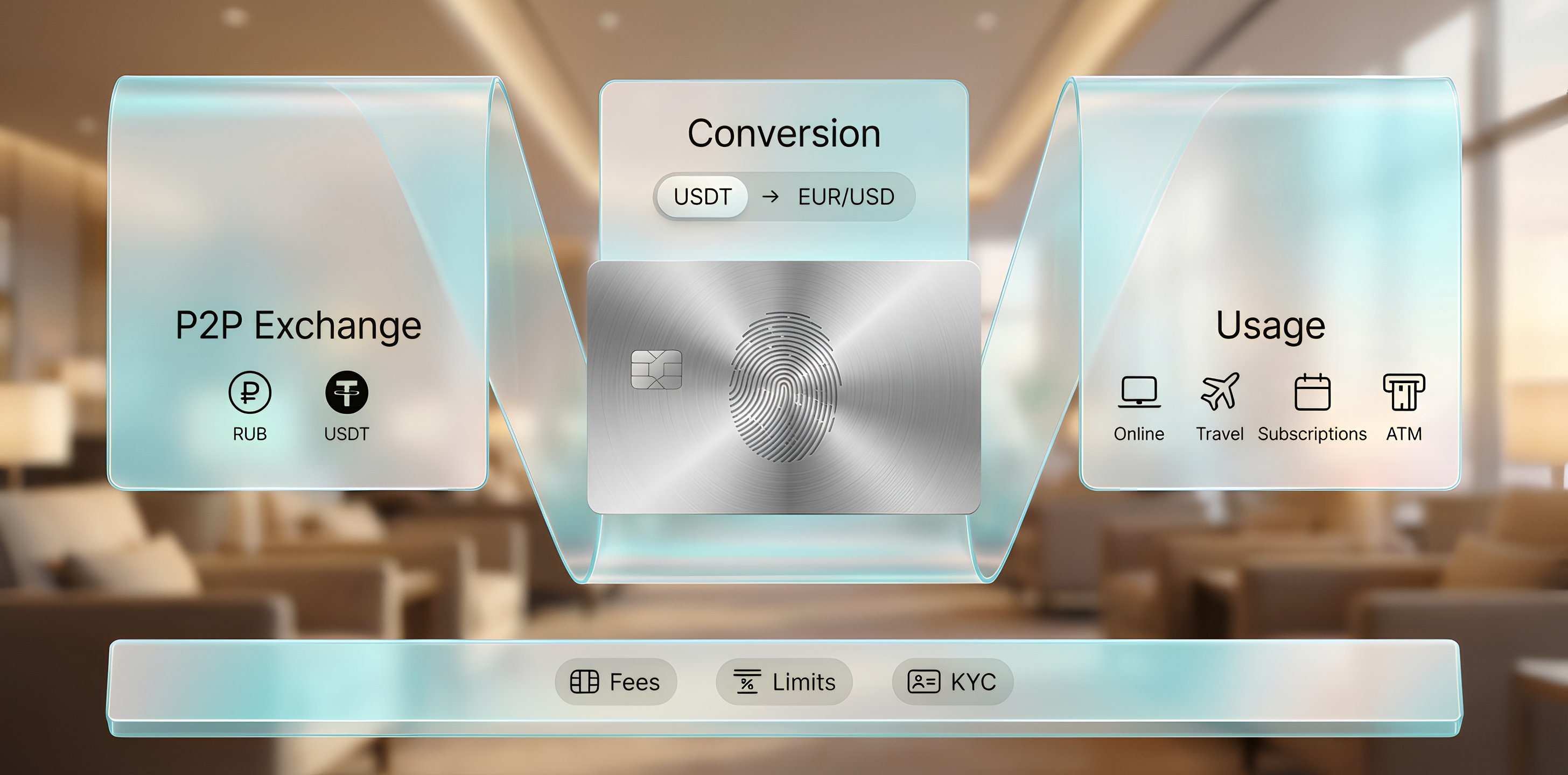
Even so, three practical tools remain for everyday payments: a crypto card (if issuance is available), P2P exchange (buying or selling, for example USDT, for rubles) and a payment chain - a scenario where you first convert crypto into fiat under the platform rules, then pay for goods and services by card or online payment.
This is not about "bypassing at any cost", but about scenarios within service rules: how to choose a card and P2P venue, how to calculate the final cost of a transaction (rate + spread + fees), and which actions reduce the risk of holds, disputes and compliance restrictions.
The goal of this guide is to give a clear action order for 2026 : what to choose for trips and online payments, how to run P2P deals more safely and how to assemble a crypto to fiat to payment route without unnecessary fee losses.
What has been strengthened in this guide
A short note on focus: practical scenarios for Russian residents, transparent fee logic and checks before KYC or card issuance.
- Updated scope → scenarios and restrictions are collected with current practice for Russian residents in mind: what actually works for payments outside Russia and in foreign services.
- Mechanics clarified → we separately explain how debiting and conversion work: where the spread, FX markup, service fees and ATM charges appear, so the "final payment cost" can be calculated.
- Expanded checks → added quick "fits / does not fit" filters and card checklists: geography, Pay wallets, limits, KYC and refund rules.
- Context strengthened → the wording is built around the "no gray schemes" principle: how to reduce the risk of holds or blocks while following issuer rules and compliance.
What a crypto card is and how it debits funds
We explain the mechanics: where the balance is held, when conversion happens and what makes up the final payment cost.
A crypto card is a debit card, sometimes prepaid, linked not to a bank account but to a crypto balance inside the issuer platform, meaning the service that issues the card and maintains your account. When you pay or withdraw cash, the issuer converts the selected asset (for example USDT) into fiat and runs a standard card transaction for the merchant.
The key point: you pay in fiat, while crypto is the funding source at the issuer. The final transaction cost usually consists of the conversion rate including spread, service fees for exchange or maintenance and ATM / operational fees if you withdraw cash or the tariff includes them.
Crypto cards are used for online payments and travel: you top up the balance with cryptocurrency and pay at regular merchants and websites. Apple Pay / Google Pay support depends on the issuer, card type and region - check it in the conditions of the specific product.
Available crypto cards for Russian residents
First a short comparison, then each option separately: who it fits, who it does not fit and what must be checked in the terms.
| Option | Payment scheme | KYC | Pay | Where it is most often used |
|---|---|---|---|---|
| WhiteBird Crypto Mastercard |
In-service conversion multicurrency accounts |
Full | Depends on region | Online and outside Russia under issuer rules |
| Volet (AdvCash) UnionPay |
First conversion into fiat spending from wallet |
Depends on account level | Often limited | Outside Russia where UnionPay is accepted |
| CoinW Card virtual / physical |
Debiting from platform balance under issuer rules |
Required | Depends on region | Online / travel if issuance is available |
| Virtual / prepaid products different issuers |
Fixed limits and tariffs usually more expensive |
Sometimes without KYC | Depends on product | Subscriptions / ads one-off purchases |
WhiteBird Crypto (Belarus)
A joint product of a crypto service and a Belarusian bank: Mastercard with multicurrency accounts (BYN, USD, EUR, RUB), remote onboarding and app-based management.
Fits if
- You need multicurrency payments and transfers.
- You value clear top-up and conversion rules.
- You are comfortable with full identity verification.
Does not fit if
- You need issuance without KYC or identity confirmation.
- You need guaranteed Apple / Google Pay regardless of region and card parameters.
- Zero fees on exchange and ATM withdrawals at any volume are critical.
What to check in the terms
- Issuance / maintenance: cost for non-residents and whether there is a subscription fee.
- Conversion: fee and spread when exchanging into fiat.
- ATM: fee-free limit and the tariff after the limit is exceeded.
- Pay: actual Apple / Google Pay support in your region.
- KYC: which documents are accepted and whether there are residency or country requirements.
Volet (AdvCash) Global
An international UnionPay card with spending from fiat that has already been converted inside the wallet. It is used for payments outside Russia; acceptance depends on the country and the specific merchant.
Fits if
- You need a card for payments outside Russia.
- You prefer to convert the balance into fiat in advance and spend from it.
- You check UnionPay acceptance in the destination country beforehand.
Does not fit if
- You need offline payments inside Russia.
- Apple / Google Pay for this exact card is critical.
- You are not ready for FX markups and fixed ATM fees.
What to check in the terms
- Geography: countries and merchant types where UnionPay works reliably.
- FX: markup when spending in a non-base currency and the conversion rate.
- ATM: fixed fee and regional restrictions.
- Pay: Apple / Google Pay support for the specific product, if claimed.
- Scenario: focus on payments outside Russia and/or online foreign merchants.
CoinW Card
A crypto exchange card: virtual Visa and physical card in SGD. Funds are debited from the platform balance, for example USDT, while conversion is performed under issuer rules at the moment of payment.
Fits if
- You need a virtual card for online payments and subscriptions.
- You prefer spending an exchange balance without manually withdrawing to a bank.
- You accept KYC and limits tied to verification level.
Does not fit if
- You need a card without an exchange account and verification.
- You need a guaranteed fixed rate without spread or markups.
- Guaranteed addition to Pay wallets in any region is critical.
What to check in the terms
- Type: virtual / physical, issuance availability and delivery countries.
- Fees: annual fee, if any, conversion tariff and spread.
- Limits: daily spending / withdrawal limits and merchant category restrictions.
- Pay: actual Google / Apple Pay support by region and card parameters.
- KYC: verification requirements and limits before / after KYC.
Prepaid and virtual solutions
If issuing a full crypto card is difficult, prepaid and virtual products can help: usually for subscriptions, advertising and one-off online purchases. Their fees and limits are usually stricter, and conditions depend on the tariff.
Fits if
- You need a tool specifically for online payments and subscriptions.
- Availability and speed matter more than minimum fees.
- Purchases are small and fit within the product limits.
Does not fit if
- You need large limits and low transaction cost.
- You need offline payments and ATM cash withdrawals.
- You need predictable conditions for months ahead.
What to check in the terms
- Fees: issuance, top-up, conversion, debits and refunds.
- Limits: per card / day / month and payment category restrictions.
- KYC: whether verification is required and which limits apply without it.
- Pay: whether the card can actually be added to Apple / Google Pay in your region.
Why some crypto cards are unavailable for Russia
A quick filter: why services refuse Russian residents and how to check availability before registration and KYC.
Some exchanges and fintech projects issue cards only to residents of certain countries. Important detail: account registration is not the same as card issuance. For Russian residents the typical scenario is this: an account may be created, but the card is not issued, KYC is not accepted, or access to payments, limits or withdrawals is restricted by the service's compliance rules.
- At the issuance stage → the card application is not opened for Russia or is rejected by country of residence and documents.
- At the KYC stage → verification fails because of the country list and document requirements, even if the account exists.
- At the payment stage → the card may work outside Russia but fail at Russian terminals and ATMs.
- At the servicing stage → limits, withdrawals and individual card functions may become unavailable if the service policy changes.
How to check availability in 2 minutes before registration
- Supported countries: is Russia listed specifically for cards, not only for the exchange overall?
- Issuance terms: which documents are accepted and what counts as the country of residence.
- Apple / Google Pay: availability by region and card type if Pay wallets are critical for you.
- Scenario: do you need the card to work in Russia, or are payments outside Russia / in foreign services enough?
How to choose a crypto card for your task
Choose your scenario and check the key parameters: geography, conversion, ATM, Pay wallets, KYC and limits.
🌍 For travel
- Where it is accepted: countries and terminals.
- Rate and FX markup.
- ATM: limit and tariff.
💻 For online payments
- Foreign services and subscriptions.
- USD / EUR and conversion.
- Payment categories and refunds.
💵 For cash
- ATM fee: fixed / percentage.
- Withdrawal rate: spread / markup.
- Source: stablecoins or fiat balance.
🎁 For cashback
- Reward currency: crypto / fiat.
- MCC and exclusions.
- Limits and reward rules.
60-second check before applying
- Where it works: Russia / outside Russia / online only - and in which countries.
- Conversion: rate, spread, FX markup and service fee.
- ATM: fee-free limits and tariffs after exceeding them.
- Apple / Google Pay: availability for your region and card type.
- KYC and limits: document requirements and restrictions before / after verification.
Crypto card comparison table
A quick view of key parameters: issuance cost, where fees most often appear and whether there is actual Apple / Google Pay support.
| Card | Payment system | Issuance / maintenance | Fees and limits | Pay wallets |
|---|---|---|---|---|
| WhiteBird Crypto | Mastercard | 250 BYN / 0 |
Top-up 1.5-2.5% ATM: up to EUR200 fee-free, then about 2%; KYC |
Apple Pay / Google Pay |
| Volet (AdvCash) | UnionPay | $29.95 / 0 |
FX about 2.95% outside the base currency ATM: $1.99-2.99; top-up / withdrawal 0.95-1.45% |
- |
| CoinW Card | Visa (virtual) / plastic (SGD) | 0 / about $50 |
No annual fee High daily limit; market conversion; KYC |
Google Pay / PayPal |
| OlduBil (virtual) | Visa (TRY) | 0 / 0 |
P2P top-up Fees about 3-4%; limit about TRY50k / month |
Apple Pay / Google Pay |
| PST.NET (virtual) | Visa / Mastercard (USD/EUR) | from $1 / $1 per month |
Purchase about 2% Limit $250-500; no KYC |
- |
FAQ on crypto cards for Russian residents
Short answers to frequent questions: funding, where cards actually work, what happens under restrictions and how compliance risks are structured.
Can a crypto card be funded through a Mir card?
How can Russian marketplaces be paid?
Will the card work in Russian ATMs?
Why can a service freeze operations or request verification?
Which workarounds are safest from a rules perspective?
Can rubles be withdrawn through a crypto card?
Are there cards with a ruble balance?
How can a foreign service be paid from Russia?
What happens if the issuer stops serving Russian residents?
How can card data leak risks be reduced?
Conclusions: scenarios and what to check before issuance
A scenario-based summary for travel, online payments and virtual cards, plus a short check to spot fees and restrictions in advance.
A crypto card is convenient for payments outside Russia and in foreign online services: you pay in fiat, while crypto acts as the funding source through conversion. Inside Russia there are fewer working options, but practical solutions remain for travel and online purchases if issuer rules and KYC are followed.
Scenario recommendations
- Payments and ATM outside Russia: choose a product with a clear rate / FX markup and transparent withdrawal tariffs (fee-free limit plus tariff after it).
- Online subscriptions and services: a virtual card in USD / EUR is often enough, but check payment categories and refund rules in advance.
- Backup plan: do not keep the whole operational balance at one issuer and have an alternative payment / withdrawal method.