Where multisig solutions are used and who uses them
A multisig wallet (multisig) is a scheme where one key is not enough to transfer funds: a signature quorum is required, such as 2-of-3 or 3-of-5. This reduces loss risk from phishing, device compromise, or the compromise of one signer key/seed backup.
Where multisig is used:
- Project teams and treasuries — treasury spending is approved by multiple signers so no single participant can withdraw everything alone.
- Investment funds and DAOs — operations run through M-of-N, with access split across managers and signers.
- Businesses and trading teams — separate keys for finance, operations, and risk control reduce the chance of an erroneous transfer.
- Large personal holdings — keys are spread across locations and devices; it is critical that no single person holds a quorum of signatures.
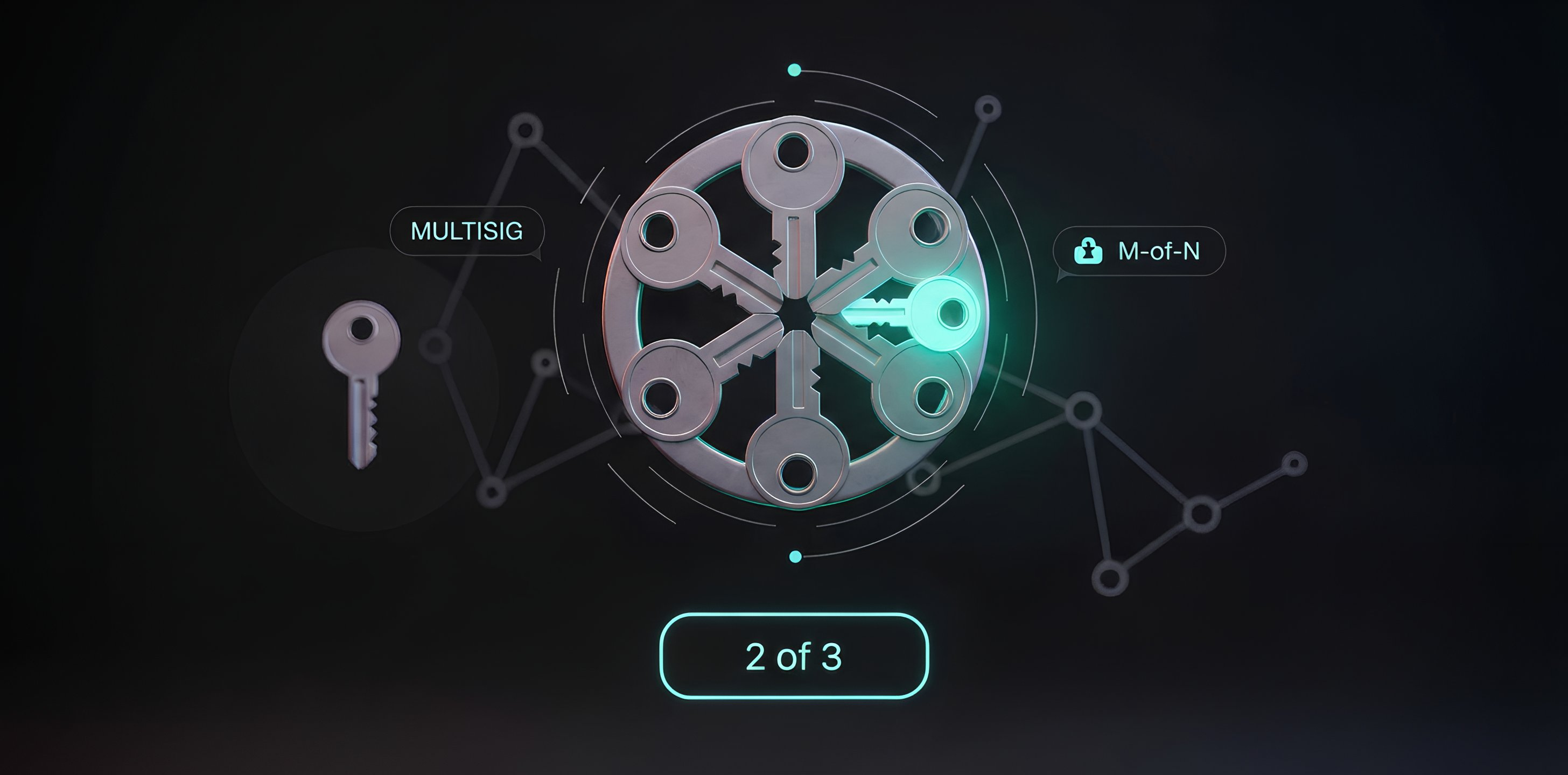
What a multisig wallet is and how it works
A multisig wallet (multisig) is a wallet where transfers are authorized by several independent private keys. One signature is not enough: spending requires a quorum.
Multisig is defined by the M-of-N rule: out of N keys, at least M signatures are needed for a transaction to be accepted by the network. Example: 3-of-5 — five signers, any three signatures authorize a transfer.
In short: multisig = “multiple keys + a signature threshold”. Compromising one key is not enough to withdraw.
How a multisig transaction works
One participant creates a proposal, the others approve it, and only after quorum is reached the transaction is sent to the network.
- Proposal
- A signer prepares the transfer as a “draft” (address, amount, fee).
- In the interface, this is usually shown as a proposal or an “execution proposal”.
- Review
- The other signers verify the parameters: where, how much, and why.
- After review, a signature is added.
- Quorum
- After M valid signatures are collected, the transfer is considered “authorized”.
- The remaining N − M signatures are not required.
- Execution
- The transaction is broadcast to the network and executed.
- If quorum is not reached, the transfer will not happen and the funds remain in the wallet.
How to choose an M-of-N scheme
The choice is a balance: protection against a single-key compromise and the risk of lockout if some signers are unavailable.
- Define the loss tolerance
- If losing one key must not block access, choose a scheme with built-in redundancy (for example, 2-of-3).
- With a “hard” threshold, lockout risk grows when signers are unavailable.
- Select the control level
- 2-of-3 — a baseline scheme: manageable and protects against a single-key compromise.
- 3-of-5 — an option for teams and treasuries: a higher barrier to unauthorized withdrawal, but more coordination.
- 1-of-2 — does not provide a multisig effect: one key can still sign a transfer.
- Test the process before a large amount
- A small-amount test: proposal → signatures → execution.
- A resilience check: one key is unavailable, the transfer still goes through with quorum.
A practical target is that one key compromise is not enough to withdraw, while losing one key does not block control. In real scenarios, 2–7 keys are used: beyond that, operational risk grows faster than the security gain.
Multisig vs other types of crypto wallets
Four models solve one task — who authorizes a transfer and how. They differ by where control logic lives (a key, a contract, a protocol) and what happens when part of the access is lost or compromised.
| Type | How a transfer is authorized | Strength | Main downside | Best fit |
|---|---|---|---|---|
| Single-key | One signature by one key/seed phrase | Maximum simplicity and speed | One key = full control and a single point of failure | Everyday amounts, personal use |
| Multisig (M-of-N) | Multiple signatures by different keys (for example, 2-of-3) | Compromising one key is not enough to withdraw | Signer coordination is required; the process is slower | Teams, treasuries, large personal holdings |
| Contract wallet | Authorization logic in a smart contract (often multisig) | Flexible rules: limits, delays, roles, modules | Code bug/vulnerability risk + higher gas costs | DAOs/DeFi/funds on EVM networks |
| MPC | One signature assembled by a protocol from key shares | Compatible with almost any network; a “normal-looking” address | Harder to verify the trust model and recovery control | Institutions/custodians, services with admin control |
Single-key
When to use: daily payments and small amounts — when speed and simplicity matter.
Multisig (M-of-N)
When to use: large holdings, family savings, teams, and treasuries.
Contract wallet
When to use: EVM, DAOs/DeFi — when limits, delays, and policy control are needed.
MPC
When to use: institutional storage and admin processes.
Any model breaks under poor hygiene: if keys sit on one device or an unknown signer exists in the scheme, protection disappears or lockout risk appears.
Benefits of multisig wallets
Multisig is useful in scenarios where a single-key compromise, spending control, and responsibility separation are critical. Below are the benefits in the format “helps → risk → mini rule”.
No single point of failure
What it provides: compromising one key or device is not enough to withdraw.
Shared control and transparent spending
What it provides: a transfer does not go through without approval from the other signers.
Resilience to losing a key
What it provides: losing one key does not have to block access to funds.
Reduces damage from phishing and mistakes
What it provides: compromising one signer is not enough to complete a withdrawal.
Escrow and arbitration deals
What it provides: a transfer executes only after confirmation by multiple parties.
Main point: multisig turns the risk “one compromise = full withdrawal” into a manageable model: spending requires several independent confirmations and a working signing process.
Downsides and risks of multisig wallets
Multisig reduces theft risk from a single-key compromise, but adds operational risk: people coordination, delays, and configuration mistakes. Below is a risk map in the format: where it hurts → what it leads to → how to reduce it.
- Setup complexity and signing discipline
- Transfer delays
- Fees can be higher
- Access lockout when keys are lost
- Technical implementation risks
Multisig beats single-key on protection from one compromise, but loses without process: who reviews, who signs, and what to do if a key is lost.
Multisig works best with a policy: parameter verification, signing deadlines, and a plan in case a key is lost. For small daily operations it is often excessive, while for reserves and treasuries it provides a measurable security gain.
Multisig wallet support across blockchains
Multisig depends on network architecture: in some networks, the M-of-N rule is built into the protocol, while in others it is implemented via a smart contract, a program, or an account-permissions system. Below is an implementation map and what to verify in each case.
Legend (where multisig “lives”):
- Protocol → the rule is validated by network nodes (no contracts).
- Smart contract → the rule is enforced by contract code (audits and upgrade rights matter).
- Program → the rule is enforced by an on-chain program (owners and upgradability matter).
- Permissions → the rule is set by account permissions (roles, thresholds, and unknown keys matter).
| Network | Where multisig is implemented | Main risk | What to verify before use |
|---|---|---|---|
| Bitcoin | Native (scripts, the address “knows” the signature threshold) | Operational mistakes + higher fees due to larger data size | |
| Ethereum / EVM | Smart contract (a contract wallet, Safe approach) | Code risk + upgradability/admin-rights risk + higher gas | |
| Solana | Program (program-owned account / program logic) | Program and upgrade risk (upgrade authority) + integration mistakes | |
| TRON | Native (permissions, thresholds, and key “weights”) | An unknown key in permissions + misunderstanding Owner/Active roles | |
| BNB Smart Chain | Smart contract (EVM logic) | Code/upgrades/modules + higher gas |
TRON trap: “ready-made wallets” promising bonuses often turn out to be a 2-of-2 multisig where the second key is held by an attacker: the balance is visible, but withdrawal is impossible without that signature.
Minimal check before launch:
- Key independence: different devices, locations, and media.
- Loss scenario: what happens if 1 key is lost or a signer is unavailable.
- Rights/upgrades: (contracts/programs) who can change logic and rules.
Popular multisig wallets and solutions
Multisig choice depends on the network and the task: EVM (contract wallets), Bitcoin (scripts/PSBT), Solana (program-based multisigs). Below is a selection in the format: task → what to use → what to verify.
Selection logic: first the network is defined, then a baseline solution is chosen, and before a large amount the M-of-N threshold, key independence, and recovery material (xpub/descriptor/settings) are verified.
- Step 1 → define the network: EVM / Bitcoin / Solana.
- Step 2 → choose a baseline solution for that network.
- Step 3 → verify before depositing: M-of-N threshold, key independence (different locations/devices), and recovery material (xpub/descriptor/settings).
EVM (Ethereum, Arbitrum, Polygon, etc.) → Safe
Process check: run one full cycle on a small amount: proposal → signatures → execution → cancellation / threshold-condition check.
Bitcoin → Sparrow / Specter / Nunchuk
Emergency route: an independent recovery/coordination tool (Caravan approach) is useful as a backup method if the primary interface is unavailable.
Solana → Squads
For program-based multisigs, upgradability is verified separately: an upgradeable program implies a risk of logic changes under weak upgrade control.
Fast selection: Safe is a baseline for EVM teams, Sparrow/Specter/Nunchuk are options for Bitcoin, and Squads is a choice for Solana. After that, process decides: who initiates, who approves, and where recovery material is stored.
How to choose an M-of-N scheme: a quick template for different scenarios
In multisig, balance matters: security (one key compromise is not enough) and resilience (one key loss should not block funds). Below is a short selection template.
Two definitions in 10 seconds:
A practical rule: compromising 1 key should not be enough to withdraw, and losing 1 key should not block access.
| Scenario | Recommendation | Why it usually works |
|---|---|---|
| Personal storage (reserves/capital) | 2-of-3 | Protection from a 1-key compromise + built-in redundancy for losing one device/seed phrase |
| Couple / family | 2-of-3 | A “two participants + a backup” scheme without lockouts under force majeure |
| Small team (2–4 people) | 2-of-3 or 3-of-5 | A compromise between decision speed and quorum control |
| DAO / treasury | 3-of-5 or 4-of-7 | A higher barrier to unauthorized withdrawal while keeping a working quorum |
| Escrow deals | 2-of-3 | Buyer + seller + arbitrator, quorum-based decision |
Three rules to keep the scheme from breaking in practice
- Loss tolerance: M is chosen so losing 1 key does not make funds inaccessible.
- Independence: keys are stored on different devices and in different places, not together.
- Recovery material: everything needed to rebuild the wallet is preserved (for example, xpub/descriptor/settings).
Three configuration failures: keys end up in one place; the threshold is chosen with no redundancy; the signing process is not rehearsed on a test amount.
A base scheme for most cases is 2-of-3. For teams and treasuries, 3-of-5 and higher are more common, but only with a signing policy and separated key storage.
Questions and answers (FAQ)
What is a multisig wallet in simple terms?
When does multisig make sense?
What happens if one multisig key is lost?
Which M-of-N scheme is the most practical?
Can multisig be created through MetaMask or Trust Wallet?
Which solutions are the most popular?
Is multisig needed for an average user?
How safe are multisig wallets?
Are multisig and MPC the same thing?
Final: when multisig is actually needed
Multisig is protection against the scenario “one key = everything”: a transfer goes through only after M-of-N confirmations. Most often it is justified for large amounts and shared budgets.
- Best fit: family/couple, team/business, DAO/treasury, long-term investor.
- Baseline scheme: 2-of-3 (built-in redundancy for losing one key).
- Where it breaks: keys are stored together or recovery material is missing (xpub/descriptor/settings).
Minimal check before a large amount: keys are stored in different places, at least one test transfer is completed, and the scenario of one unavailable key is verified.
Main point: multisig delivers security through process: independent keys, separated storage, and a proven confirmation scheme.