Most cryptocurrency losses happen not because of hacks, but because of mistakes in storing the seed phrase.
Introduction: why seed phrase security is critical for your assets
A seed phrase is a unique set of 12-24 words that a wallet creates when a new account is set up. All private keys and addresses are deterministically restored from this phrase, including rarely used and "hidden" ones, and access can be recovered on any compatible device.
Unlike a bank login and password, nobody stores your seed phrase for you and nobody can send it again. Decentralized wallets have no recovery center: while only you know the seed phrase, you control the assets; if it is lost or disclosed, access disappears with no legal or technical path back. If the basic terms are still unfamiliar, you can use the crypto glossary with simple definitions.
- Full control over the wallet and every address inside it, including unused addresses.
- The ability to sign transactions, transfer funds, and connect to DeFi and NFT services.
- The only practical way to restore access without involving third parties.
In short: losing or leaking a seed phrase almost always means losing money. Analysts estimate that up to 20% of all issued bitcoins are permanently locked on-chain because keys and recovery phrases were lost.
Reliable seed phrase storage comes down to several key tasks: understanding real access-loss scenarios, choosing offline media that can survive time and everyday risks, and removing a single point of failure.
The recommendations below are practical: they account for human error, moving homes, repairs, damaged media, lost devices, and phishing. The approach works both for small balances and for long-term capital storage, where the cost of a mistake is especially high.
Bottom line: crypto assets remain under your control only while the seed phrase is stored offline and unavailable to third parties.
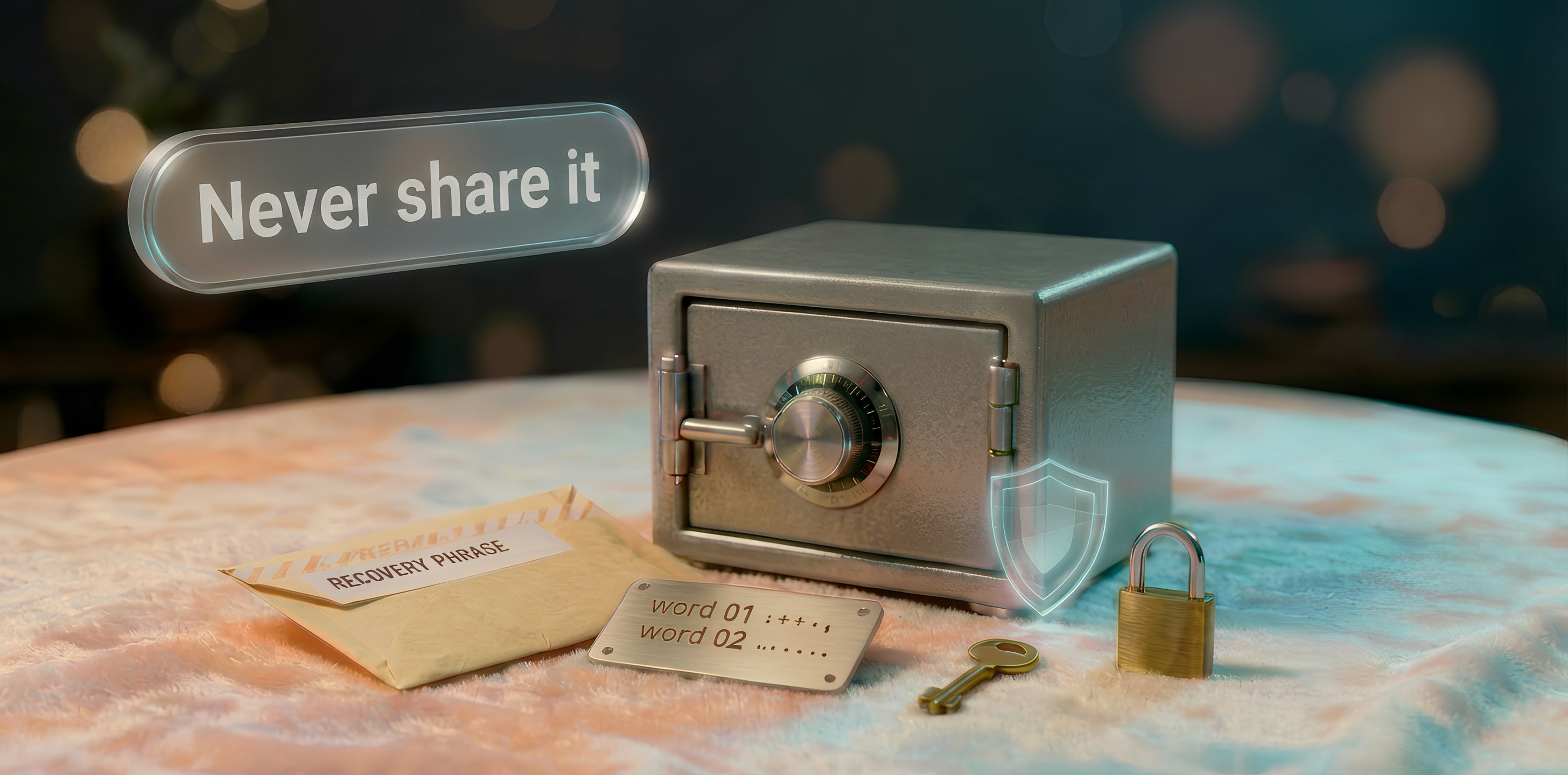
One wrong way to store a seed phrase can cancel out every other security measure and backup.
How not to store a seed phrase: the red list
A seed phrase stays protected only while it exists exclusively on offline media. Any digital trace sharply increases the chance of a leak, especially if the device or account is connected to the internet.
What you should categorically avoid when storing a seed phrase:
- A photo or screenshot of the seed phrase. A smartphone gallery and automatic cloud backups are often compromised together with the device.
- Storing it in cloud notes. A hacked account or lost account access leads to an immediate seed phrase leak.
- Sending the seed phrase in messengers or by email. Chats and mailboxes are regular targets for phishing and account takeovers.
- An unencrypted file on a computer or flash drive. Malware, remote access, or device repair makes that copy vulnerable.
- Keeping it in a password manager without separate protection. A seed phrase should not sit next to logins and passwords unless it is isolated by a separate master key.
- Entering the seed phrase on websites opened from email or chat links. Any "wallet recovery" form outside the official application is almost always phishing.
A reliable starting point is a physical offline medium: paper or metal stored in a protected place with carefully planned backup copies.
Bottom line: any digital copy of a seed phrase creates a higher leak risk, so safe storage starts with a complete refusal to keep it online.
Seed phrase loss scenarios often look minor until they lead to complete loss of access.
Risks and consequences: real seed phrase loss scenarios
While the wallet works, the risk is easy to underestimate: transfers go through, access exists, and the problem seems unlikely. In practice, a significant share of crypto assets is permanently locked precisely because of seed phrase storage mistakes.
🧷 Physical loss of the medium
Critical riskRisk essence: the seed phrase exists on one physical medium that is easy to lose.
- Typical: cleaning, moving homes, temporary storage among documents.
- Consequence: wallet recovery becomes impossible.
- Protection: several offline copies in different physically separated locations.
Main point: one lost copy without a duplicate means complete loss of access.
🔥 Damage or degradation of the medium
High riskRisk essence: the medium with the seed phrase is physically destroyed or becomes unreadable.
- Typical: fire, water, ink fading, mechanical damage.
- Consequence: the words cannot be restored correctly.
- Protection: steel backups and periodic readability checks.
Main point: a backup is useless if it cannot survive time and ordinary accidents.
☁️ Digital trace
Critical riskRisk essence: the seed phrase enters a digital environment and gradually escapes your control.
- Typical: photos, screenshots, notes, files, cloud backups.
- Consequence: a compromised device equals a leaked master key.
- Protection: a complete refusal to store the seed phrase digitally.
Main point: a digital copy of a seed phrase almost always becomes a leak point.
🎭 Phishing and fake "recovery"
Critical riskRisk essence: the user is persuaded to voluntarily reveal the seed phrase.
- Typical: fake websites, apps, and "support" in chats.
- Consequence: funds are withdrawn instantly and irreversibly.
- Protection: the seed phrase is never entered or shared under any circumstances.
Main point: any request for a seed phrase means an attempted theft.
🧩 Homemade "encryption" schemes
High riskRisk essence: the owner makes storage so complicated that they lose the recovery logic themselves.
- Typical: reordering words, personal marks, splitting parts without clear rules.
- Consequence: loss of access without any external attack.
- Protection: simple and verifiable offline storage schemes.
Main point: homemade complexity more often hurts than protects.
Bottom line: most seed phrase loss scenarios are irreversible, so protection must be planned in advance and built around offline storage.
A single seed phrase leak turns the wallet over to someone else, while understanding the mechanics protects you from fatal mistakes.
Seed phrase: what it is and why it cannot be recovered
A seed phrase, also called a recovery phrase, is a list of 12, 18, or 24 words from a standardized dictionary. Most wallets use the BIP-39 standard, where all of a user's private keys and addresses are deterministically derived from one seed phrase.
- The seed phrase is shown only once: when the wallet is created.
- One phrase replaces dozens or hundreds of separate private keys.
- A seed phrase can restore access in any wallet that supports BIP-39.
When choosing a storage format and protection level, it is important to consider the wallet type. The practical differences between hot and cold solutions are explained in the review of hardware crypto wallets.
Key point: a seed phrase is fundamentally unrecoverable. Decentralized wallets have no central server with a copy of the phrase and no support or document-based procedure for returning access. This is a deliberate architectural decision.
- Developers and services do not know or store your seed phrase.
- The phrase cannot be reset or replaced like a normal password.
- If the seed phrase is lost, you cannot prove ownership of the address and restore access through any official route.
Mini glossary for seed phrase terms
- Seed phrase: a set of words used to restore a wallet's private keys and addresses.
- Recovery phrase: another name for a seed phrase.
- Private key: a cryptographic key used to sign transactions.
- Multisignature (multisig): a setup where moving funds requires several signatures.
- Shamir Backup: a method for splitting a secret into parts with a recovery threshold.
A seed phrase is the master key. Anyone who learns it in full receives complete and uncontrolled access to the funds, regardless of PIN codes, passwords, or devices.
If a seed phrase is lost, the assets continue to exist on the blockchain, but the owner can no longer sign transactions. In practice, this becomes a permanently locked balance: the funds are visible on-chain, but cannot be transferred or used.
Bottom line: the seed phrase is the only unrecoverable master key to the wallet, so losing it means permanently losing control over the assets.
The right storage medium for a seed phrase determines whether your backup will survive years and everyday incidents.
Paper, steel, or digital media: what is better for seed phrase storage
In practice, the choice comes down to a medium that can withstand time, household risks, and human error. The three most common approaches are a paper record, metal media, and offline digital storage. Each option behaves differently during a fire, flood, move, or device compromise.
| 📌 Aspect | 📄 Paper | 🧱 Steel medium | 💾 Digital storage (offline) |
|---|---|---|---|
| 🔥 Fire and water resistance | Low: paper burns at about 230 °C and is easily damaged by moisture | High: steel can survive fire and flooding | Depends on the medium: the file is not physically burned, but the carrier itself can fail |
| 🌐 Online compromise risk | Absent: the medium is fully offline | Absent: access is only physical | Low under strict offline mode, high with cloud storage and synchronization |
| 🛠 Preparation complexity | Minimal: manually writing down the words | Higher: engraving or mechanical fixation is required | Medium: creating an archive, encryption, and checking backups |
| 💸 Cost | Almost zero | Medium or high depending on the kit | Low: uses available storage media |
📄 Paper
Basic levelWhen it fits: as a fast and cheap start, if you are disciplined about keeping copies offline.
- Pros: easy to prepare, almost free, leaves no digital trace.
- Risks: fire, water, ink fading, accidental loss during moving or cleaning.
- Rule: store only in a protected place, not "in a folder in the desk".
A paper backup works when there are two copies and reliable storage conditions.
🧱 Steel backups
ReliableWhen it fits: for long-term storage and situations where the cost of a mistake is meaningful.
- Pros: high resistance to fire and water, survives years of storage without degradation.
- Risks: higher cost and a need for accuracy during preparation.
- Rule: separate copies by location instead of keeping everything in one place.
Steel media reduce the chance of irreversible loss from one physical incident.
💾 Digital storage (offline)
RiskyWhen it fits: only under strict offline mode and with the understanding that you are adding one more secret: the password.
- Pros: compact and convenient for backups when discipline is strong.
- Risks: leaks through synchronization, malware, user mistakes; losing the password blocks access.
- Rule: never store a seed phrase unencrypted and never allow cloud copies.
A digital format requires a strict offline perimeter and constant control of every access point.
Practice: resilience usually comes from combining methods: several offline copies on different media and in different locations. This way one incident, such as fire, theft, or flooding, does not destroy every backup at once.
🛠 How to make a safe seed phrase backup in 10 minutes
Even a simple backup scheme gives a noticeable security improvement if it is done carefully.
- Prepare paper or a metal medium and a pen with fade-resistant ink.
- Write down every seed phrase word strictly in order, checking the spelling twice.
- Create a second copy and place it in a physically separate protected location.
- Run a test wallet recovery on a separate device to verify the record.
- Record the storage locations for yourself without writing the words, and do not share that information with third parties.
Bottom line: for most users, the most reliable setup remains several offline seed phrase copies on different media, stored in independent protected places.
Once you have chosen the storage medium, the next step is to match the protection level to the actual amount you are protecting.
What level of security is justified for different asset amounts
Security takes time and resources, so it is reasonable to choose solutions in proportion to portfolio size rather than "maximum protection just in case".
| 💼 Asset amount | 🛡 Recommended protection level | 📌 Practical meaning |
|---|---|---|
| Up to about $1,000 | 2 paper seed phrase copies in different places | A reliable basic option when storage places are normal (a safe, a protected drawer). More complex solutions at this level are usually excessive. |
| $1,000-$10,000 | Paper plus one steel backup, basic hardware wallet | The cost of a simple hardware wallet and steel backup looks reasonable relative to the portfolio, while the setup remains manageable. |
| $10,000-$50,000 | 1-2 hardware wallets, 1-2 steel backups, separated locations | Additional copies and devices increase resilience to failures and household incidents without making the system overly complex. |
| $50,000 and above | Hardware wallets, steel backups, multisignature / Shamir Backup | More complex setups are justified to reduce the single point of failure and plan long-term access to the assets. |
In practice: there is no need to build an excessively complex system for a small portfolio. A simple and understandable storage scheme that you actually use without mistakes is much more important.
As assets grow, it makes sense to review the storage strategy and gradually strengthen the protection level by adding more durable media and distributing storage points.
Bottom line: the security level should grow together with portfolio size: you are protecting a specific amount, not abstract cryptocurrency.
These five practical manufacturer rules cover the main access-loss and theft scenarios.
Advice from Ledger, Trezor, and Keystone: how to store a seed phrase safely
Hardware wallet manufacturers regularly see the consequences of user mistakes: lost backups, leaked phrases, and blocked access to funds. Their recommendations can be treated as a minimum standard based on real incidents, not theory.
The basic standard for secure seed phrase storage:
- Offline only. Do not take photos, screenshots, notes, or files on devices with internet access: over time, they end up in backups, clouds, or malware.
- Several copies. Keep at least two copies in different places so a fire, theft, or loss of one medium does not remove access.
- Metal for meaningful amounts. For a long horizon and a noticeable portfolio, a steel backup reduces the risk that water, fire, or time destroys the phrase.
- Tell nobody. A request for 12 or 24 words in any form means an attempt to gain control over the funds.
- Regular checks. Periodically make sure the copies are readable and in place: paper fades, metal can be damaged, and separate parts can be lost.
The key conclusion in all guides is the same: security is defined not by "device features" but by seed phrase storage discipline. A hardware wallet cannot compensate for a mistake if the master key became available to third parties or was lost.
Bottom line: offline seed phrase storage, several independent copies, and a ban on sharing the phrase with third parties cover most practical scenarios of losing or having funds stolen.
Even when users understand the basic rules, they often lose access because of recurring mistakes.
Common seed phrase mistakes: what you should definitely avoid
Even experienced users often overestimate their memory and underestimate everyday risks. These mistakes most often lead to a lost seed phrase or direct theft of funds.
📱 Storage on a phone or in the cloud
CriticalMistake essence: the seed phrase is saved digitally on a device or in a cloud service.
- Typical: screen photos, notes, files in Google Drive or iCloud.
- Risk: malware, account takeover, or backup leak.
- Consequence: an attacker gains full control over the wallet.
Any digital copy of a seed phrase eventually becomes a potential leak point.
📄 Single copy without a duplicate
High riskMistake essence: the seed phrase exists in only one copy.
- Typical: one sheet of paper or one card.
- Risk: loss, fire, water, accidental destruction.
- Consequence: access recovery becomes impossible.
One seed phrase copy means one point of failure.
🧩 Homemade "encryption"
Common mistakeMistake essence: the user complicates the seed phrase record using personal logic.
- Typical: reordering words, marks, splitting without clear rules.
- Risk: losing the logic of the scheme over time.
- Consequence: loss of access without any external attack.
Complex schemes break more often because of forgetfulness than because of attacks.
🎭 Sharing the seed phrase with third parties
CriticalMistake essence: revealing the seed phrase under the guise of help or support.
- Typical: "support", an acquaintance, or a "specialist" in a messenger.
- Risk: instant withdrawal of funds.
- Consequence: transactions cannot be reversed.
Anyone who knows the full seed phrase controls the wallet.
🕰 No backup checks
Delayed riskMistake essence: backups exist, but nobody checks their condition.
- Typical: faded ink, damaged metal, lost parts.
- Risk: recovery becomes impossible at the critical moment.
- Consequence: access is lost even though backups exist.
An unchecked backup is equivalent to no backup.
Bottom line: most losses happen because of repeated everyday mistakes, not complex attacks. They can be avoided if you understand the risks in advance and do not rely on memory or "convenient" solutions.
For large portfolios, one backup is no longer enough: you need setups without a single point of failure.
Multisignature and Shamir Backup: additional measures to protect a seed phrase
When control over funds depends on one seed phrase, losing or compromising it means complete loss of access. Advanced storage schemes remove this single point of failure by distributing control across several keys or backup parts.
-
Distributing control instead of relying on one secret.
- Meaning: not storing one critical key in one place.
- Effect: one loss or compromise does not lead to loss of access.
-
Multisignature (multisig).
- How it works: moving funds requires several signatures, for example 2 of 3.
- Advantage: one stolen key or device does not give control over the funds.
- Practice: keys and devices are stored in different physical locations.
-
Shamir Backup (SLIP-39).
- How it works: the seed phrase is split into parts with a defined recovery threshold.
- Advantage: one separate part does not reveal the original secret.
- Practice: backup parts are stored separately, and losing one is not critical.
-
More complexity and higher discipline requirements.
- Feature: the number of keys, media, and storage points increases.
- Risk: a configuration mistake can block access just as badly as losing the seed phrase.
Such setups are especially relevant for users who already consider operational and technical risks, similar to how it is done during smart contract verification before interaction with DeFi and Web3 services.
To reinforce the material, here are short answers to the questions that most often arise when storing a seed phrase.
❓ FAQ on secure seed phrase storage
What is a seed phrase in simple terms?
A seed phrase is a list of 12-24 words that any compatible wallet can use to restore all your private keys and addresses. In essence, it is the master key to all assets: if you know the seed phrase, you can restore wallet access on another device; if you lose it, you lose that ability forever.
Why can't a seed phrase be recovered or "sent again"?
Decentralized wallets do not store the seed phrase on servers and do not know which words you saw when creating the wallet. This is a deliberate architectural decision: nobody except you should have access to the master key. Therefore, after the seed phrase is lost, it is impossible to prove ownership and recover access through support.
How many seed phrase copies should I make, and where should I store them?
For most users, 2-3 offline copies in different locations are optimal: for example, a paper copy in a home safe and a steel backup in another protected place. One copy creates a single point of failure, while too many copies increase the risk of leakage.
Can I store a seed phrase on my phone, in the cloud, or in a password manager?
Storing a seed phrase digitally on internet-connected devices is extremely risky. If the device or account is hacked, or malware infects it, an attacker receives full control over the wallet. Even password managers are not designed to store master keys. The safest option is offline media with no digital traces.
What should I do if I lost a backup or doubt that it is still secure?
If there are doubts about the security of the current backup, the right decision is to create a new wallet and transfer funds to it while access is still available. The old seed phrase should be considered potentially compromised. After the transfer, organize new backups according to all the rules.
Do seed phrase backups need periodic checks?
Yes. Paper copies can fade or be damaged, metal backups can be lost, and separate Shamir Backup parts can be forgotten. Periodic checks of readability and the presence of all copies reduce the risk of unexpected access loss at a critical moment.
Do small portfolios need multisignature and Shamir Backup?
For small portfolios, careful offline seed phrase storage with backup copies is usually enough. Multisignature and Shamir Backup are justified as the amount grows, when removing a single point of failure and increasing resilience to mistakes and emergencies becomes important.
Bottom line: understanding the seed phrase as the only master key and following basic offline storage principles helps avoid both complete loss of access and theft caused by backup mistakes.
Everything discussed above comes down to several key storage principles.
Final takeaways on secure seed phrase storage
Let's bring everything into one picture: which steps really help preserve a seed phrase and avoid losing access to crypto assets over time.
Reliable seed phrase protection starts with basic but fundamental actions: writing the phrase offline, creating backup copies, and placing them in protected locations. Paper remains a good starting option, while steel media are a more durable solution for long-term storage and meaningful amounts. Regular readability checks and a recovery rehearsal help identify problems before they become critical.
The next protection level depends on portfolio size and acceptable risk. For small amounts, careful handling of one seed phrase and basic security hygiene are enough. As capital grows, distributing backups across different locations and using more resilient setups, including hardware wallets and multisignature, becomes justified. Whatever strategy you choose, the principle is unchanged: control over crypto assets is directly tied to control over the seed phrase.
Main point: the seed phrase is the only master key to crypto assets, and thoughtful offline storage with backup copies significantly reduces the risk of losing funds because of one mistake.