The token sale format determines where the risk appears: at the payment stage, during token distribution, or at the moment when a real market starts to exist.
Why the difference between IDO, IEO and ICO matters for investors
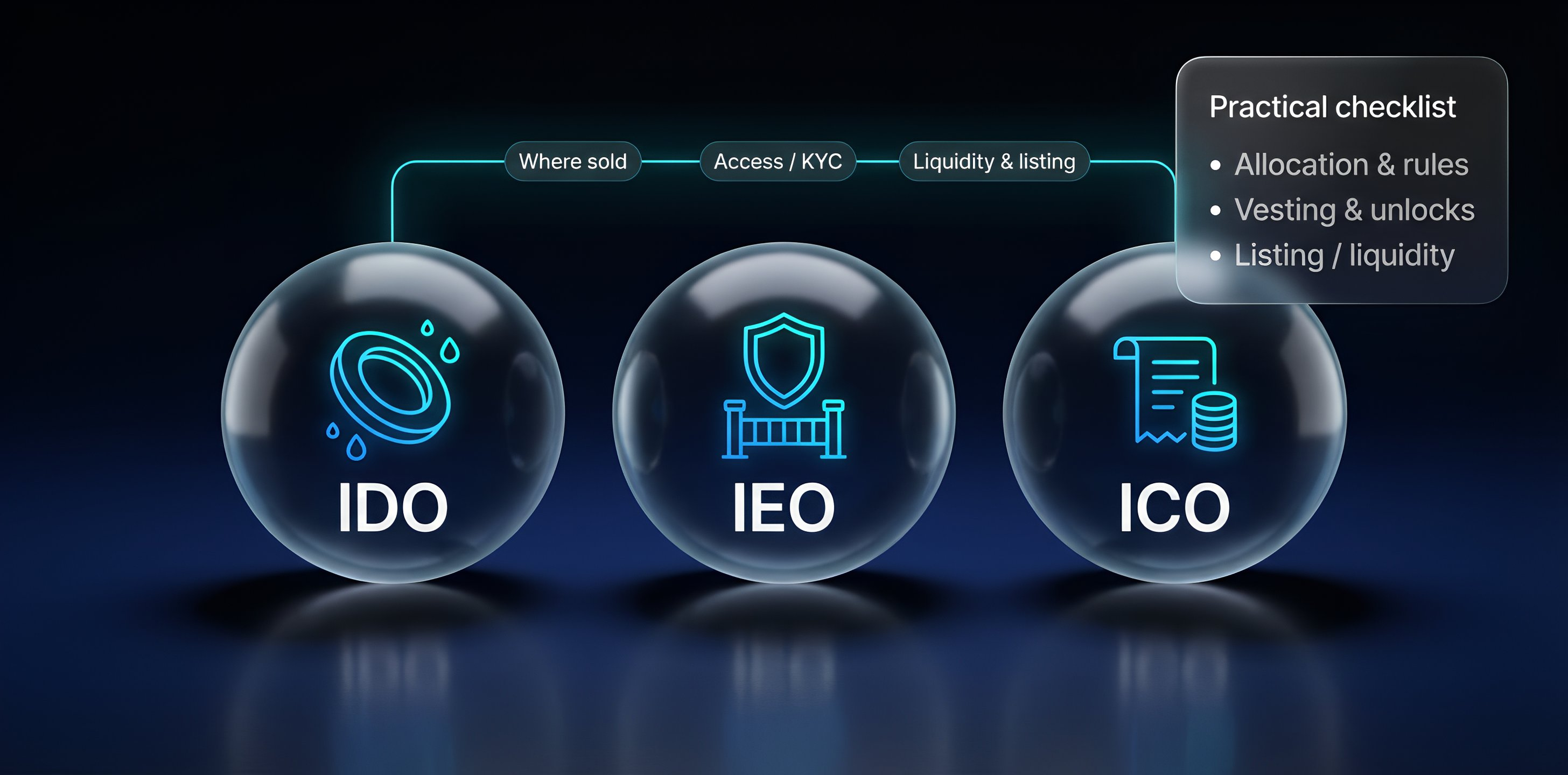
ICO, IEO and IDO are ways to buy a token before broad public trading begins, but they differ by transaction venue, admission procedure and by who controls token distribution after payment.
Goal of this guide: to explain how ICO, IEO and IDO work, list the typical participation conditions (KYC, allocations, vesting) and point out concrete risks (wrong address, phishing, delayed listing, liquidity withdrawal), so the format can be matched to the investor's experience level and holding horizon.
In an ICO, the project accepts cryptocurrency directly to its address or smart contract; in an IEO, the exchange debits funds from the participant's exchange balance; in an IDO, the purchase and the start of trading go through DEX smart contracts. The differences in transaction operator and custody location define the typical execution mistakes (address/network/claim), the speed at which a market appears and the risk profile (exchange, project, contract).
Below, ICO, IEO and IDO are used in the same broad sense: “a primary token sale before stable secondary trading exists”.
ICOs give the project maximum control over fundraising and leave the investor with the fewest built-in checks; IEOs add the exchange as transaction operator and admission filter; IDOs create an instant market on a DEX, but move the risk toward contract security, network fees and on-chain transaction parameters.
IEO: token sale through an exchange, KYC and quick access to trading
IEOs move purchase execution into exchange infrastructure: the exchange accepts payment, records allocations and credits tokens to the exchange balance. In an IEO, launchpad rules define access (KYC, country restrictions, account requirements), allocation size (lottery/subscription/FCFS) and the moment when tokens are credited (immediately or at TGE).
What a launchpad is. A launchpad is a service inside an exchange for the primary placement of a token: it accepts applications, calculates allocations, debits funds from exchange balances and launches trading pairs after the sale is completed.
KYC (Know Your Customer) is identity verification for the user. In an IEO, KYC is usually mandatory because the exchange applies compliance rules and blocks participation from prohibited jurisdictions.
In an IEO, the purchase is executed inside the exchange account, without an on-chain transaction to the sale contract.
- There is no need to enter a wallet address or choose a network, so the risk of an address mistake or wrong network is lower.
- Execution and token crediting are controlled by the exchange, not by the project's smart contract.
- The risk shifts into launchpad rules: limits, allocation format and account status.
When choosing a platform, it is important to compare launchpad rules with the expected liquidity of the trading pair after listing (a detailed comparison is in the review of exchanges with IEO and launchpad).
How an IEO works step by step
- The exchange announces the IEO and publishes the parameters: subscription dates, payment currency (for example, USDT), per-participant limit and account requirements.
- The participant completes KYC and checks country and account-status restrictions before depositing funds to the exchange.
- The participant submits an application or joins the distribution through the launchpad model (lottery, subscription, proportional allocation).
- The exchange debits funds from the exchange balance and credits tokens at the distribution moment or at TGE according to the IEO terms.
- The exchange opens trading pairs according to schedule; position management is done with exchange orders (limit, market, stop orders) if they are available for the pair.
How exchanges distribute allocations
Allocation is the amount of tokens credited at the sale price. In IEOs, allocation size most often depends on the distribution model and the level of demand in the subscription.
- Lottery: some participants receive the right to buy a fixed amount; the chance depends on admission rules and the number of applications.
- Proportional subscription: the token amount depends on the participant's share of the total subscription; the exchange often factors in the average balance of its exchange token over a defined period.
- First-come, first-served: purchase is based on who manages to enter first; time limits and platform load increase the risk of failing to complete the purchase.
IEO examples: fast listing and limited allocation
BitTorrent (BTT, 2019): strong demand for the IEO meant most participants received minimal allocations because total subscription demand exceeded the token supply many times over.
Polygon / Matic (2019): launchpad placement gave the token a fast listing and early liquidity because the exchange opened the trading pair immediately and connected market making.
IEO for investors: pros and cons
✅ Pros
- The exchange sets uniform access and payment rules: the purchase is made through the exchange balance without entering an address or choosing a network.
- The listing is announced in advance, so the trading start time is known before participation.
- Exit and position management can be handled with exchange orders if the exchange provides limits and stops for the pair.
- Market making and initial liquidity usually appear faster than when a project launches trading on its own.
❌ Cons
- KYC and country restrictions can block participation or limit account functions on the sale day.
- Allocations are often small because demand is overheated; the final position may not compensate for listing-volatility risk.
- Exchange outage, withdrawal freeze or additional account review can restrict access to tokens and funds.
- A listing creates a market, but it does not prevent the price from falling after trading starts.
IEOs reduce address-error and wrong-network risk by keeping the purchase inside the exchange, but they leave price-drop risk in place and add account-restriction and launchpad-rule risk.
ICO: direct token sale without intermediaries and without built-in guarantees
ICOs give the project direct access to investor funds: the investor sends cryptocurrency to the project address or sale smart contract without an exchange operator that checks the project or distribution process. In an ICO, the investor checks the sale terms, chooses the network and sends funds independently; an address mistake or phishing replacement of the contract can cause irreversible loss.
What a white paper is. A white paper is a project document describing the product, tokenomics, distribution and risks. In ICOs, the white paper often contains the sale contract address, price, limits and vesting terms, so vague wording and missing unlock dates increase the risk of misjudging the deal.
TGE (Token Generation Event) is the moment when the token is created and distributed. Receiving a token in a wallet does not guarantee the ability to sell it at a market price, because selling requires an exchange listing or a liquidity pool on a DEX.
Private sale and public sale. ICOs almost always include a private round (funds) and a public round (retail). Discounts and earlier unlocks in private rounds create additional supply immediately after trading starts and add selling pressure on unlock dates.
In an ICO, there is no exchange that accepts payment and credits tokens under unified rules. This structure can make participation simpler without an account and without KYC, but it increases the role of due diligence: the investor checks the contract address, network, sale deadlines, claim mechanism and vesting dates before sending funds.
How an ICO works step by step
- The project publishes a white paper, sale rules and an address/smart contract for accepting funds.
- The investor checks limits, dates, country restrictions and the token-receipt mechanism (automatic distribution or claim).
- The investor sends funds to the contract or project address; the transaction is recorded in the selected network.
- At TGE, the investor receives tokens at their address or performs a claim according to the project rules.
- Selling becomes possible after a CEX listing or after a liquidity pool is created on a DEX; listing dates can move.
How participation terms are formed in ICOs and where asymmetry appears
Allocation in an ICO depends on round terms and distribution rules. For retail investors, the risk is often not the token sale price itself, but when large holders become able to sell tokens into the market.
- Early-round discounts: funds and private investors may buy cheaper and take profit earlier because they need a smaller price increase to exit with a gain.
- Vesting and cliff: large unlocks on a single date increase market supply on that day and often coincide with waves of selling pressure.
- Claim and receipt timing: tokens are often issued through a separate site; checking the domain and contract address falls on the investor.
ICO examples: success, scale and expectation problems
Ethereum (2014): the ICO was a sale of an infrastructure token that later gained mass use in the Ethereum network; this outcome is rare for most token sales.
EOS (2017): a large fundraising amount did not guarantee sustainable token-price growth after trading started because the market reacted to supply and expectations.
Tezos (2017): internal conflicts and delays meant the project took a long time to deliver the announced development stages, which negatively affected the token price after the ICO.
ICO for investors: pros and cons
✅ Pros
- Participation can be possible from a personal wallet without an exchange account and without transferring funds to an exchange operator.
- Some ICOs do not require KYC, so access can be simpler than in an IEO.
- Buying before the broad market can be possible if the project later creates liquidity and demand for the token.
❌ Cons
- Checking addresses, terms and dates is entirely the investor's responsibility; phishing and contract substitution lead to irreversible losses.
- Listing and liquidity are not guaranteed; the project can delay the market launch or fail to create a market at all.
- Team and early-round unlocks can pressure price on specific vesting dates.
ICOs suit investors who are ready to verify addresses, network, claim terms and vesting schedule before sending funds, and who accept the risk of delayed listing and an illiquid market.
IDO: decentralized sale through a DEX and smart contracts
IDOs require on-chain execution: network fee, slippage limit and transaction ordering in the mempool affect the final trade price and the ability to sell the token without a deep discount (selling well below the expected price because the pool is small or slippage is high). Price and execution depend on liquidity-pool depth, selected slippage and the gas fee that determines transaction priority.
DEX and AMM. A DEX is an exchange without a central operator. Most often it uses AMM (automated market maker), where a smart contract calculates the price inside a liquidity pool and executes token swaps without an exchange order book.
Liquidity pool. This is a pair of assets (for example, ETH and the new token) deposited into an AMM protocol. A small pool causes a strong price shift during buying or selling because the AMM formula changes price when pool reserves change.
Liquidity lock. If the team has not locked LP tokens or the contract allows liquidity to be withdrawn, the liquidity owner can take the reserve of the base asset (for example, ETH) in one transaction; after such a withdrawal, the token price in the pool collapses because there is no opposite-side liquidity.
In an IDO, transaction parameters and contract actions are visible in a blockchain explorer: token address, pool address, mint/burn events, buy and sell transactions. On-chain transparency does not remove risk: a wrong token address, incorrect slippage or unlocked liquidity can cause a direct loss on the very first trade.
How an IDO works step by step
- The launch network is chosen and the investor prepares a balance of the network's base token for fees (for example, ETH for Ethereum or BNB for BNB Chain).
- The token address and sale contract address are checked through the project's official channels, and the domain is verified to avoid signing a transaction on a phishing site.
- The wallet is connected to the DEX/launchpad and the purchase transaction is signed with pre-set slippage and gas parameters (limit/priority), if the wallet supports them.
- Tokens are received immediately or through a claim according to contract rules; the vesting schedule can limit the amount available for sale at launch.
- After the market starts, selling or adding to the position is done through the same pool, taking pool depth and AMM price movement into account.
Three practical IDO difficulties that are often forgotten
- Slippage: the actual execution price differs from the price at the moment the transaction is signed because pool reserves change before the transaction is included in a block.
- Network fees: when the network is congested, the fee rises; a low-priority transaction may not enter a block in time and may execute at a worse price.
- MEV and bots: participants using bots and high gas can insert transactions before the investor's trade, buying earlier and selling higher while worsening execution price.
How IDOs distribute access and allocations
Allocation in an IDO is the amount of tokens that the smart contract allows one address to buy at a fixed price or under the sale rules. Allocation restrictions are usually set by wallet limits and whitelist rules.
- Whitelist: purchase is available only to addresses on the list; the smart contract checks the sender address of the transaction.
- Limited fixed price: the contract accepts payment at a predefined price and limits the maximum purchase per address.
- First-come, first-served: the contract sells tokens to the first transactions included in a block; competition appears as higher gas and bot activity.
- Claim and vesting: the contract may release tokens in tranches (parts according to a predefined schedule); part of the purchased amount becomes sellable only after the unlock date.
IDO examples: where a launch strategy breaks
Low-liquidity case: the pool exists but the reserve of the base asset is small; selling a moderate amount of the token sharply reduces the price because the AMM formula changes price as the base-asset reserve falls.
Execution-problem case: the network is congested and transactions compete through gas; a low-priority transaction confirms later and executes after a series of buys, so the actual purchase price is higher than expected.
IDO for investors: pros and cons
✅ Pros
- Participation is done directly from a wallet without an exchange account and without transferring funds to an exchange operator.
- A DEX market often appears immediately after a liquidity pool is created, so selling can be possible without waiting for a centralized listing.
- Contract address, transactions and pool parameters are visible on-chain, so verification is possible through a network explorer.
❌ Cons
- Token-address mistakes, incorrect slippage and phishing lead to irreversible losses because blockchain transactions cannot be cancelled.
- In the first minutes of trading, volatility is at its highest; a market buy through an AMM often executes at an inflated price because the pool is small.
- There is no project-quality filter: the contract may contain hidden admin rights or a liquidity-withdrawal function.
IDOs provide early DEX market access, but they require checking addresses and contracts, setting slippage and evaluating pool depth before the first purchase.
Price after a token sale is determined not by the purchase moment, but by how and when tokens enter circulation.
Tokenomics and vesting: what really determines price after a token sale
Tokenomics defines the amount of supply in the market: issuance (the total number of tokens created) and unlock dates determine how many tokens enter circulation after TGE and when selling pressure increases. Circulating supply, FDV and the vesting schedule help forecast specific dates when token supply will rise because of team, fund or ecosystem-pool unlocks.
Tokenomics is the set of rules for token issuance and distribution: total supply, team and investor shares, public-sale share and the token's role inside the product: utility (payment of fees/access to features) or governance (voting on protocol parameters).
Vesting is the schedule by which tokens enter circulation. The schedule often includes a cliff (a period with no unlocks), after which tokens enter the market in tranches; unlock dates increase supply and can pressure price in specific weeks and months.
Two metrics that matter more than the “token sale price”
- Circulating supply is the amount of tokens in circulation at the start of trading; a small circulating supply makes price sensitive to modest demand because few tokens are available for sale.
- FDV (fully diluted valuation) is the project's valuation at full supply; a high FDV with a weak product means price growth requires disproportionately large demand because the market is already assigning a high valuation.
Market observation: small circulating supply can support price in the first days, but large vesting unlocks increase supply and often trigger waves of selling on unlock dates.
What to check in distribution terms
- Team and fund shares, the presence of a cliff and the dates of the first major unlocks.
- The structure of “ecosystem” and “marketing” allocations: who controls those tokens and by what rules they enter circulation.
- Stated buyback or burn mechanics (buying tokens from the market or permanently destroying them) and the funding source for buyback (product revenue, protocol fees, project treasury).
- How the investor receives tokens: immediate crediting, claim through a site, tranche distribution or lockup of part of the amount until an unlock date.
Skewed distribution and aggressive unlocks create selling pressure even when the product is good, because supply grows faster than user demand.
Having trading available is not the same as being able to sell at the expected price: that is determined by market liquidity.
Liquidity and listing: how the market after ICO, IEO and IDO differs
Liquidity determines execution price: with shallow market depth, selling leads to a discount because of slippage or a lack of opposing orders.
After an IEO the market starts on the organizing exchange. Execution price depends on order-book depth and market-maker activity; the participant can use limit orders.
After an IDO the market forms through a liquidity pool on a DEX. Price changes according to the AMM formula; with small reserves, even a small trade moves the price noticeably.
After an ICO the market may appear with a delay or not appear at all. Without a listing or liquidity pool, selling the token at a market price is impossible.
How investors can assess “market quality”
- Depth and volume: orders near the current price and daily turnover show how many tokens can be bought or sold without a strong price shift.
- Trading support: market making and a dedicated liquidity budget determine whether the order book/pool can maintain a tight spread and stable depth after the first hours of trading.
- Unlock schedule: major unlocks increase supply on specific dates and can worsen market depth if many holders sell at once.
A listing creates a trading point, while liquidity determines execution price; with weak liquidity, the exit strategy turns into selling with heavy slippage.
Comparing ICO, IEO and IDO by key investor criteria
The same goal, “buy before the market,” creates different risks because the transaction operator, custody location and liquidity-creation mechanics differ.
| 📌 Criterion | ICO | IEO | IDO |
|---|---|---|---|
| Venue | Project website and sale contract | Centralized exchange and its launchpad | DEX or decentralized launchpad |
| Who executes the purchase | Investor sends funds to the project address/contract | Exchange debits funds from exchange balance and credits tokens | DEX/launchpad smart contract executes the swap on-chain |
| KYC | Often absent, depends on the project | Usually mandatory and depends on the country | Often absent, depends on the platform |
| Market appearance | Depends on listing or pool creation; may not happen | Usually scheduled on the organizing exchange | Usually immediately after a liquidity pool is created |
| Typical execution mistakes | Wrong address/network, phishing, missed claim | Account issues, KYC restrictions, exchange failures | Wrong token address, high slippage, fees and MEV |
| Main source of systemic risk | Project honesty and fulfillment of listing promises | Exchange rules and stability plus project risk | Contract and liquidity security plus project risk |
What investors need before participation
| 🧰 Preparation | ICO | IEO | IDO |
|---|---|---|---|
| Wallet | Required, self-custodied | Not required for the purchase | Required, self-custodied |
| Exchange account | Not needed | Required | Not needed |
| Network fees | Present when sending funds and receiving tokens | Usually absent at the purchase stage inside the exchange | Critical at launch because of gas competition |
| Participation skill | Checking addresses, terms, claim and unlocks | Checking launchpad rules and KYC restrictions | Checking contracts, slippage, gas and pool liquidity |
The token sale format determines where an irreversible mistake appears: in ICOs, when sending funds to a wrong address; in IEOs, through account restrictions and launchpad rules; in IDOs, during on-chain execution (slippage, gas, MEV, liquidity).
Token sale risks are distributed across transaction stages and do not depend on the investor's intentions: some of them trigger even when the investor acts correctly.
Token sale risks: what can go wrong in ICO, IEO and IDO
Token sale risks appear at specific moments: before payment (phishing and address replacement), during distribution (claim and vesting) and in the first trades (liquidity and volatility).
- Market risk
- Price can fall after trading starts when supply from unlocked holders exceeds demand in the first listing days.
- In the first hours, the market often moves through market orders and short impulses because limit orders and depth have not yet formed.
- Early-round investors buy tokens cheaper, so they can start selling immediately after listing, creating pressure on price.
- Tokenomics and unlock risk
- The vesting schedule defines the dates when token supply in circulation increases.
- Large team and fund unlocks increase sellable volume on specific dates and can keep price under pressure for a long time.
- Product-metric growth does not compensate price if new token supply enters the market faster than user demand grows.
- Technical risk
- In ICOs and IDOs, the investor interacts with a smart contract or address directly, without an exchange operator.
- A mistake in token code, distribution logic or admin rights can block transfer, prohibit selling or allow additional supply to be minted.
- Phishing works through domain substitution, contract-address replacement and fake claim pages; signing a transaction on the wrong contract is recorded on-chain irreversibly.
- Operational risk
- Operational loss comes from user actions rather than token price.
- Typical mistakes: wrong network, wrong address, missed claim deadline, not enough gas to confirm the transaction.
- Reducing operational mistakes is connected to wallet choice and seed-phrase access control (solutions are compared in the crypto wallet review).
- Legal and compliance risk
- Exchanges can restrict access to IEOs and trading by country because they apply compliance rules and KYC.
- Trading can be suspended if the platform changes listing rules or receives requirements to block users.
- In ICOs and IDOs, the investor is responsible for following restrictions because participation happens without centralized account screening.
Token sale risk is distributed across stages; the greatest damage comes from scenarios where the token cannot be received, cannot be sold, or funds were sent to the wrong address.
Common mistakes investors make in token sales
Most token sale losses come from concrete mistakes: buying without an exit plan, ignoring unlocks and taking the wrong action during on-chain execution.
- Participating without an exit plan and risk limit
- The investor buys at listing with a market order and makes decisions emotionally in the first minutes.
- Profit-taking and loss levels are not defined in advance.
- High volatility turns the position into uncontrolled risk even if the project continues to develop.
- Focusing on the “token sale price” instead of circulating supply, FDV and vesting
- A low token price does not mean a low project valuation because issuance can be enormous.
- High FDV with low circulating supply creates an expectation of growth that breaks at the first major unlock.
- Team and fund unlocks increase supply on specific dates and can pressure price regardless of news.
- Overestimating “listing” as a guarantee of liquidity
- A listing creates trading, but it does not automatically create market depth.
- On a DEX, a small pool creates heavy slippage when exiting.
- On a CEX, the order book can be thin in the first days if market making is weak.
- Execution mistakes: addresses, network, deadlines, claim
- Sending funds on the wrong network or to the wrong address causes loss because the transaction is irreversible.
- Missing the claim deadline leaves tokens unclaimed if the contract limits the claiming period.
- IEOs involve fewer such mistakes, but account restrictions and KYC blocks can prohibit participation on the sale day.
- Entering “at market” in the first minutes without accounting for fees, slippage and bots
- In an IDO, every AMM swap moves the price, so a market buy often executes at an inflated price.
- Slippage and gas fee change the final transaction price between signing and block inclusion.
- MEV bots can insert trades before the transaction and worsen execution price.
What should an investor choose: practical logic for choosing between ICO, IEO and IDO
Choosing between ICO, IEO and IDO comes down to three parameters: KYC availability, skill in checking contracts and skill in managing a position at the start of trading.
Beginner: priority is simple participation and fewer operational mistakes
Optimal format: most often an IEO on a major launchpad, if KYC is available and the country is allowed by the exchange rules.
- IEO removes the need to send funds to a contract or enter addresses, reducing wrong-network risk and phishing-address replacement risk.
- The exchange credits tokens to the exchange balance, so the risk of “missing the claim” is usually absent.
- The listing is often scheduled in advance, so the market-appearance moment is known before participation.
Active trader: priority is liquidity, speed and exit control
Optimal format: IEO for order-book trading, or IDO for an early market if the trader is ready for on-chain execution.
- IEO is more convenient for limit and stop orders if the exchange provides them for the pair and the order book has depth.
- IDO gives access to the market immediately after the pool, but trade price depends on slippage and gas, so entry and exit require transaction-parameter control.
- The quality of the first trading hours is determined by order-book depth (CEX) or pool reserves (DEX), not by the name of the format.
DeFi user: priority is autonomy and on-chain control
Optimal format: IDO if the investor can check addresses, admin rights and liquidity-lock conditions.
- IDO allows participation from a wallet without an exchange account and without transferring funds to an exchange operator.
- Verification comes down to on-chain facts: token address, pool address, contract-owner rights and whether liquidity is locked.
- At launch, transactions require slippage and gas control and an understanding of MEV because transaction ordering affects execution price.
Long-term investor: priority is tokenomics, product and sustainability
Optimal approach: the format is secondary; unlocks, product demand and the liquidity-creation plan matter more.
- Over months, the key risk is supply growth through vesting and the market's ability to absorb unlocks without a price collapse.
- The liquidity plan matters: an exchange listing with market making or a pool with sufficient reserves defines the exit conditions.
- The purchase format (ICO/IEO/IDO) does not remove selling pressure if team and fund unlocks are large and close in time.
The optimal format is the one where the critical risk is controlled for the investor's current skill level: in an IEO, account rules and KYC; in an ICO, address and claim timing; in an IDO, slippage, gas and liquidity security.
Project check before a token sale: minimum due diligence for a retail investor
Checking a project before participation comes down to three objects: product and team, token-distribution terms, and the technical security of contracts and addresses.
- Product and team
- Evidence of a product demo, updates, releases and integrations; lack of releases combined with aggressive marketing increases the risk that promises do not match reality.
- Public team information and relevant experience for the stated tasks; inconsistencies in roles and biographies increase management-failure risk.
- The token's role in the product: payment of fees, access to features, staking or governance; no clear role makes token demand purely speculative.
- Tokenomics and unlocks
- Early-round shares and the dates of the first large unlocks; major unlocks after listing often coincide with waves of selling pressure.
- Circulating supply at launch and FDV; high FDV with a weak product reduces upside potential because the valuation is already priced in.
- Public-sale terms: price, per-participant limit, vesting and token-receipt mechanism (crediting or claim).
- Security and operational details
- Audit availability and the list of checked contracts; a token audit does not replace an audit of the sale contract or pool contract.
- Sources for token and contract addresses: official project channels; an extra domain check reduces the risk of visiting phishing pages.
- Failure scenario: unavailable claim, network congestion and rising fees; no predefined response increases the chance of impulsive transactions at a worse price.
The purpose of due diligence is to reject deals where losses come from phishing, aggressive unlocks or lack of liquidity, not from “bad timing”.
Practical cases: what the ICO boom, launchpad IEOs and decentralized launches teach
Practical cases show recurring causes of token sale losses: unlock asymmetry, limited allocations and weak liquidity at the start of trading.
ICO: survivorship bias and the illusion that “earlier = better”
The expectation of guaranteed profit from early entry is formed by a few successful examples, while most ICOs do not create a sustainable market.
- Investors overestimate the probability of multiple growth and underestimate the base scenario of a price drop after listing.
- Discounts and early unlocks in private rounds increase supply immediately after trading starts.
- Buying at a low price does not compensate for selling pressure when liquidity and an exit plan are absent.
IEO: fast listing with limited allocation
IEOs provide a fast market launch, but strong competition on the launchpad often limits the final position size.
- Small allocations limit potential profit while listing-volatility risk remains.
- KYC restrictions, limits and account status can affect access to purchase and trading.
- Placement on a launchpad does not guarantee price stability after the first trading days.
IDO: instant market at the cost of higher on-chain risk
IDOs create a market immediately through a liquidity pool, shifting the key risks to on-chain execution parameters and contract security.
- A small liquidity pool makes price sensitive: trades move the AMM price noticeably.
- MEV and bots can worsen execution price through transaction priority.
- Liquidity withdrawal or hidden admin rights can remove the ability to sell the token at a market price.
The recurring causes of loss are inflated expectations from early entry, selling pressure from unlocks and weak liquidity at the start of trading, regardless of the token sale format.
Questions and answers (FAQ)
What is safer for beginners: ICO, IEO or IDO?
Why do IEOs almost always require KYC?
Can the token be sold immediately after purchase?
What matters more: token sale price or tokenomics?
How can IDO participation risks be reduced?
Why can high FDV be a problem after listing?
Is it worth joining a token sale without an exit plan?
✅ Risks and differences between IDO, IEO and ICO
- ICO: the investor sends funds to the project address/contract and is responsible for checking the address, network, claim deadlines and liquidity plan; phishing and delayed-listing risk are highest.
- IEO: the exchange executes the purchase and credits tokens, so address-error risk is lower; account and KYC restriction risk is higher, while price-drop risk after listing remains.
- IDO: the DEX smart contract executes the trade, so market access is fast; risk depends on pool depth, slippage, gas, MEV and liquidity lock.
Choosing the format relies on three checks: KYC availability for IEOs, the ability to verify addresses and claim terms for ICOs, and the ability to verify the contract and pool liquidity for IDOs. These checks reduce the probability of an irreversible mistake because they cover the main loss points: wrong address, unavailable market and liquidity withdrawal.