Quick check: can the market absorb your trade in 2 minutes?
Before entering, you need to know one thing: the price at which you will actually be filled.
Here you get a fast filter for
Liquidity is your ability to buy and sell without a meaningful price penalty. In a thin market you pay twice: you enter at a worse price and then close the position worse than expected — even if you were right about direction. That is why checking liquidity is part of risk management, not extra caution.
Goal: give a practical liquidity-check algorithm before trading on
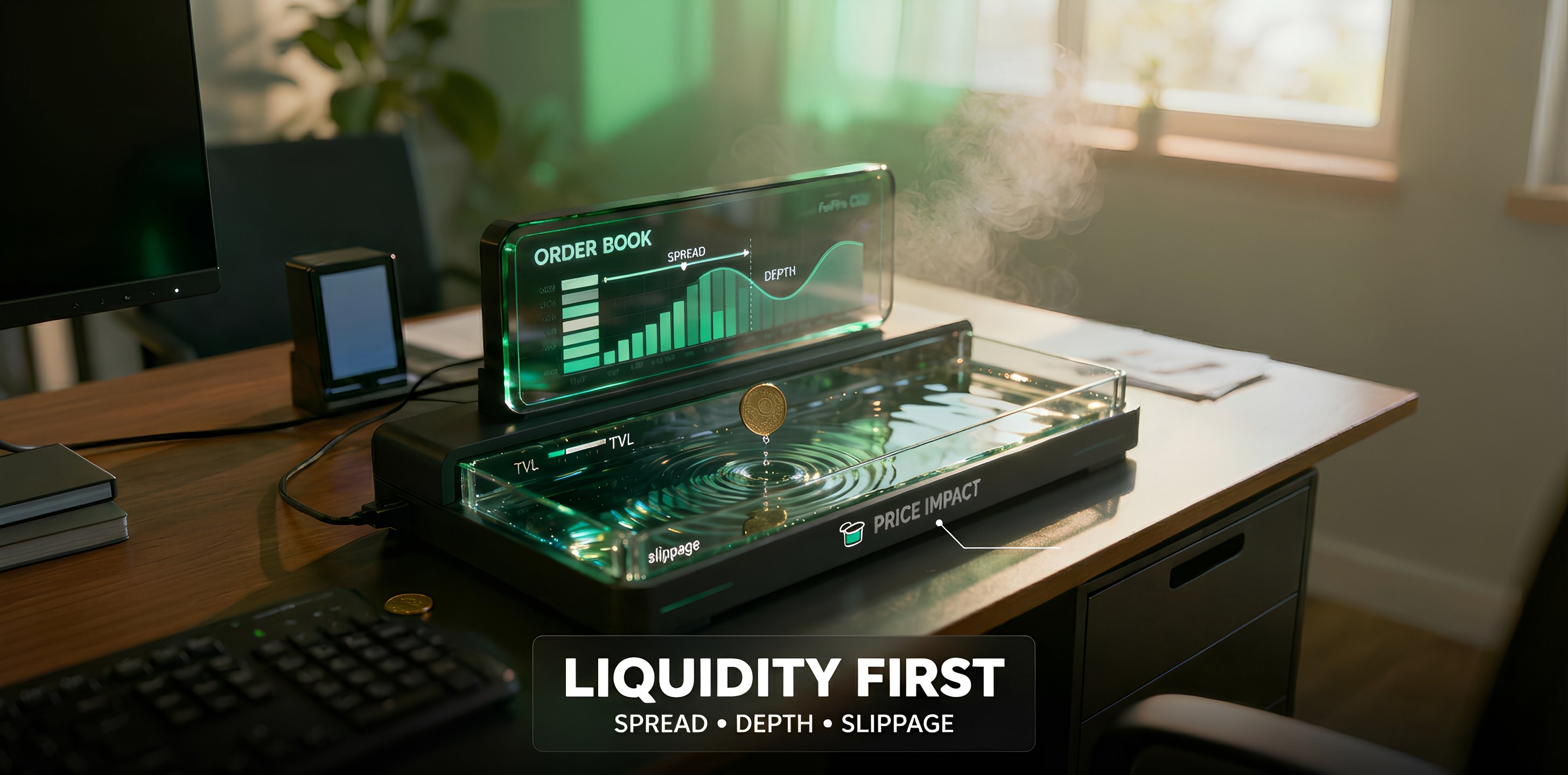
What liquidity means in the crypto market and why it decides the outcome of a trade
Liquidity is execution quality: how close your entry and exit will be to the price you expected for your actual order size.
A common mistake is to treat liquidity as the same thing as volume. Volume matters, but it does not answer the main question: at what price you can really close the positionin advance.
In a liquid market, execution is usually predictable: the spread is tight, there is enough size near the current price, and orders refresh continuously. In a thin market, the opposite happens: even a “medium” order moves price against you — the entry becomes more expensive, and taking profit is worse than planned.
Where liquidity takes its cut: you can see it at three moments of the trade.
Liquidity is not constant. It drops during panic, news events and sharp candles — when large players remove orders or the market fragments across venues.
Bottom line: liquidity is position control: how predictably you can enter and exit, and how much you give back to the market through spread and slippage.
Liquidity on CEX and DEX: the same goal, different rules of the game
Let us compare CEX and DEX practically: where liquidity lives and what to check before a trade so you do not get caught by slippage.
CEX (centralized exchanges) means an order book: you see buy and sell orders. The denser the book is near the current price, the closer execution will be to the expected price and the smaller the entry and exit losses.
DEX (decentralized exchanges) most often work through
- If CEX → look at spread and depth within ±1–2% — is there enough size close to the current price?
- If DEX → look at TVL and impact for your order size — does the swap already bite on entry?
| What we compare | CEX | DEX |
|---|---|---|
| Source of liquidity | Orders in the book | Funds in the pool |
| Key check | Spread and depth near price | TVL and price impact for your size |
| Typical failure | Gaps in the book, spread widens | High impact; MEV (bots influencing transaction order) |
| How to reduce losses | Limit orders, splitting the size | Aggregators, splitting, moderate slippage tolerance |
Bottom line: on a CEX you check whether the order book can absorb your size. On a DEX you check whether the pool can absorb it. If it is thin, change tactics: limit order, split execution, or use a more liquid venue.
Liquidity metrics: what to check first
“24-hour volume” is only background. Real executability is visible through spread, depth and slippage (on DEX — price impact) for your exact order size.
|
1) Trading volume Shows activity, but does not guarantee an easy exit. Check stability across days and where trading is concentrated (by venues and pairs). |
2) Spread Your direct “tax” on entry and exit at that moment. If the spread widens for no clear reason, the market is fragile: execution becomes worse than expected. |
|
3) Market depth How much you can really buy or sell near the current price. Check volume within ±1–2% — that is exactly where slippage is born. |
4) Slippage and price impact How much you lose on execution for your own order size. If it already bites noticeably on entry, the market is thin specifically for your size. |
Bottom line: do not try to guess liquidity from a single number. First check spread and depth, then estimate slippage/price impact for your size — and only then enter.
How to check liquidity on CEX: a fast 2-minute algorithm
Check spread and depth for your size — this lets you see the exit slippage risk before you trade.
- Check the spread: if it is noticeable or floating, entry and exit are already more expensive.
- Estimate depth within ±1–2%: are the nearest orders enough to cover your size?
- Look for gaps and steps: breaks between levels are the main source of slippage.
- Compare your size with the pair’s daily activity: if you are visible, split the trade.
- Look at the trade rhythm: is the tape alive, or does the market freeze for minutes?
Bottom line: on CEX, liquidity is checked through the order book: spread plus depth for your size. If both are weak, change tactics instead of relying on “24-hour volume”.
How to trade without giving money back to the market through execution
Three techniques that actually make trades cheaper: limit orders, splitting size and entering calmly instead of chasing impulse moves.
Limit order instead of market order
A market order fills against “what is available” in the book — and often worsens the average price. A limit order sets your price in advance and protects you from sudden deterioration at the moment of execution.
-
When to use it
The spread is noticeable, the book is thin, or price moves in jumps. -
How to do it
Place a limit at a reasonable price and let the market touch your order without racing it. -
Common mistake
Entering with a market order on an impulse and overpaying for speed.
Splitting the size
If your size is visible to the market, one large order pushes price against you. Split the trade into parts — execution becomes smoother, and price impact is lower.
-
When to use it
Nearest depth cannot cover your size without a meaningful price move. -
How to do it
Execute a series of smaller orders and watch the market reaction after each part. -
Common mistake
Trying to force the market with one click and losing on the average execution price.
Do not enter “on one candle”
During impulses, the book becomes fragile: the spread widens, orders disappear, and market orders fill worse. At that moment you are paying not for the asset, but for a shortage of liquidity.
-
When it is especially dangerous
News, sharp breakouts, impulse candles and pump-like bursts. -
How to do it
Enter in parts, use limits and let price cool down after the first jump. -
Common mistake
Buying the excitement and getting poor execution before the move even goes in your favor.
Bottom line: a safe trade is not only an entry point, but also the method of execution. Limit orders and splitting often save more than trying to catch the “perfect” signal.
DEX check before a swap: where you pay the market’s “hidden fee”
On DEX, the main test is not the numbers on the display, but the final price: what the interface shows as price impact for your exact amount.
In an AMM pool, you do not trade at “the last price”; you trade along a curve determined by token balances. The more sensitive the pool is to your size, the worse the average execution price will be — even if the chart looks calm.
- Check TVL: large TVL usually makes price more stable; small TVL makes the swap sensitive to size.
- Assess activity: pool trading volume matters more than one-off spikes — you need a regular flow of swaps.
- Enter your amount: compare price impact for your size and for a smaller size. If impact falls noticeably when the amount is reduced, split the swap.
- Clarify the type of liquidity: in Uniswap v3-like pools, liquidity is often “within a price range” (concentrated liquidity means funds are not placed across the whole curve, but inside a narrow corridor). Outside the range, slippage rises sharply — even with good TVL.
- Account for MEV: in public networks, bots can reorder transactions inside a block (MEV), including through sandwich attacks — two trades around yours that worsen your price. The risk is higher with excessive slippage tolerance and a thin pool.
Important nuance → high TVL still does not promise a comfortable swap. If liquidity is concentrated in a narrow range, you may face a situation where “there is a lot of money overall”, but little of it is near the current price — and price moves away.
Mini case from practice → you enter a small amount and the interface already shows a noticeable price impact. TVL still looks solid. Most often this means liquidity is placed “not where you need it right now”. In such situations, simple actions help: reduce the amount, split the swap into parts, or choose another pool/route through an aggregator.
Bottom line: for DEX, the most important thing is price impact for your amount. If it is noticeable, reduce size, split execution and do not overstate slippage tolerancein advance.
How to recognize showcase liquidity and fake volume
A quick market-quality test: what you see in the book/prints — and what to do so you do not fall for the showcase.
Three columns — and the picture is clear: what you see → what it means → how to act.
| Signal | What it means | What to do |
|---|---|---|
| High volume, but no depth | Activity does not turn into execution near price | Check depth within ±1–2% and compare it with your size |
| The book tears in chunks | Large gaps between levels — price jumps steps | Step away from market orders: use a limit order or split the size |
| Spread jumps for no reason | The market is fragile: orders are pulled, liquidity is breathing | Wait for stability; if this is normal behavior, do not trade size |
| Prints are too even | Looks like activity being painted with identical trades | Check depth and orders; if in doubt, switch venue/pair |
| Small orders move price | There is little liquidity at the current level | Reduce aggression: limit, split, or skip the trade |
Important → make the market “prove liquidity” across a price distance. If you cannot buy/sell within ±1–2% without meaningful deterioration, what you are seeing is a showcase.
Bottom line: quality liquidity is recognized by execution: a stable spread, dense depth near price and predictable slippage for your order size.
Trader’s pre-trade checklist: CEX and DEX
Go through these points — and you will see in advance how much execution will eat and where you can get stuck.
🏦 Liquidity check on CEX
Do not check “24-hour volume”; check executability near price: spread, depth and gaps.
- Spread: is it stable now and 10–15 minutes ago? If not, entry/exit will be more expensive.
- Depth ±1–2%: is there enough size on both sides? If not, prepare for slippage.
- Gaps: are there breaks between levels? Then a market order will jump steps and worsen the average price.
- Trade visibility: does your size look large compared with daily activity? Split it.
- Execution: if it is thin or nervous — use limit orders and series, not an aggressive market order.
Main point: a good CEX is “dense close to price”. Far-away book volume will not save you.
🧩 Liquidity check on DEX
Here you trade against a pool. That is why price impact and the conditions under which it becomes painful decide the result.
- TVL + activity: are there funds and regular swaps? A pool with little trading often slips.
- Price impact: enter the amount — is impact acceptable? If not, reduce or split.
- Concentration: is liquidity “inside a price range”? Outside that range, impact rises sharply.
- Slippage tolerance: keep it at the minimum needed for execution — a high tolerance makes a worse outcome easier.
- Route: if impact is high, an aggregator or another pool is usually cheaper than forcing this one.
Main point: if price impact is unpleasant as soon as you enter the amount, the market is thin specifically for you.
The best market is one where execution is predictable: entry and exit happen without sharp price loss.
Practical scenarios: how traders lose money on liquidity
You may guess direction correctly. Execution cannot be guessed if the market is thin. These cases show the cost of that mistake.
Bottom line: liquidity decides how much you actually earn. If the market cannot hold your size, change the execution method, or the market will change it for you.
Liquidity FAQ: quick answers that protect you from poor execution
Short and practical: what to check on CEX/DEX so you do not overpay on entry or get stuck on exit.
Can I rely only on 24-hour volume?
How can I quickly assess order-book depth without complicated tools?
What spread is dangerous?
Why can price impact be high even with large TVL?
Should I always reduce slippage tolerance to the minimum?
What if the market is thin but I still want to buy the coin?
Why does liquidity worsen during news events?
What is the main beginner mistake when checking liquidity?
Final rule: exit first, entry second (the liquidity rule for CEX and DEX)
Your main risk is not being wrong about direction, but being unable to exit. First check the exit through liquidity, then enter.
Liquidity is your control over the position. It shows how close the trade will execute to your expected price and whether you can close the size without an unpleasant price penalty.
On
If the test fails, change tactics, not hope. Reduce size, split execution, use limits, choose a more liquid venue/pool or wait until the market becomes more stable.
Main point: a safe trade starts with an exit plan. Check liquidity for your own size — and only then enter the position.