Money flows in GameFi: token issuance, mandatory spending, and balance breakpoints
Why “generous rewards” can hide flow imbalances — and how to assess reward issuance, in-game spending, and token-buy demand.
GameFi economies rarely break all at once: reward issuance first starts to exceed in-game token consumption, while the rewards interface keeps showing “yield” without reflecting growing sell-side and downward price pressure.
Short answer: the sustainability of a GameFi economy depends on the balance of mint/day, burn/day, and Demand, while vesting unlocks and liquidity determine how strong price pressure becomes.
Goal: provide a set of criteria for evaluating a GameFi economy: reward emissions, token inflation, sink mechanisms, liquidity, vesting unlocks, and the risk of an “active-user pyramid” model.
In most GameFi projects, the conflict is built into incentives: some players try to convert rewards into stablecoins or fiat by selling the token on the market.
The project economy needs a reverse flow: regular in-game token spending (upgrades, crafting, fees, entry into modes) that reduces sell volume. When in-game demand is weak and reward emissions grow, token sell pressure intensifies.
Typical scenario: declining reward yield → lower activity → lower in-game spending → a larger share of rewards sold on the market.
The imbalance becomes visible without complex models if the economy is broken down into three flows and token issuance, in-game removal, and reasons to keep the token inside the game are compared.
- Token issuance (Mint) — how many tokens appear per day from rewards and unlocks.
- Token removal (Sink) — how many tokens are burned or locked through in-game mechanisms.
- Demand — what reasons make players buy and hold the token inside the game instead of simply selling it on an exchange.
GameFi belongs to high-risk models: liquidity in gaming tokens often falls faster than in large crypto assets, and price can decline as emissions rise even without “negative news.”
Key idea: the sustainability of a GameFi economy begins with the balance of Mint, Sink, and Demand, not with the size of rewards shown in the interface.
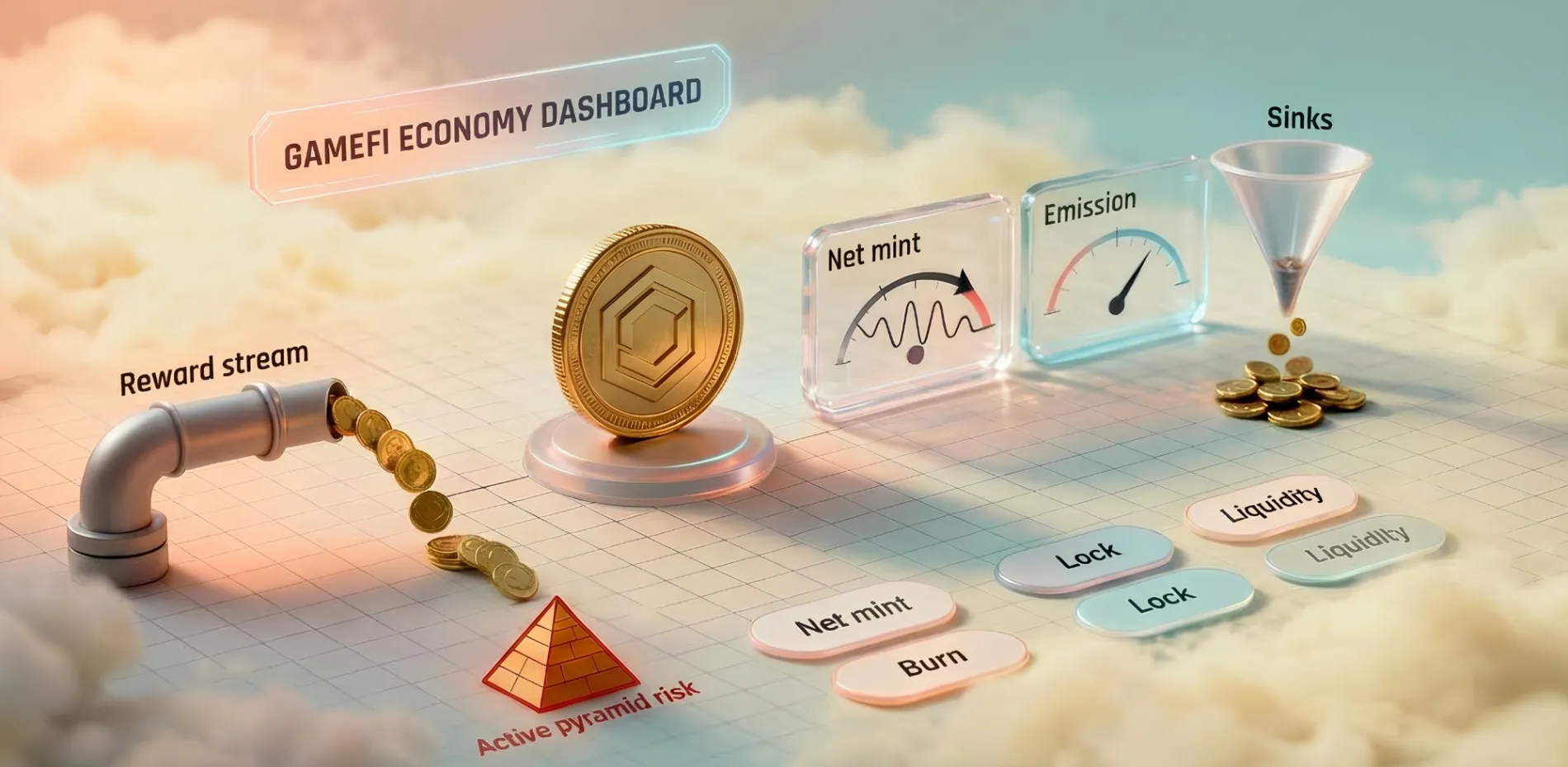
The basic model: where value comes from and where the token goes
A three-flow framework (Mint / Sink / Demand) that shows the source of price pressure: excessive issuance, weak spending, or no reason to hold the token.
- Mint (issuance) — how many tokens appear per day: rewards + reserve unlocks.
- Sink (removal) — how many tokens are burned or locked for a long period: crafting, upgrades, fees, lockups.
- Demand — why the token is bought and held: progress, access to content, competition, cosmetics, governance, speculation.
If Mint is consistently higher than Sink while Demand does not grow with player activity, reward sell pressure becomes constant and the token price tends to drift downward. If demand is supported only by growth expectations, the cycle repeats: growth in active players → growth in emissions → growth in selling → price decline → reward and spending adjustments.
Sustainable demand more often forms when the token is embedded in progression (upgrades, access, tournaments) and consumed regularly, rather than only distributed as a reward.
| What to check | What it shows | Red flag |
|---|---|---|
| Reward emissions mint/day |
The speed of supply growth | mint/day is rising, while burn/day and in-game spending are not rising with activity |
| Burning and fees burn/day |
The strength of permanent token removal | removal is rare, voluntary, or weakly connected to progression |
| Token demand use-cases |
Reasons to buy and hold | the token is needed almost only for withdrawal and sale |
| Vesting unlocks | Supply growth from reserves on a schedule | large unlocks are close, while liquidity and demand are weak |
| Liquidity | The ability to exit without heavy slippage | low volumes, high price impact, a single market |
Key idea: the sustainability of a GameFi economy is determined by the Mint, Sink, and Demand trio, not by the promoted reward yield.
How to calculate token inflation: net mint and daily inflation formulas
Two formulas that turn “inflation” into numbers: net mint and the share of net mint in circulating supply.
In GameFi, token inflation usually means growth in circulating supply caused by rewards and unlocks. Supply growth creates price pressure if in-game spending and token-buy demand do not absorb the volume of new tokens. The basic pressure metric is net mint, the difference between issuance and burn over a period.
Formulas:
| Net mint | = | Mint − Burn |
| Daily inflation | = | Net mint / Circulating supply |
These two calculations are enough to reveal the source of pressure: with positive net mint, supply is growing, and that difference must be absorbed by token purchases or regular in-game spending.
Calculation example
Given: issuance of 10M tokens per day, burning of 3M tokens per day through upgrades and fees.
Calculation: net mint = 7M tokens per day. With a circulating supply of 500M, that is about 1.4% per day.
The next step is to compare the value of rewards distributed and the value of in-game spending over the same period. If rewards significantly exceed spending, the gap is usually closed by selling the token on the market.
Two reference points for flow imbalance:
- $1M in rewards per day with around $150K in in-game spending per day creates $850K in daily sell pressure if there is no comparable buy demand.
- Growth in player activity where mint/day outpaces burn/day and in-game spending usually leads to a price decline before activity itself starts to fall.
Reference point: net mint dynamics are especially visible during seasonal launches and major updates, because mint/day often outpaces changes in sinks and use-cases.
Key idea: net mint and daily inflation provide a numerical estimate of inflationary pressure and make it possible to compare games within one framework.
Reward emissions: endless printing or a rule-based budget
Three emission models and their risks: unlimited issuance, a fixed pool, and dynamic reward-rule adjustments.
Reward emissions are the issuance of new tokens to players for activity (quests, battles, rankings, resource farming, seasonal missions). Imbalance begins when reward issuance grows with the number of players, while limits on mint/day are absent or activated only “after overheating.” In that model, circulating supply grows faster than sinks and demand, so sell pressure becomes constant.
Three common emission models and their risk point:
- Unlimited rewards — issuance is proportional to farming: whatever is earned is issued. Risk: mint/day scales with player activity and accelerates inflation.
- Fixed reward pool — a set amount is distributed per day or per week. Risk: reward per player falls as activity grows, but total mint/day remains controlled.
- Dynamic emissions — rules adjust mint/day based on conditions (player activity, price, spending volume, seasons). Risk: opaque rules are perceived as manual “cuts” and reduce trust.
Controlled models often use seasonality: rewards are defined by a season budget rather than issued “as long as activity exists.” That limits mint/day during periods of player growth and reduces the risk that reward issuance starts to outpace sinks and use-cases.
Check: whether there is a rule that limits mint/day when player activity rises 2–3x. Without such a rule, audience growth automatically accelerates emissions.
Key idea: reward sustainability starts with mint/day limits and clear rules for recalculating the budget.
Token inflation: imbalance signals before the price falls
Early signs of pressure: rising reward withdrawals, a declining role of in-game spending, and repeated seasonal drawdowns.
In GameFi, inflationary pressure more often looks like a flow imbalance: the reward token reaches the market faster than buy demand or mandatory in-game spending can form. In that imbalance, reward selling dominates, so price declines even when player activity remains stable.
| Early signal | What it indicates |
|---|---|
| Token withdrawals are rising faster than in-game spending | reward tokens are moving to the market, while sinks do not remove a comparable volume |
| The value of in-game purchases is declining | content and pricing are being made “cheaper” to retain activity when token demand is weak |
| Regular seasonal drawdowns | season endings trigger reward realization and repeated waves of selling |
| Discussion focus shifts to ROI | demand is driven by payback expectations rather than by token use inside gameplay |
Inflation is not always destructive: an inflationary currency can work if the token is regularly consumed by sinks and is needed for progression. The critical risk appears when three factors combine: high mint/day, weak mandatory spending, and no use-cases that remain when reward yield falls.
Red flag: trying to stabilize the system only by cutting rewards. Lowering mint/day reduces price pressure, but also removes the activity incentive if sinks and use-cases do not create independent demand.
Key idea: GameFi inflation is measured through mint/day and burn/day, while early signals appear in the gap between reward withdrawals and in-game spending.
Sink mechanisms: what reduces pressure permanently, and what only delays selling
Separating sinks into hard and soft shows whether supply is reduced permanently or the token is only temporarily locked.
Sink mechanisms are ways to remove a token from circulation or restrict its use for a long period. An effective sink is embedded in progression: upgrades, crafting, consumables, paid mode entries, and fees work best when they repeat across most active players.
The useful split for analysis: hard sink (burns permanently) and soft sink (locks or moves tokens to the treasury).
Hard sink — the token is burned and disappears from supply: crafting, upgrades, minting, mode entry with burn, fees with burn.
Soft sink — the token is locked or moved to the treasury: staking, lockups, deposits, fees without burn. A soft sink reduces current selling, but does not reduce total supply.
Sustainable economies are built around the cost of progression: if efficiency requires regular token spending (repairs, upgrades, consumables), sinks work continuously and scale with player activity.
| Sink type | How it works | What effect it creates |
|---|---|---|
| Upgrades and crafting burn |
the token is spent on improvements and burned | reduces net mint and inflationary pressure |
| Market fees fee + burn |
a percentage of trades is partly sent to burn or the treasury | removes part of turnover and smooths overheating |
| Staking and lockups lock |
the token is locked for bonuses and access | reduces selling in the short term, but does not reduce supply |
| Entry tickets spend |
payment for participation in modes, events, and tournaments | creates recurring demand to buy the token |
The share of active players who use sinks regularly. If use is infrequent, burn/day and in-game spending have little impact on net mint.
Key idea: a sink stabilizes the economy when it is mandatory for progression and creates mass burn/day or mass recurring spending.
Token demand: reasons to buy and hold without “earning”
A demand check without hype: which use-cases remain when reward yield falls and market interest declines.
Token demand answers one question: why the token is bought or held if the reward no longer provides quick payback. In GameFi, demand sources are mixed, but their stability differs.
Three demand-scenario checks:
- Utility demand — the token is needed for progression (upgrades, crafting, access).
Check: whether token purchases continue during a temporary decline in reward yield.
Negative answer: the token is perceived as “salary,” not as a progression resource. - Social-competitive demand — the token is needed for rankings, tournaments, or clan goals.
Check: whether there are recurring reasons to spend the token for competitive outcomes.
Negative answer: the competitive layer does not create demand and does not support sinks. - Investment demand — the token is held because of growth expectations and narrative.
Check: whether demand remains when market interest declines.
Negative answer: demand depends on the external market and is not tied to gameplay.
Utility demand is usually the most sustainable because it is tied to in-game actions rather than market expectations. If demand is sustained mainly by a “growth narrative,” the token becomes vulnerable when attention shifts away from the project.
Strong signal: token buying continues during a drop in yield because the token is needed for content access, faster progression, or participation in game modes.
Key idea: the more use-cases are tied to progression and recurring spending, the less the economy depends on investment demand.
Reward token vs value token: why a two-token model does not solve flow imbalance
Two tokens distribute roles, but sustainability is still determined by reward emissions, sinks, player activity, and demand for use-cases.
Many GameFi projects use a two-token structure to separate rewards and long-term value between different assets. That design reduces pressure on one token, but it does not eliminate the imbalance of mint/day, sinks, and demand.
The point of the model is to separate the reward flow and long-term rights/status:
Reward token (reward token)
Most often inflationary: reward issuance creates constant mint/day, and reward realization turns part of that issuance into market selling.
- Function: to stimulate activity in the short term.
- Source of pressure: high mint/day and regular reward selling.
- Condition for sustainability: mandatory spending embedded in progression that creates comparable burn/day or in-game consumption.
Value (governance) token (participation token)
Usually limited in issuance and tied to rights, access, or status, but its value depends on player activity and trust in the reward economy.
- Function: rights, access, status, long-term bonuses.
- Source of pressure: declining player activity and declining trust in tokenomics.
- Condition for sustainability: reasons to hold the token when yield falls (use-cases, access, status mechanisms).
The model “reward falls, value holds” works only with stable player activity and demand for the use-cases of both tokens. A sharp decline in the reward token reduces the incentive to play, lowers activity, and reduces demand for the value token through falling trust and shrinking player activity.
Observation from P2E cycles: reward tokens often fell faster than governance tokens, but when motivation to play declined, player activity dropped, and governance tokens lost support along with the ecosystem.
Key idea: the number of tokens does not define sustainability; emissions, mandatory spending, and in-game demand do.
Vesting unlocks: delayed emissions on a schedule and pressure windows
Unlocks increase supply on a schedule: analyzing allocations, the unlock schedule, and liquidity shows the risk of supply overhang.
An unlock is the moment when tokens in lockup become available to holders (team, investors, ecosystem funds). Unlocks act as delayed emissions: circulating supply grows regardless of current reward mint/day.
A large unlock creates price pressure if the unlock size is comparable to daily trading volume or exceeds market depth in pools/order books.
Three unlock checks that often coincide with drawdowns:
- Unlock recipients — team, early investors, funds, or the community. A high share allocated to the team and early investors increases the risk of selling during the unlock window.
- Unlock shape — cliffs and “jumps” create sharper pressure than a smooth linear schedule.
- Exit liquidity — a large unlock during low trading volume usually leads to slippage and a faster price decline.
What to watch on the calendar: upcoming unlock dates and volumes, the share of “insider” allocations, and whether unlock dates coincide with seasons and updates, because selling volume often rises during those windows.
Sharp moves more often come from a combination of a large unlock + thin liquidity + declining player activity. In that window, buy demand is weaker while available supply grows on schedule.
Increased marketing before an unlock is worth verifying against the unlock calendar and trading-volume data, because rising interest can coincide with rising available supply.
Key idea: unlocks are emissions distributed over time; analysis without an unlock calendar underestimates supply pressure.
Liquidity: why the “chart price” is not the exit price
Liquidity determines the exit price: volumes, depth, and the number of markets show the risk of slippage when selling rewards.
Liquidity is the ability to buy or sell a token without noticeable price impact. In GameFi, problems often arise not because of the price level, but because selling a reward-sized volume causes heavy slippage in a thin market.
Mini-scenario: the chart shows “stability,” but market depth is low. When rewards are sold, the first orders quickly absorb demand, the price shifts downward, and the average sale price ends up noticeably below the quoted price.
Three liquidity checks:
- Stable trading volume — the norm over several days matters more than a one-time spike after news.
- Pool/order-book depth — if a small volume moves the price noticeably, slippage will be high.
- Number of markets — multiple pools/exchanges reduce the risk of a “trapped exit” when one market has a problem.
In weak economies, liquidity looks sufficient until most holders start selling rewards at the same time. When sellers exit in sync, the market cannot absorb the selling fast enough, so the price decline accelerates.
Red flag: high advertised reward yield with low market depth. That combination means the model looks more stable in the interface than under mass selling.
Key idea: liquidity determines the exit price; analysis without assessing depth and trading volume ignores slippage risk.
The “active-user pyramid”: signs of a model that depends on a flow of newcomers
Diagnosing a model that “depends on newcomers”: signs that rewards and demand rely on a constant inflow of new money.
The “active-user pyramid” is a dynamic where the economy looks functional while the number of players and initial entry spending (NFTs, characters, land) keeps growing. When growth slows, token demand and in-game spending fall, while reward selling starts to dominate.
Red flags:
- The main revenue source is entry (NFTs/characters/land), while reward payouts effectively depend on newcomer money rather than on in-game revenue and token consumption.
- Communication focuses on ROI, payback, and “farming”, not on balance, retention, and content that creates in-game demand.
- Rewards grow faster than in-game spending and revenue from content/services.
- When player activity declines, rewards are cut sharply because there is no source of demand and spending that absorbs emissions.
Test: the scenario of “30 days without audience growth.” If token demand remains because of progression, content, competition, and mandatory spending, the model is closer to sustainable; if demand disappears along with the flow of newcomers, the model is closer to pyramid-like dynamics.
Key idea: an economy that requires a constant inflow of new buyers to pay rewards is structurally vulnerable when player growth slows.
Checklist: evaluating a GameFi economy
The final filter: points that help capture the risks of emissions, sinks, unlocks, and liquidity.
- Token role: in-game use scenarios beyond withdrawal and speculation. The absence of progression, access, or competitive use-cases means weak Demand.
- Reward emissions: whether mint/day limits, seasonality, dynamic adjustment, and anti-farming protections exist. Unlimited emissions without control usually accelerate circulating supply faster than sinks.
- Net mint: mint/day − burn/day and the share of net mint in circulating supply. Persistent daily inflation quickly becomes visible over a span of weeks.
- Sink mechanisms: whether sinks are mandatory for progression and used at scale. Voluntary and rare spending rarely creates meaningful burn/day.
- Vesting unlocks: upcoming dates, volumes, and the shares allocated to the team and investors. Large unlocks increase supply regardless of player activity.
- Liquidity: stable volumes, market depth, and alternative venues. A thin market means high slippage when rewards are sold.
- Sustainability without growth: a scenario of stagnant player activity and simultaneous reward selling. The absence of internal demand in that scenario means structural fragility.
- Audience motivation: the dominance of ROI and “farming” in discussions instead of content and progression points to Demand being driven by payback expectations.
3–4 Systemic risks in the checklist usually indicate a model better suited to a short-term experiment than to a sustainable economy.
Key idea: the checklist does not guarantee an outcome, but it identifies the causes of token and player-activity declines through mint/day, sinks, unlocks, and liquidity flows.
Industry cases: what Axie, STEPN, Pixels, and Big Time teach
Four cases with recurring patterns: where flow imbalance creates inflation, where seasonality helps regulate emissions, and what to check before entering.
GameFi has gone through several cycles of growth and overheating. The cases below show the causes of imbalance in mint/day, sinks, and demand regardless of genre and audience.
Axie Infinity: rewards without a sufficient sink accelerate inflation
An early pattern: rewards are high, entry is expensive, and token demand depends on audience expansion. When growth slows, reward sell pressure becomes visible.
- Trigger: player growth slows while reward mint/day remains high.
- What breaks: reward selling becomes the dominant flow, and price falls under constant supply pressure.
- What to check: whether the main sink depends on a single mechanic (for example, breeding or crafting), because a single consumption point creates a bottleneck.
Lesson: a sink stabilizes the economy when it is distributed across progression and repeated at scale, rather than relying on a single mechanic.
STEPN: mass farming scales emissions faster than demand
Move-to-earn showed how mint/day scales: when millions of players perform one action for a reward, emissions grow with player activity, while demand and spending often lag behind.
- Trigger: the reward is tied to a simple repeatable action (farming “by step/button”).
- What breaks: sell-side pressure becomes constant even with added repairs, minting, and extra spending.
- What to check: whether issuance limits, anti-abuse measures, and emission “caps” exist from day one rather than only after overheating.
Lesson: the simpler the farming mechanic, the stricter mint/day limits and mandatory sinks must be.
Pixels: seasonality and in-game value help preserve balance
Newer projects more often move away from “salary-like” distribution toward seasons, progression, and goals. When the token is needed for content access and upgrades, Demand remains more stable as hype declines.
- Sustainability trigger: the token is regularly consumed inside the game through content, progression, and activities, not just withdrawn.
- What stabilizes: planned reward rebalancing through seasons instead of emergency cuts to mint/day.
- What to check: whether in-game spending grows with player activity, or whether only reward issuance grows.
Lesson: seasonality provides a manageable emission budget and reduces the risk of abrupt adjustments that break motivation.
Big Time: a fair launch reduces insider overhang risk
An approach that distributes the token through gameplay reduces the share of closed allocations, so the risk of sharp unlocks is lower. Even so, the balance of mint/day, sinks, and Demand remains the decisive price factor.
- Model advantage: fewer sharp sell-offs from large closed unlocks and a lower risk of supply shocks.
- What remains a risk: mint/day exceeding sinks and demand still creates price pressure even with a fair launch.
- What to check: the reasons to hold the token when yield falls (use-cases, progression, access, status).
Lesson: a fair launch increases trust, but sustainability is still determined by emissions, sinks, and demand for use-cases.
Key idea: GameFi patterns repeat: sustainability emerges where emissions are controlled by budget, sinks scale across most active players, and Demand is tied to gameplay.
FAQ on GameFi game economics
Short answers to common questions: emissions, net mint, sink strength, the impact of unlocks, and the risk of thin liquidity.
What matters more in GameFi: token price or the speed of reward emissions?
In short: more often, the speed of emissions matters more, because mint/day creates systemic reward sell pressure.
In practice: when mint/day rises without growth in sinks and Demand, reward selling becomes the dominant flow. To check this, it is enough to compare mint/day, burn/day, and in-game spending over the same period.
How can inflationary pressure on the token be identified?
In short: calculating net mint and its share of circulating supply shows the scale of daily inflation.
In practice: net mint = mint/day − burn/day, then daily inflation = net mint / circulating supply. Positive net mint means supply is growing and must be absorbed by Demand or regular in-game spending.
Which sink mechanisms are considered strong?
In short: strong sinks are used at scale and mandatory for progression, because they create regular burn/day or regular token consumption.
In practice: upgrades, crafting, mode entry, and fees with burn work best when efficiency falls or access is blocked without them. Rare voluntary spending usually does not scale.
Why does a two-token model not guarantee sustainability?
In short: both tokens depend on player activity and trust in the reward economy.
In practice: a falling reward token reduces the incentive to play, shrinks player activity, and reduces demand for the value/governance token through weaker use-cases. Sustainability is still determined by the balance of emissions, sinks, and demand.
How do vesting unlocks affect token price?
In short: unlocks are delayed emissions that increase supply on a schedule.
In practice: a large unlock with weak liquidity increases the chance of a drawdown: supply rises while market depth stays the same. For evaluation, it is enough to compare the unlock size with trading volume and market depth.
What is thin liquidity, and why is it dangerous?
In short: thin liquidity means the market cannot absorb selling without a noticeable price drop.
In practice: with low volume and weak depth, even a small sale creates heavy slippage, so the “yield” shown in the interface does not match the average sale price. To check this, it is enough to look at daily-volume stability and pool/order-book depth.
How can an “active-user pyramid” in GameFi be recognized?
In short: the key sign is that reward payouts and token demand depend on a constant inflow of newcomers and entry money.
In practice: a sharp cut in rewards when player activity declines means there is no internal demand and spending absorbing emissions. Sustainable games preserve demand through progression, content, and mandatory spending even when the audience plateaus.
Key idea: FAQ answers all come back to checking the balance of mint/day, sinks, unlocks, and liquidity, because that balance determines supply pressure.
Final conclusion: what GameFi economics stand on
One framework instead of “gut feeling”: token value depends on controlled emissions, mandatory spending, and stable demand for use-cases.
A sustainable GameFi economy rests on balanced flows: emissions are set by rules and budget, sinks are embedded in progression and create recurring spending, and Demand is supported by in-game use-cases. In that case, the token keeps its role as a resource even when market interest declines.
A weak model depends on audience growth: rewards are issued without mint/day limits, spending remains voluntary and rare, and the main incentive is selling the reward on the market. When player growth slows, supply pressure becomes the dominant flow, and price falls first.
Two factors intensify the risk: unlocks increase circulating supply on a schedule, while thin liquidity worsens the average sale price through slippage.
Lesson: GameFi evaluation is built on five checks:
Key idea: over a span of weeks, the value of a reward token is determined by whether net mint is absorbed by in-game spending and buy demand.