KYC on a crypto exchange can get stuck because document checks stop, selfie validation is not completed, or the case waits in a manual review queue at the compliance provider. In most cases, the status can be moved if you stay inside the exchange’s requirements and verification flow.
A stuck KYC case is identified by the verification status in the account profile, the set of active requirements and the restrictions the system applies until a completed verification step is recorded.
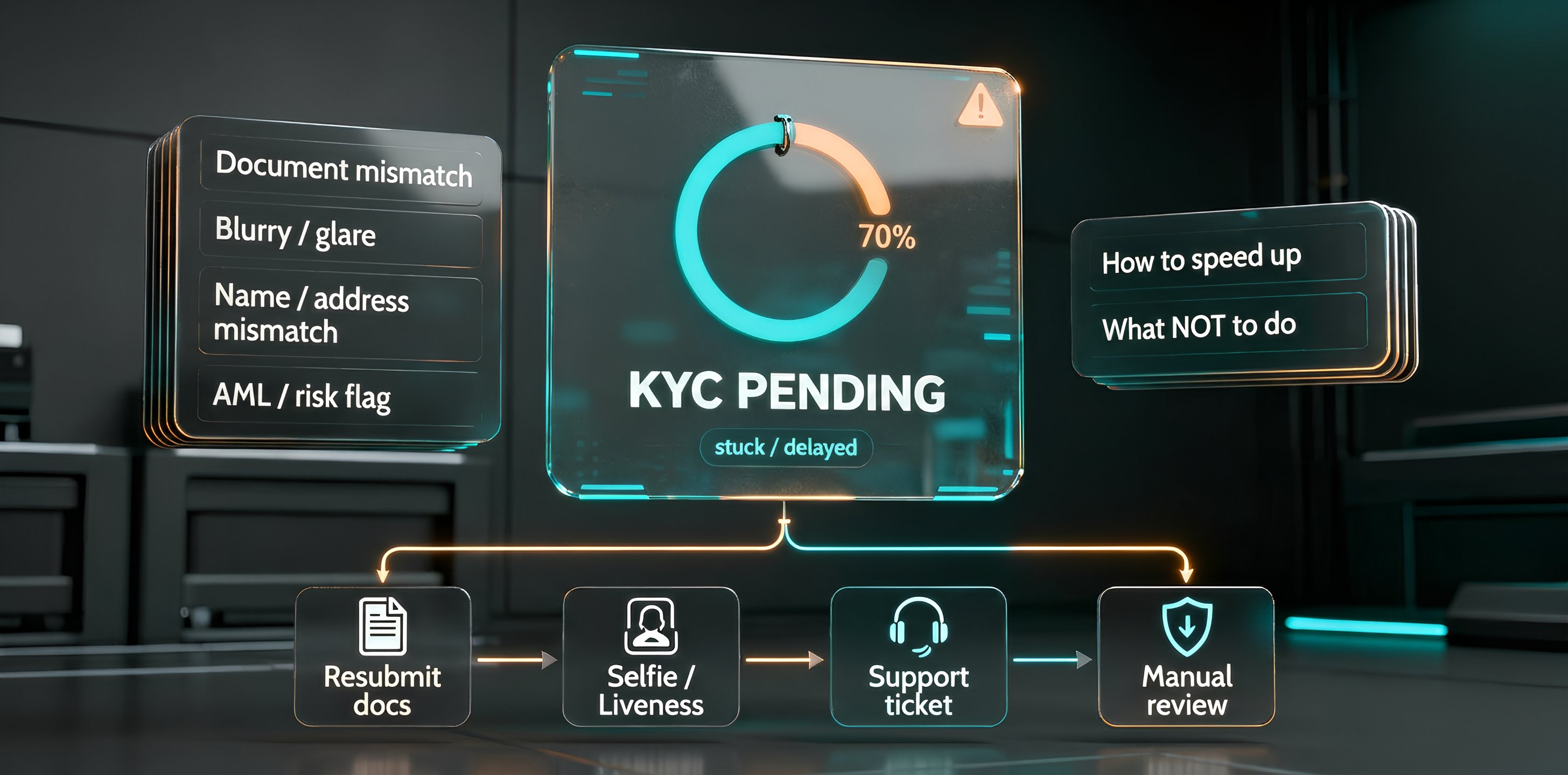
🧩 Why KYC on a crypto exchange can get stuck and stop changing status
KYC status stops updating when a specific verification task is not closed at the verification provider, or when the verification result has not been applied to the account profile on the exchange side.
| Cause | What exactly is not completed | How it appears in the account |
|---|---|---|
| Automated check | The document data extraction or matching step has not received a final status | Pending or Under review without a Resubmit request |
| Manual compliance queue | The task has been handed to an operator and is waiting for processing | Long Under review status with no change in requirements |
| Profile update | The verification result has not been applied to the account | Restrictions remain even though KYC is formally completed |
In all cases, the system is not simply “waiting for a decision”; it is holding the account on a specific unfinished task, and that task is always reflected either in the verification-step status or in the state of profile restrictions.
🛠️ What you can do safely to move KYC forward
KYC status changes only after actions that create an event in the KYC provider’s system or cause an update to be applied to the account profile on the exchange side.
🔍 Record the current verification state
This step is needed to determine exactly which verification task remains open and which actions the system can link to that task.
The KYC page in the account profile shows the status of a specific verification step, and that status corresponds to a separate task at the verification provider or in the compliance queue.
If the status and requirements are not recorded accurately, later actions may miss the active task and fail to change the verification state.
- Record the exact KYC step status without paraphrasing or generalizing.
- Check whether the interface asks for Resubmit or liveness.
- Check whether account restrictions remain while the status is unchanged.
- Check whether the requirements list changes after refreshing the profile page.
The result of this step is a recorded verification status, a list of active requirements and confirmation that account restrictions are still in force.
📤 Complete the action the system actually counts
This step is needed to create a new verification event that will be recorded by the provider and applied to the account profile.
When Resubmit is active, the document upload must be done only through the KYC interface, because this channel links the file to the verification task and records the result.
For liveness, the selfie check must be completed through the final confirmation screen so that the session receives completed status and the verification step can be closed.
- If Resubmit is requested, upload one document of the same type shown in the account profile.
- Check that the document number and date of birth are readable, with no glare or cropping.
- For liveness, complete the selfie check inside the exchange app through the final confirmation.
- Create one support ticket with the account identifier and the current KYC status.
The result of this step is recorded as a change in active requirements, a verification status change, or the lifting of restrictions in the account profile.
🚫 What does not speed up KYC and often only interferes with verification
The following actions do not close the active identity-check step and are not recorded in the KYC provider’s system as completed, so the account status remains unchanged.
| User action | Which verification step is not closed | Where it is recorded |
|---|---|---|
| Uploading documents again without Resubmit | Document check and data matching | KYC page: Pending or Under review without new requirements |
| Sending documents or selfies through support | Document verification or liveness step | The ticket does not create an event in the KYC pipeline |
| Uploading a different document type without an interface request | Document type validation | The task is moved into manual review |
| Creating several tickets for one account | The original compliance task | KYC status is held without changes |
| Repeated liveness attempts without a request | Selfie identity check | Sessions are marked incomplete at the provider |
| Logging back into the account or refreshing the page | Any KYC step | Only the interface display changes |
If an action does not close a specific verification step and does not create a completion event in the provider’s system, the account profile does not receive an update and KYC status does not change.
⏳ When waiting is unavoidable
In these scenarios, KYC status on a crypto exchange does not change after all available actions are completed, because the active verification step is closed by an internal compliance decision and does not accept user events.
🕒 Manual review by compliance
Waiting is unavoidable when the KYC task has been moved to a manual queue and excluded from automated data matching.
After transfer to the manual queue, the system records the verification task as requiring an operator decision and keeps the account in Under review until a compliance operator checks the documents, selfie and profile data and records the final verification result in the KYC provider’s system.
| Object | Action | Recording point |
|---|---|---|
| KYC task | Transfer to manual queue | Under review status |
| Account profile | Restrictions retained | Restricted access |
| Operator decision | Task closure | KYC status update |
- The KYC page shows Under review without active Resubmit or liveness requirements.
- Uploading documents again does not create a new verification event in the provider’s system.
- Account restrictions remain until the decision is applied to the profile.
The phase ends only after the operator closes the task and the verification result is applied to the account profile.
🏛️ Additional checks under regulatory rules
Waiting is required when the system starts additional profile validation that is not shown as a separate step in the KYC interface.
This check is performed by the exchange or the KYC provider, analyzes whether the account matches internal rules and regulatory requirements, and keeps the profile in verification status until the result is recorded and applied in the compliance system.
| Object | Action | Recording point |
|---|---|---|
| Account profile | Additional validation | Unchanged KYC status |
| Compliance rules | Regulatory check | Restrictions retained |
| System decision | Result application | Profile update |
- Document and profile data go through additional matching outside the user interface.
- The account remains under extended compliance control until the decision is recorded.
- The verification result is applied to the profile asynchronously and is not reflected in the status immediately.
KYC status updates only after the decision is recorded in the compliance system and applied to the account.
🔗 Where KYC is avoided and what risks appear instead
In this article, stuck KYC is treated as a process on a centralized crypto exchange, where the object of verification is the account profile, the action is a compliance-team decision, and the recording point is KYC status plus operational account restrictions.
If the goal is to remove KYC as a cause of account blocking, the trading model must avoid a centralized user profile and avoid manual compliance decisions being applied to account operations.
On decentralized options platforms without KYC, control shifts to the smart contract and protocol parameters, while the result is recorded in protocol settlement and execution of conditions through the liquidity pool.
| Trading model | Control object | Where the result is recorded |
|---|---|---|
| Centralized exchange with KYC | Account profile | KYC status and operational restrictions |
| Decentralized options without KYC | Smart contract and liquidity pool | Condition execution and protocol settlement |
The mechanics of decentralized options platforms without KYC, including smart-contract structure, liability calculation and sources of risk, are covered in a separate guide.