Most token sales become unprofitable not because of a market decline, but because of issuance parameters: high FDV, low free float at TGE, and large unlocks increase supply faster than buyer demand appears.
Why “Down After Listing” Has Become the Norm
A token sale is the sale of tokens to investors before trading begins or at the moment of listing. An ICO sells tokens through the project website, an IEO sells tokens through a centralized exchange, and an IDO sells tokens through a decentralized platform and liquidity pool. After trading begins, the price often makes a short spike because of a shortage of freely circulating tokens, and then declines when new batches of tokens enter the market according to the unlock schedule.
The goal of this material: to explain how tokenomics, Fully Diluted Valuation (FDV), and the vesting schedule create supply pressure after listing, worsen expected ROI (return on investment — expected profitability) for exchange purchases, and which signs help filter out weak offerings before entry.
The key term for post-listing dynamics is TGE (Token Generation Event), meaning the moment the token is issued and starts circulating. On the day of TGE, circulating supply appears — the number of tokens available for trading. Tokens outside circulation remain locked and become available according to the vesting schedule, which is often called the unlock schedule.
- price on the exchange is formed by a small free float (few tokens are in circulation), so even small buy and sell orders move the quote noticeably (the current trade price on the exchange);
- the main part of the issuance (the project’s issued tokens) is temporarily not traded, but will become liquid after unlocks, so expectations of future selling affect buyer and seller behavior in advance;
- unlocks increase token supply, and demand must grow at a comparable pace, otherwise the price falls to the absorption level;
- the public price on listing day often does not account for the future increase in circulating supply.
The gap between a small circulating supply and a large volume of locked tokens creates asymmetry: a small volume trades on the exchange, while public presentations often use FDV (Fully Diluted Valuation) — capitalization calculated as if all tokens were already in circulation.
Pressure is reinforced by token distribution across categories. Private rounds and funds receive large allocations at prices below the public listing price, while retail buyers acquire the token at a price shaped by free-float scarcity and marketing. Every large unlock gives early holders liquid tokens and creates an incentive to sell them on the exchange if the market price is above their entry price.
One missed unlock or incorrect circulating supply changes the FDV calculation and the scale of future supply, so the buyer often ends up with an overvalued asset and a price decline after the first months of issuance.
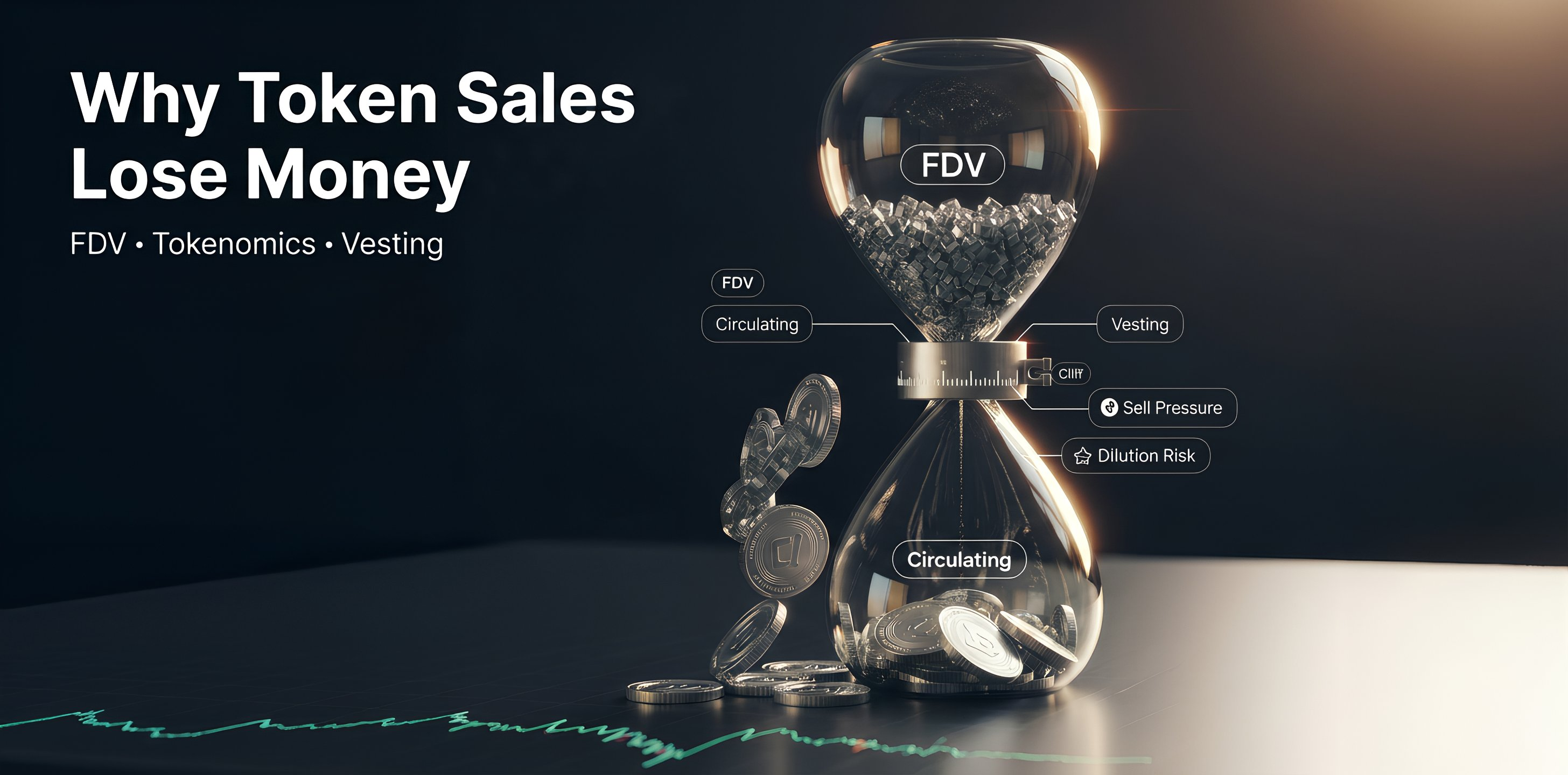
Where to Find Tokenomics Figures: Parameters to Cross-Check Before Buying
An unprofitable listing purchase is often linked to using figures from a presentation without checking issuance parameters in the tokenomics and without accounting for the nearest unlock dates.
Parameters usually recorded in the documentation
- Max supply and circulating supply at TGE. Max supply and circulating supply at TGE define the scale of future supply and make it possible to calculate FDV and the FDV/MC gap correctly (where MC is the market capitalization of tokens in circulation).
- Allocations. Shares for team, investors, foundation, incentives, and liquidity show which categories will receive liquid tokens and may sell them on the exchange.
- Vesting and cliff. Dates and volumes of the nearest unlocks, especially across the 90–180 days after TGE.
- Issuance and rewards. The presence of regular token issuance through incentives and the volume of tokens entering circulation over each period.
- Token utility. The specific function that creates daily demand: product fees, payments, service access, mandatory staking, or participation in governance that affects revenue distribution or protocol parameters.
If the tokenomics does not contain exact figures for max supply, circulating supply, and unlock dates, and instead uses wording like “to be announced later” or “subject to change,” market participants treat the price more cautiously and are more willing to buy only at lower levels even before tokens are actually issued.
After TGE, the price is shaped not by team promises, but by the volume of tokens in circulation, the speed of new token release, and the depth of buy orders in the order book or pool.
What Actually Moves Token Price After TGE
In the first trading days, price is determined by the balance of buy and sell orders under a small circulating supply. With a small free float, even one large order shifts the price noticeably, and further movement depends on how many new tokens enter circulation through unlocks and how much demand can absorb that supply.
1) Supply scarcity at the start of trading
In the first days, only circulating supply trades on the exchange. If circulating supply is 3–10% of max supply, the price often makes a local peak because limit sell orders in the book are exhausted faster. When new tokens enter circulation under the vesting schedule, sellers increase the volume of supply, and the price falls to the level at which buyers can absorb the expanded supply without constant slippage.
2) Speculative demand instead of product demand
At TGE, demand is often formed by buyers purchasing the token with the expectation of reselling it at a higher price, not for use in the product. This demand lasts while price growth is expected. If the token is not needed for paying fees, access, mandatory staking, or another regular function, buying declines after interest fades, and the market is left with growing supply from unlocks and issuances.
See also: IEO and launchpad rules matter for understanding allocations and restrictions, because the distribution format sets the entry price and the token volume participants receive. A comparison of offering formats and typical risks is covered in the article best exchanges with IEO and launchpad platforms.
3) Limited liquidity and shallow market depth
Liquidity is the ability to execute a trade of a given size without a strong price move. At an early listing, the order book is often thin: there are few orders within ±1% of the current price, so an order of noticeable size moves the price by percentage points. A thin book worsens entry and exit prices and increases slippage losses.
4) Expectations of future unlocks
Traders price in the unlock calendar in advance and reduce risk ahead of the event date. If a large unlock is expected in 30–90 days, some participants take profits and reduce buying because additional supply will appear on the exchange after the unlock. The larger the unlock volume is relative to current circulating supply and average trading volumes, the stronger the pressure through selling before and around the date.
High FDV creates overvaluation when circulating supply is small. As more tokens enter circulation through unlocks, the price often declines so that the market can absorb the increased supply.
FDV as a Trap: Why a “Billion-Dollar Valuation” Often Lacks Demand Support
FDV shows capitalization calculated as token price multiplied by max supply. At listing, the price is formed on the basis of a small circulating supply, so the gap between current circulating market cap and FDV is often multiple times over. The larger the FDV/MC gap and the faster circulating supply grows through unlocks, the higher the probability of price decline due to supply expansion.
FDV is useful as a reference point only when token issuance is transparent and user demand for the token is stable. FDV turns into a marketing figure when 3–8% of the issuance trades on the exchange, while 92–97% of tokens will enter circulation according to the unlock schedule without confirmed growth in user demand.
Overvaluation arises from the calculation method. If 5% of max supply is in circulation, the price is formed on that small token volume. At that price, $10 million in circulating market capitalization automatically turns into $200 million FDV, because FDV is calculated as price × total max supply, even though most tokens are not yet traded.
When circulating supply increases, sellers receive new tokens and expand supply in the order book and on DEXs. If buying demand does not grow at a comparable pace to the increase in circulating supply, the price falls because buyers’ limit orders are filled only at lower levels.
Risk becomes stronger when a project advertises a “small current market cap” and does not show the FDV/MC gap. Circulating market cap may look low, but the scale of future supply is revealed only through the combination of FDV, the unlock calendar, the rate of rewards issuance, and the token shares held by categories that receive liquid tokens.
| 🧱 Project | 🚀 Launch Logic | ⚠️ Typical Risk | 🔍 What to Watch |
|---|---|---|---|
| Aptos (APT) | High valuation with low free float | Long correction as circulation grows | FDV/MC, unlock pace, insider share |
| Sui (SUI) | Supply scarcity at launch and high interest | Pressure during the first significant unlocks | Unlock calendar, unlock volume, liquidity |
| Immutable X (IMX) | Listing on hype and inflated expectations | Overvaluation when the market regime changes | Real token demand and ecosystem economics |
| Pixels (PIXEL) | Speculative momentum without sustainable utility | Rapid price loss as supply expands | Token utility, inflation, incentives |
Condition of elevated risk: FDV significantly exceeds circulating market cap, near-term unlocks increase circulating supply by a noticeable share, and the product does not show comparable growth in users, turnover, or fees that create token demand.
High FDV with low free float more often leads to price decline during unlocks, because supply grows faster than the depth of buy orders.
Unlocks create a flow of supply: a one-time calendar event turns into a regular release of tokens into circulation.
Vesting and Unlocks: Why Supply Almost Always Beats Demand
Vesting distributes the release of team, fund, and early-investor tokens across dates. Every unlock increases circulating supply and adds liquid tokens that can be sold on the exchange. The larger the share of tokens in lockup and the closer a major unlock, the higher the probability of price decline because of supply growth.
Vesting: a schedule under which team, fund, and early-investor tokens move from lockup into free circulation.
Cliff: a period with no unlocks, after which tokens start entering circulation in portions or in an even stream.
Public share: the part of the issuance available to the open market at TGE or shortly after, as distinct from tokens still under vesting.
Price charts often show a typical sequence: during the cliff, tokens do not enter circulation, and before the first major unlock date, sellers increase pressure through sales and lower limit prices. Selling pressure often begins before the unlock date because the unlock calendar is available in advance.
An unlock serves two functions. On the technical side, it increases circulating supply — the number of tokens in circulation. On the market side, it gives early holders tokens that can be sold on the exchange. If the sale price is above their private-round entry price, profit remains even if the quote declines further, so early holders still have an incentive to sell tokens on price rises and after rebounds.
Pressure increases with concentrated unlocks: a large monthly or quarterly release adds a large token volume over a short period. For buyers to absorb the release without sharp slippage, the price often declines into a range where the volume of buyers’ limit orders becomes comparable to the release.
| ⏱️ Vesting Signal | 📌 What It Means | 📉 How It Affects Price | 🛡️ How to Account for It in Evaluation |
|---|---|---|---|
| Short cliff | Early holders receive liquid tokens quickly | Peak selling pressure around the first unlock date | Checking unlocks for the 60–90 days after TGE |
| Large unlock on one date | A large token batch becomes available at once | Higher volatility and faster price decline | Including the major unlock date in trade timing |
| Long even unlock | Constant inflow of new supply | Long-term pressure and weak rebounds | Comparing release pace with demand and volume growth |
| High insider share | Most of the issuance belongs to the team and early investors | Selling stretches across months and quarters | Assessing the public share and category distribution |
Vested dump: price decline during unlock periods. The decline can occur without malicious intent: the flow of new tokens reaches the exchange faster than buying demand grows, so price shifts downward toward the level where supply can be absorbed.
An unlock becomes critical when the release volume is comparable to liquidity: the order book widens the spread, and slippage increases execution losses.
Unlock Pressure in Numbers: “% of Circulation” and “Days of Volume”
Unlock pressure is best evaluated not through emotion, but through two measurable ratios: unlock volume relative to current circulating supply and unlock volume relative to average daily trading volume. These ratios show how noticeably supply will grow and how many “days of liquidity” the market needs to absorb the release.
Two key unlock metrics:
1) % of circulating = unlock volume / current circulating supply (share of supply growth).
2) Days of volume = unlock volume / average daily trading volume (the release expressed in daily turnover equivalents).
Step-by-step calculation
- Step 1: determine the current circulating supply and the volume of the nearest unlock in the tokenomics or on an unlock tracker.
- Step 2: calculate % of circulating — what share of current circulating supply is added to circulation by one unlock (unlock volume divided by current circulating supply).
- Step 3: use the average daily volume over 14–30 days and calculate “days of volume” as unlock / avg daily volume.
- Step 4: evaluate liquidity for the target trade size: order-book depth or pool TVL (the total value of assets in the pool) and expected slippage.
- Step 5: record the unlock recipient category (team / investors / rewards), because selling speed differs across holder categories.
Mini example: circulating supply = 100 million tokens, nearest unlock = 10 million tokens. Then % of circulating = 10%. If average daily volume = 5 million tokens, then days of volume = 2. A release equal to 10% of circulating supply and 2 days of turnover often triggers selling before the date, because the release noticeably increases supply and requires several trading days for absorption.
How to interpret % of circulating
- Up to ~3–5%: the release is often absorbed without prolonged pressure if the order book and volumes are stable.
- ~5–8%: the release is noticeable for current circulation, and price decline often begins days or weeks before the date.
- >8–10%: the release is large relative to current circulating supply, and price decline occurs more often, especially under weak volumes.
- Clarification: the calculation uses circulating supply specifically, because a max-supply-based calculation hides the real increase in freely circulating supply.
How to interpret “days of volume”
- < 0.5: the release is often absorbed without a sharp repricing if order-book depth is normal.
- 0.5–2: a zone of elevated risk: volatility rises and selling before the event increases.
- > 2: the release is comparable to several days of turnover, and price more often declines before or after the event.
- Clarification: with a thin order book or low TVL, the same “days of volume” value produces a sharper move because of slippage.
See also: types of unlocks (cliff, linear, stepped), the link between “days of volume” and liquidity, and typical price-reaction scenarios are explained in the material vesting and token unlocks: how unlocks pressure price and liquidity.
Even with the same unlock volume, price reaction differs in timing and strength: some sellers reduce risk before the event, some sell on the event day, and some sell on rebounds after the event. The reaction depends on the unlock date in the calendar, whether the release is distributed evenly or concentrated in one period, and on the category of holders receiving tokens and able to sell them into the market.
- A large one-date unlock causes a sharper move than a series of small ones. When a large token volume becomes liquid at once, supply rises sharply, and the order book cannot absorb it without a price decline, even if the total volume is the same.
- The holder type affects the speed and shape of selling. Rewards unlocks usually create a long background of selling because tokens arrive regularly, while investor unlocks more often lead to a burst of selling around a specific date.
Allocations define the seller queue: a low public share at TGE and cheap private rounds increase the probability of selling after unlocks.
Distribution and Allocations: Why Retail Often Funds Insider Exits
Allocations are the distribution of the entire token issuance across holder categories: team, early investors, funds, incentive programs, and public sale. Allocations show who receives tokens, at what price, and on which dates those tokens move into free circulation.
A low public share at TGE creates free-float scarcity and supports price at the start of trading, while large shares for team and investors form the future stream of supply through unlocks. When price rises, an early holder with a low entry price gets a convenient profit-taking point.
Distribution parameters that determine the supply flow
- Who controls the main share of issuance and on which dates those volumes move into free circulation (team, investors, foundation).
- Public share size at TGE. A low free float accelerates price growth but raises the risk of decline during unlocks.
- Entry-price difference between private rounds and listing: an early holder remains profitable at a lower price, so selling after an unlock remains rational for the early holder even during a correction.
- Number of supply sources. Incentives, funds, marketing, and liquidity create separate token flows that may reach the exchange.
- Transparency of the unlock schedule. Clear dates make it possible to assess issuance, while the absence of dates forces the buyer to price in risk through a lower token price.
Example of the dilution effect: the token trades at $1 with 8% circulating supply and FDV of $1 billion. After one year, circulating supply grows to 20% under comparable demand. To hold the same price, the market must absorb supply that has grown 2.5 times; under stable demand, price more often declines so that new-token volume can find buyers without sharp slippage.
High APR is often paid for with token issuance: rewards increase circulating supply and turn rewards into market supply.
Inflation and Rewards: When “Yield” Turns into Selling Pressure
In addition to team and investor unlocks, a token receives additional supply through emissions for staking, farming, and incentive programs. Such emissions release new tokens on a regular basis, so sellers receive a constant flow of tokens that can be sold on the exchange if utility does not keep the token locked.
Signs that rewards function as issuance
- High APR without a revenue source. If the protocol does not generate fees or revenue, APR payouts most often come from issuing new tokens.
- Weak or non-essential utility. When the token is not needed for daily operations, the rewards recipient sells tokens on the exchange more quickly.
- Ongoing incentive campaigns. If volumes and activity depend on token giveaways, then when giveaways decline, demand weakens while token issuance continues to increase supply.
- Non-transparent issuance pace. If the project does not show issuance volume by period and emission limits, the buyer prices in risk through a lower token price.
- Rewards are not equal to income. Income comes from fees, revenue, or another cash flow, while rewards without revenue increase circulating supply.
- Issuance requires demand growth. If demand does not grow together with issuance, price compensates for excess supply through decline.
- Incentives have a short-lived effect. Incentives often increase activity for weeks, but after the campaign ends, demand falls because the holder’s motivation disappears.
In a thin market, price shifts easily under volume: buying raises the quote, while selling worsens execution through slippage.
Liquidity and the “Thin Market”: Why Early Trading Rarely Gives a Fair Price
In the first days after listing, price is often formed under low circulating supply and limited market depth, so it reflects the structure of the order book and buyer activity rather than a stable level of demand. With low order-book depth and low pool TVL, even medium-sized trades shift price noticeably.
- Limited depth and fragmented volume
- free float at launch is minimal and does not reflect future supply from unlocks;
- liquidity is distributed across exchanges, trading pairs, and DEX pools, so depth in one place may be low;
- a medium-sized order moves price because there are few orders within ±1–2%;
- the first sellers after unlocks quickly increase supply and break the local impulse.
- The typical “pump → FOMO → unloading” scenario
- price rises on a thin book and limited sell volume;
- late buyers join after the rise and push price higher through market orders;
- early holders sell tokens into the rise and increase supply;
- buying happens at impulse prices, while selling happens under worse depth and higher slippage.
- DEX and price impact: price shift caused by AMM
- a DEX liquidity pool often does not contain enough funds for a noticeable trade size;
- buying raises the price inside the pool because an AMM (automated market maker) calculates price from the ratio of tokens in the pool, and buying reduces the reserve of the sold token, making the next token more expensive;
- selling lowers the price inside the pool because the AMM recalculates price by reserves in the opposite direction;
- losses from price impact (the price shift caused by the trade) and fees can produce a negative result even when price moves sideways.
See also: in DEX trades, the key parameters are pool depth, slippage, and price impact, because an AMM (a pricing algorithm based on pool reserves) changes the price inside the pool during order execution. The basic pool mechanics and risks are explained in the article liquidity pools in DeFi.
- Low market depth: one order changes price by double-digit percentages when few orders are present.
- High slippage: execution price is worse than the price at the moment of clicking because of a lack of matching orders.
- Weak arbitrage: price differences between venues persist longer because liquidity and volumes are small.
- Unstable liquidity: disappearing orders and a rapid spread increase (the difference between the best bid and ask) worsen execution even without news.
Display liquidity looks like a dense order book, but disappears when trying to execute a noticeable trade size: the spread widens and slippage grows.
Market Making and Listing: How to Distinguish “Display” Liquidity
At the start of trading, a market maker may place dense orders near the current price and create a narrow spread. Such an order book may look stable on small orders, but on a noticeable trade size the orders are removed or exhausted, so price shifts more than the buyer expects.
Liquidity checkpoints before a trade
- Depth at the target size. Calculation of price shift when buying and selling the planned amount.
- Spread and slippage. The spread shows the difference between the best bid and best ask, while slippage reflects execution losses across several book levels.
- Cross-venue comparison. A long-lasting price discrepancy between exchanges signals weak arbitrage and low real liquidity.
- Volume dynamics in the first 24–72 hours. A one-day surge after listing is often followed by low volume and empty book levels.
- The liquidity illusion breaks at the moment of a large order. Pulled orders immediately widen the spread and increase slippage.
- Thin liquidity raises manipulation risk. Price is easier to move with a series of small orders when there are few matching orders in the book.
Unprofitable token sales repeat the same parameters: low free float, high FDV, and large unlocks in the first months after TGE.
Typical Scenarios of Unprofitable Token Sales
Typical unprofitability scenarios are formed by tokenomics parameters: circulating supply volume, FDV level, and the unlock schedule. These parameters directly affect token supply after listing and set the conditions under which price more often declines.
| 🧱 Scenario | 👀 What It Looks Like | 📉 Why the Loss Occurs | ⚡ How to Recognize It in Tokenomics |
|---|---|---|---|
| High FDV + low free float | 3–8% of issuance in circulation, FDV multiple times higher than MC | Price rises on scarcity, and unlocks increase supply and push price lower | Comparison of FDV/MC and the circulation-growth schedule |
| Aggressive unlocks in the first months | Short cliff and large monthly unlocks | Unlocks give sellers liquid tokens earlier than sustainable demand appears | Check the unlock calendar for the next 90–180 days |
| Token without sustainable utility | Buying for resale, minimal product use | Demand fades after hype, while supply continues to grow | Record the token’s role in the product’s daily operations |
| Too large an insider share | Team and funds control a significant share of issuance | Early holders sell after unlocks because of their low entry price | Assess team/investor shares and vesting terms |
| Low liquidity at launch | Thin order book, small pools, high slippage | Buying and selling at real size worsen execution price | Compare depth and execution at target trade sizes |
Project price histories repeat one formula: scarcity of circulating supply at TGE creates a peak, and unlocks and emissions later increase supply and push price lower.
Cases: How Tokenomics and Unlocks Show Up in Real Projects
Aptos (APT): High Valuation and a Long Correction
Aptos launched with a high valuation and low free float, so the listing price was formed on a small amount of supply on the exchange.
- small circulating supply limited the number of tokens available for sale and accelerated price growth in the first days;
- FDV grew to multiples of circulating market cap because of the low share of tokens in circulation;
- unlocks increased circulating supply and added sellers after release dates;
- price growth was more often used for profit-taking by early holders who received tokens at a lower price.
Pixels (PIXEL): Momentum Without Sustainable Utility
PIXEL showed strong momentum that depended on speculative buying and was not supported by daily token demand.
- price growth was supported by expectations and speculative buying after listing;
- buying weakened after the momentum faded because the token is rarely needed by the user on a daily basis;
- limited utility led to the sale of rewards and unlocked tokens on the exchange;
- expanding circulating supply pressured price under weak demand depth.
Arbitrum (ARB): Strong Product and Long Supply Overhang
ARB is tied to active network usage, but tokenomics with large vesting shares created long-term supply pressure.
- the product value of the network supported interest, but token price depended on the release of tokens into circulation;
- large token shares remained locked and moved into circulation according to the schedule;
- each unlock date increased circulating supply and added sellers;
- price reacted to unlock expectations and to the volumes the market could absorb in the order book.
Checking tokenomics before buying often provides more value than trying to guess the “perfect listing”: FDV, unlock, and liquidity parameters show risk in advance.
How to Reduce Risk: Minimum Due Diligence Before Joining a Token Sale
Due diligence in the context of a token sale is the review of issuance, unlock, and liquidity parameters that determine how fast token supply grows and whether market depth can absorb it after listing.
Minimum due diligence checklist
- Record token utility and the source of demand without tying it to price growth and giveaways: fees, access, mandatory staking, or another daily use case.
- Compare FDV and circulating market cap while recording the FDV/MC gap.
- Check the unlock calendar for the next 90–180 days and write down unlock volumes by date.
- Assess the token share held by team and investors and their release schedule (cliff and linear vesting).
- Check order-book depth or pool TVL at the target trade size and estimate slippage.
- Record the rate of rewards issuance and the volume of tokens added to circulation by period.
- Assess product traction (actual use and demand) through measurable metrics: active users, turnover, fees, or revenue, if the metric is available.
Practical check: if the nearest unlock equals the average weekly trading turnover, the order book needs additional buying demand to absorb the release; without that demand, price more often falls to the level where buyers agree to absorb the larger supply.
After listing, the same questions appear: why price falls, how to read FDV, and when unlocks will create stronger pressure.
FAQ: Common Questions About Token Sales, FDV, and Vesting
Why does a token often fall right after listing even if the project looks strong?
The listing price is formed on a small circulating supply, so a shortage of tokens for sale pushes the price higher. When unlocks and emissions increase circulating supply, sellers add supply, and the price falls into the range where buying volume can absorb the release without constant slippage.
Is FDV more important than market capitalization?
Market capitalization shows the valuation of tokens in circulation, while FDV shows the valuation at max supply. To assess dilution risk, the important factors are the ratio of FDV to the market capitalization of tokens in circulation (FDV/MC) and the schedule by which tokens enter circulation, because unlocks increase supply and change the balance in the order book.
What is more dangerous for price: a short cliff or a long even unlock?
A short cliff concentrates the release and creates a peak in supply around one date. A long even unlock adds supply continuously and creates prolonged pressure if demand does not grow. In both cases, the evaluation comes down to comparing the release pace with liquidity and average trading volume.
Is it possible to profit from token sales consistently?
A more stable outcome is usually produced by tokens with moderate FDV, a transparent unlock calendar, a sufficient public share at TGE, and utility that creates daily demand. Without these conditions, growth in circulating supply through unlocks and emissions worsens the profitability outlook for buying at listing.
How to tell that liquidity is insufficient?
Insufficient liquidity is visible through a wide spread, noticeable slippage at the target trade size, and a small number of orders within ±1–2% of the current price. If a trade of the planned size moves price, the current quote remains indicative rather than executable.
Does an unlock always mean a price drop?
An unlock increases circulating supply and raises the probability of pressure, but a price drop is not guaranteed. Price can hold if buying demand grows faster than the release, order-book liquidity is sufficient to absorb it, and the release is already priced in by the market without triggering an additional selling wave.
Is there an “ideal” risk-free token sale?
Fully balanced token sales hardly exist. Every offering contains trade-offs between valuation, the share of tokens in circulation, the unlock schedule, and liquidity at the start of trading.
In practice, the issue is not the absence of drawbacks, but how limited those drawbacks are in scale and duration. The lower the supply pressure and the more transparent the issuance parameters, the lower the risk of a sharp price decline after listing.
✅ What Actually Decides the Fate of a Token Sale
At listing, supply mathematics decides the outcome: scarcity at TGE is often replaced by growth in circulating supply from unlocks and emissions.
The unprofitability of token sales for the retail buyer is often explained by issuance parameters. Low free float at TGE pushes price higher on scarcity, high FDV creates an inflated valuation on a small circulating supply, and vesting and rewards increase circulating supply and add sellers to the market.
Even with a strong product, token price often declines when the volume of tokens entering circulation grows faster than the depth of buy orders. Every price rebound often coincides with sales by early holders, because early holders receive tokens at a lower price and receive liquid tokens on unlock dates.
- Price at launch is formed on a small free float and easily moves above the level supported by sustainable demand.
- FDV grows mechanically under low circulating supply and is often not supported by buy volume.
- Unlocks increase circulating supply and add supply to the order book and DEXs.
- Early holders have an entry-price advantage and more often sell tokens after unlocks.
- Token utility must create daily demand, otherwise supply from unlocks and rewards dominates.
A rational token-sale participation strategy relies on checking max supply, circulating supply, FDV/MC, the unlock calendar, allocation shares, and liquidity, because these parameters define supply and trade executability. Such a check reduces the probability of buying a token whose supply grows faster than demand in the first months after TGE.