📖 OKX User Experience: What Users Praise and Where Problems Arise
This review of OKX user feedback from the past 12 months is based on recurring usage patterns: interface, fees, withdrawals, support, P2P transactions, and everyday trading.
The analysis shows which scenarios earn OKX consistent praise, where delays and restrictions tend to appear, and which conditions are most often linked to account freezes, repeated verification, and lengthy contact with support.
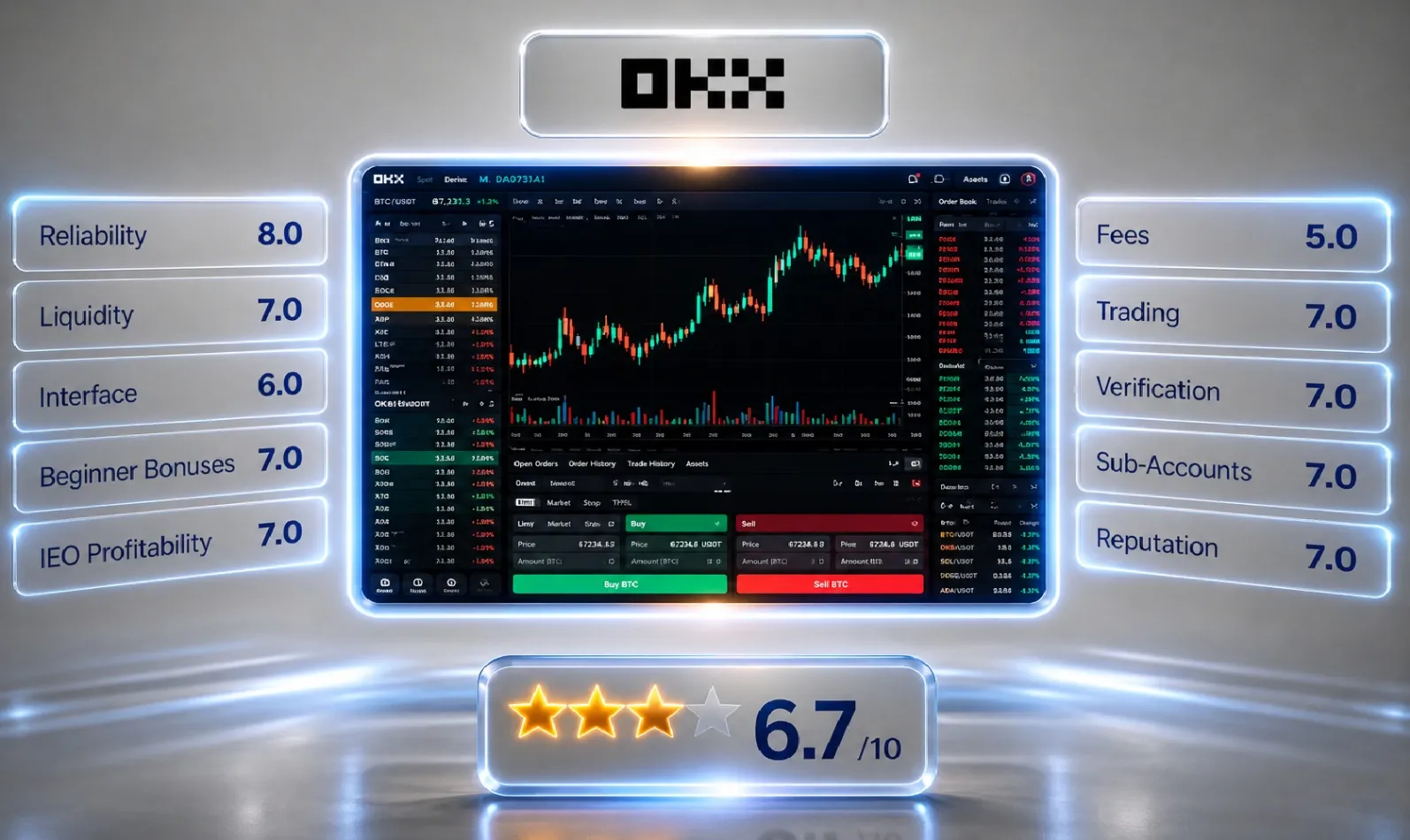
📘 OKX Overview: Platform Profile and Ecosystem
The OKX ecosystem includes an exchange terminal, mobile apps, a Web3 wallet, passive income tools, and additional services for managing digital assets within a single platform. This combination broadens the ways OKX can be used: it suits not only active traders, but also users who want to handle several tasks without constantly moving funds to third-party services.
🧪 Review Analysis Methodology: What Was Reviewed and How Noise Was Filtered Out
Reviews are grouped into key areas: interface, trading fees, account security, compliance checks, support, deposits and withdrawals, P2P transactions, bonuses, and regional restrictions. This structure helps separate complaints about a single operation from the broader impression of the platform.
The type of review also matters. Short ratings show the overall tone, while longer descriptions reveal the mechanics of the problem: when the delay appeared, what the platform requested, and why the user described the situation as a freeze.
📊 OKX Ratings Across Different Platforms: How to Interpret the Gap
How Users Rate OKX
Difference in tone: TradingView features more short positive ratings from active traders, while Trustpilot contains more detailed complaints about withdrawals, repeated verification, and support quality.
| Platform | Average rating | What users mention most often |
|---|---|---|
 | ≈ 4.7 / 5⭐ ~16–17K reviews | Short positive feedback from traders: a convenient interface, fast terminal performance, low fees, chart-based trading, and overall platform stability. |
 | ≈ 2.9 / 5⭐ ~1.7–1.8K reviews | Longer problem-focused cases: withdrawal delays, repeated KYC/AML checks, account restrictions, and complaints about the speed and substance of support responses. |
📊 1–5 Star Ratings: What Drives Praise and What Pulls Scores Down
1–2 Star Reviews of OKX
Harshest complaints: negative feedback is concentrated in situations where funds have already been deposited to the platform, but withdrawals or operations are suddenly restricted.
- Withdrawal issues and lengthy KYC/AML checks, where the operation status appears complete but the funds are effectively delayed.
- Temporary account freezes after large, unusual, or poorly understood transactions from the platform’s perspective.
- Template-based or slow support replies that leave users unclear about which document or step is needed to lift the restriction.
- Risks in P2P transactions: disputes with counterparties, confirmation delays, and restrictions on posting listings.
3 Star Reviews of OKX
Mixed experience: users acknowledge OKX’s strengths, but do not view the service as equally predictable in every scenario.
- The interface and fees are rated positively, but some operations feel less predictable than trading itself.
- Deposits and withdrawals move quickly in standard cases and slow down once additional checks begin.
- Support sometimes resolves a case, but the path to that resolution often takes longer than expected.
4–5 Star Reviews of OKX
Main reasons for praise: positive reviews focus on everyday use of the platform rather than stressful scenarios involving checks or disputes.
- Clear interface and convenient chart-based trading through TradingView integration.
- Low fees and tight spreads on liquid trading pairs, meaning pairs with high volume and a dense order book.
- Wide asset selection, fast listings, and a broad range of products within one ecosystem.
- Fast deposits and withdrawals in standard scenarios after verification has already been completed.
| ⭐ Rating | 📊 Share of reviews | 💬 What usually drives the rating |
|---|---|---|
| 1–2 stars | ~15–20% | Withdrawal delays, repeated checks, account restrictions, and weak communication from support. |
| 3 stars | ~10–12% | Good trading conditions and reasonable fees, but inconsistent service processes outside trading itself. |
| 4–5 stars | ~70–75% | Clear interface, low fees, wide asset selection, stable trading, and a convenient ecosystem. |
🧭 OKX Interface: How Users Describe Day-to-Day Convenience
The OKX interface receives strong ratings in reviews for simple navigation and quick access to trading tools. Beginners point to a clear path from deposit to first trade. Experienced traders highlight clean charts, terminal speed, and access to professional tools without an overloaded screen.
Criticism appears less often and is tied to more complex scenarios. The issue is not a basic asset purchase, but partial profit-taking, switching position modes, working across several product types, and moving between CEX and Web3 tools. At first, the interface feels clear, but more advanced trading takes time to get used to.
💸 OKX Fees: When Trading Costs Stay Low
Reviews of OKX fees are mostly positive. On spot and futures markets, users often mention low trading costs, especially when they trade liquid pairs regularly. That is why fees often appear in positive reviews alongside interface convenience.
Negative feedback appears in narrower scenarios: fiat deposits through an intermediary, a less common withdrawal channel, a dynamic network fee, or an extra check at the withdrawal stage. In those cases, users lose not only money but also time. The frustration is tied less to the fee itself and more to the fact that a simple operation turns into an additional review step.
The exchange fee and the final transaction cost are not the same thing. The final amount depends on the full chain: deposit method, intermediary, network, currency, transfer direction, and limits on the platform or bank side.
🛡️ Security and Compliance at OKX: How Access Protection Differs From Transaction Checks
Technical Account Protection
The system protects account access and fund withdrawals through standard control mechanisms.
- It uses 2FA, anti-phishing codes in emails, withdrawal address whitelists, and active session monitoring.
- Proof of Reserves shows the presence of reserves and serves as confirmation that client assets are held.
- Repeated hacking cases are rarely seen in reviews. Restrictions are more often linked to transactions than to account access.
Account protection works at the access level, not at the transaction review level.
KYC and AML Checks
The platform checks user identity and source of funds before completing certain operations.
- KYC verifies identity. AML reviews the source of funds and transaction behavior.
- At the withdrawal stage, the system may request documents, an address, a description of the funds route, or an explanation of the transaction.
- Checks are triggered more often for large sums, frequent transfers, a country change, a new device, or an unusual route.
Delays arise during transaction review, not because of account protection itself.
What Reduces the Risk of Delays in OKX Transactions
The clearer the account profile and the transaction, the less often the system triggers an additional review.
- Full verification before making transactions reduces the chance of a document request at the withdrawal stage.
- A test withdrawal shows how the transfer works through the chosen route.
- Splitting funds reduces dependence on a single review when withdrawing the full amount.
The risk of delay depends on how standard the transaction appears to the system.
🧰 OKX Support: Where Fast Replies End and Manual Case Review Begins
The overall pattern is consistent: users note that support is available and reasonably fast for simple questions, but criticize communication in more complex scenarios. The main source of dissatisfaction is not the review itself, but the lack of a clear answer about what exactly must be provided, who is handling the case, and when the next step will happen.
For this reason, support reviews sound harsher than comments about fees or the interface. When funds are unavailable or an account is restricted, a template reply feels less like a formality and more like an absence of real help.
💳 OKX Deposits and Withdrawals: Where Transactions Stay Smooth and Where Checks Begin
Deposits go through without noticeable complications for most users. The main complaints are concentrated at the withdrawal stage. At that point, automated filters and manual review may request additional documents or temporarily restrict the transfer. For users, the situation looks simple: the funds are already on the platform, but quick access to them is no longer guaranteed.
In the P2P segment, the pattern is different. Negative feedback is linked not to OKX architecture, but to the behavior of the other party in the transaction: delayed confirmation, disputes over payment details, or restrictions on posting listings. That is why P2P represents a separate user risk rather than a standard bank-style transfer inside the exchange.
Which Conditions Reduce the Risk of a Problematic Withdrawal
The clearer the account profile, source of funds, and withdrawal address appear to the platform, the lower the chance that a standard operation turns into a lengthy review.
- Full KYC and pre-prepared proof of address and source of funds reduce the chance of an additional request at the time of withdrawal.
- A small test withdrawal to a whitelisted address allows the route to be checked without major operational risk.
- A sudden change of device, IP geography, and route type before withdrawal more often increases the chance of an additional review.
- In P2P transactions, a long counterparty history and splitting large sums reduce the risk of a disputed transaction.
🧱 OKX Features: What the Ecosystem Offers Beyond Spot Trading
Over the past year, users have repeatedly noted that OKX is convenient not only as a venue for buying and selling assets. The platform combines spot, derivatives, conversion, Earn, a Web3 wallet, and promotional activities. The effect is clear: fewer switches between services and fewer points where users need to register again or move assets manually.
Comments about the ecosystem are also consistent. They are linked not to missing features, but to the depth of refinement. Reviews mention a lack of local fiat gateways, less convenient workflows for advanced trading, and a weak educational layer inside the interface.
OKX integration with TradingView receives strong feedback in scenarios where the chart is analyzed and the trade is placed at the same time. Fewer switches between windows mean fewer mistakes in instrument selection, price, and order type.
🌍 Regional Rules and Compliance: Where Additional Restrictions Tend to Appear
OKX serves users across different regions, so differences in review depth between countries and transaction types become especially visible here. Problems arise more often in region-specific scenarios. The reason is not that the platform suddenly changes its rules, but that the depth of review varies by country and transaction type.
A simple pattern applies here: the more complex the deposit and withdrawal route, the more intermediaries, currencies, and device changes it involves, the higher the chance of an additional review. That is why negative cases in this area are linked less to the interface and more to the combination of documents, region, and account behavior.
🧩 OKX Account Freeze: How the Review Process Is Structured
- At the first stage, one unified document package is prepared: passport or ID, proof of address, source of funds, screenshots of deposits and addresses, and a short transaction timeline with dates.
- Next, the documents are uploaded through the official verification channel. At this stage, file quality and the readability of key fields matter.
- The working correspondence is built around one main ticket that lists the documents already submitted, transaction dates, and the subject of the current request.
- Parallel attempts to make new withdrawals and transfers during the review often add internal flags and make the case more complex.
- If there is no movement within 48–72 hours, the next step is escalation with a request for the missing document, the responsible manager, and the date of the next update.
⚖️ OKX Pros and Cons: What User Reviews Consistently Confirm
✅ Pros
- Convenient interface and mobile app: logical navigation, a fast terminal, and clear core workflows for beginners.
- Low trading fees: users regularly note that spot and derivatives costs remain competitive at normal trading volume.
- Wide product range: spot, margin trading, perpetual contracts, options, copy trading, a Web3 wallet, Earn, and promotional activities.
- TradingView integration: the chart can be analyzed and an order placed immediately without extra switching between services.
- Technical stability: reviews praise the platform for stable interface performance more often than they criticize it for outages.
- Deep ecosystem: many core tasks can be handled within OKX without constant reliance on third-party tools.
❌ Cons
- Additional checks during withdrawal: an unusual transaction can trigger a document request and delay access to funds.
- Support in complex cases: users often receive general replies where a concrete list of steps and a timeline for the next decision are needed.
- P2P transaction risks: problems arise not at the interface level, but from counterparty behavior and the speed of dispute review.
- Costs outside the standard scenario: the final transaction cost rises when intermediaries, rare networks, or an unusual withdrawal route are involved.
- Regional restrictions and compliance: part of the audience sees stricter checks as a risk of a sudden freeze.
📌 OKX, Binance, and Bybit: A Brief Comparison Across Key Use Cases
| Criterion | OKX | Binance | Bybit | Comment |
|---|---|---|---|---|
| Fees | Low | Low | Low | All three platforms keep fees competitive. The differences appear in pricing details and the type of product used. |
| Tools | Wide selection + Web3 | Very wide range | Wide range | OKX stands out for its combination of TradingView integration and ecosystem features. Competitors place more emphasis on other product areas. |
| Withdrawal checks | Strict | Strict | Strict | With unusual routes and large sums, additional checks are possible at all major centralized exchanges. |
| Support | Unstable in complex cases | Unstable in complex cases | Unstable in complex cases | This issue is typical across the industry: simple questions are resolved faster, while cases requiring manual review tend to take longer. |
❓ FAQ About OKX Reviews and Real User Experience
What average rating does OKX receive across different review platforms?
Why are withdrawals delayed for some OKX users?
How do reviews separate technical security from operational risk?
What affects the speed of repeated verification on OKX?
Where does the main risk arise in OKX P2P transactions?
Why do OKX support replies sometimes feel template-based?
In which scenarios does OKX receive stronger user ratings?
🧾 OKX: Platform Strengths and Core Risks
OKX holds strong positions when the platform is used as a working trading tool. Reviews repeat the same advantages: a convenient terminal, low fees, TradingView integration, a broad product range, and a unified ecosystem without unnecessary switching between services.
Harsh negative feedback is concentrated elsewhere: withdrawals, repeated verification, source-of-funds checks, and communication with support in complex cases. The weak point of OKX in user reviews is tied not to day-to-day trading, but to high-stress scenarios where documents, timelines, and clear action from the platform matter most.
OKX looks stronger in scenarios where low fees, trading tools, and TradingView integration matter most. It looks weaker where immediate access to funds is critical and users want to avoid the risk of a compliance pause during an unusual withdrawal.