📖 BloFin reviews: trader experience, withdrawal checks, and key user opinions
BloFin is a centralized cryptocurrency exchange.
BloFin reviews focus on withdrawal limits, KYC (identity verification through documents), trading fees, withdrawal speed, and support quality.
The selection includes reviews where users describe an operation and the result handled by the exchange. This may include a deposit, withdrawal, document request, operation status, or support response.
The focus is on recurring themes in BloFin user feedback: registration, KYC, risk control, terminal interface, futures trading, fees, deposits and withdrawals, account security, and support.
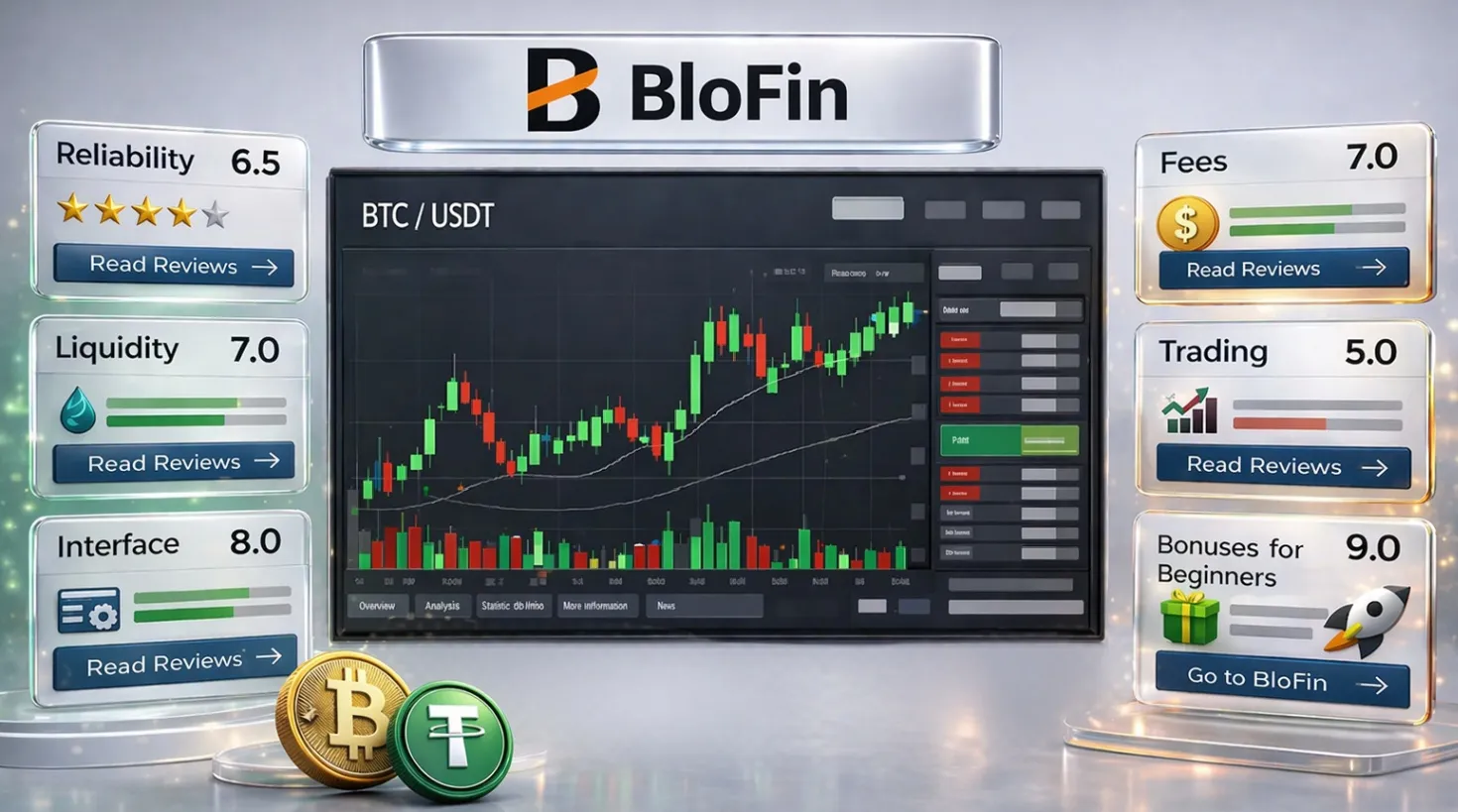
📚 BloFin terminology glossary for reviews and trading conditions
KYC: verification of a user's identity through documents.
AML/KYT: verification of the origin of funds and analysis of blockchain transaction chains.
PoR (Proof-of-Reserves): public verification of an exchange's reserves. It shows the stated 1:1 ratio between reserves and client assets, but does not replace an audit of the full legal and operational structure.
🔑 BloFin user experience: registration, fees, withdrawals, and support
| 🚀 Registration | 💻 Interface | 💰 Fees | 💱 Withdrawals | 🛡️ Security | 🤝 Support |
|---|---|---|---|---|---|
| Email-based start, no KYC up to 20,000 USDT per 24 hours A document request is possible if the exchange sends a withdrawal for risk-control review | Terminal with an order book (buy and sell order list) and order settings Futures, copy trading (copying trades of a selected trader), bots, demo account | 0.1% maker/taker A maker adds an order to the book, while a taker executes against the book | In some reviews, withdrawals are completed without delays AML/KYT (verification of the origin of funds through blockchain transactions) may pause a withdrawal | Proof-of-Reserves (public reserve verification) with a stated 1:1 ratio, cold wallets (asset storage outside hot online infrastructure) Offshore registration; licenses are not disclosed | 24/7 support Online chat, email, Telegram |
🧪 Methodology and review sample
Period: the last 12 months.
Filtering: the selection includes reviews where users describe an operation and its result. Very short comments and duplicates were excluded.
Limitations: reviews describe personal experience. Problem cases are published more often than routine operations. This may shift the distribution of opinions.
📊 Review distribution: why users leave 1, 3 and 5 stars
1–2 stars: 81% of reviews
- 🚫 Withdrawal complaints and account restrictions: users report frozen balances, closed access or inability to withdraw assets.
- 🚫 Some reviews describe disputed situations with futures positions: according to users, profitable trades were closed at a loss or liquidated due to price discrepancies.
- 🚫 Support is often described as slow and template-based: negative reviews repeatedly mention the lack of a specific resolution after contacting support.
3 stars: 4% of reviews
- 😐 Users describe working access to trading, but point to disputed terms in promotions and bonus programs.
- 😐 Negative feedback is more often linked to delays with promised bonuses, lack of quick support responses and unclear handling logic for requests.
- 😐 For test trading, some users may consider the experience acceptable. For larger amounts, reviews more often mention the need to check withdrawals, KYC and limits in advance.
4–5 stars: 15% of reviews
- ✅ Users praise the ability to trade derivatives and use the platform for active futures strategies.
- ✅ Some users note that they used BloFin for a long time without critical account problems.
- ✅ Positive experience more often describes trading convenience rather than long-term asset storage on the exchange.
🔐 BloFin registration and verification: account setup and KYC limits
Registration starts with email confirmation. The no-KYC withdrawal limit is stated as 20,000 USDT per 24 hours.
Registration. Reviews describe a standard account setup flow.
The user confirms an email address, sets a password, and enables basic security settings. After that, the interface provides access to the trading terminal.
Verification (KYC). BloFin states a withdrawal limit of up to 20,000 USDT per day without KYC.
In some cases, a withdrawal stops when risk control places it under review. In this status, the exchange requests identity documents and confirmation of the source of funds. The withdrawal remains under review until the documents are uploaded and checked.
A user made several small deposits and requested a withdrawal of about $10 without KYC. The exchange paused the withdrawal and requested KYC and screenshots of previous operations. The no-KYC withdrawal limit did not prevent the review in this case. Risk control stopped the transaction until documents were provided.
Review observations. In no-KYC scenarios, withdrawal pauses are linked to a sharp change in the sequence of operations.
Examples mention a deposit followed by a fast withdrawal, a withdrawal to a new address, and a sharp increase in turnover. If KYC is requested during withdrawal, the withdrawal remains paused until the documents are checked.
📉 BloFin risk control: withdrawal checks and verification triggers
What may trigger a review
- A deposit arrives from an address that AML/KYT checks flag as risky, or a withdrawal is requested immediately after a deposit.
- Trading volume rises sharply, or the entire balance is withdrawn to a new address.
- Trading takes place on a low-liquidity market. The order book contains few orders, and the price makes sharp spikes with a fast pullback.
What a ticket-based review looks like
- The ticket includes the TXID (blockchain transaction identifier), addresses, and dates. Screenshots confirming the source of funds are attached to the ticket.
- Documents and explanations are collected in one ticket. The ticket correspondence history shows this sequence.
- The operation description includes the asset, network, withdrawal address, and amount. The operation status from the exchange interface is also added.
- Clarifications for one operation are added to the same ticket. Reviews associate duplicate tickets for one withdrawal with slower processing.
- After the restriction is removed, some users test the withdrawal with a small amount. Then they repeat the main withdrawal.
One ticket with the TXID, addresses, dates, and confirmation of the source of funds reduces the number of follow-up requests from support.
💻 BloFin interface and trading functionality
BloFin interface reviews describe terminal speed, the order book, the chart, and order settings.
Interface usability (UI/UX — interface and user experience). Reviews link UI/UX to specific elements in the trading terminal.
Users mention fast response, a readable order book, and clear fields for price and volume. They also note fast switching between trading modes in the interface.
Functional capabilities. Reviews highlight BloFin derivatives (contracts whose price depends on an underlying asset).
They mention more than 400 USDT-M contracts, leverage up to x150, and SL/TP orders (stop-loss/take-profit — a protective loss order and a profit-locking order). They also mention trailing stop (an order that moves the stop level after the price), copy trading, and trading bots.
Demo mode and learning. A demo account allows users to open a position and place orders without real funds.
Reviews describe demo mode as a way to test order settings and the trading terminal interface.
Technical details. Some reviews describe position display glitches and order execution delays.
These cases are linked to periods of sharp price movement. With high leverage, execution delay increases the risk of position liquidation.
Reviews praise the BloFin terminal for speed and order settings. Complaints more often relate to order execution during sharp volatility.
⚙️ BloFin derivatives: futures risk, leverage, and execution in reviews
BloFin futures reviews mention leverage. They also describe position liquidation when the price moves against the position.
Contract selection and market liquidity
Contract liquidity is visible through order book depth and order volume. With low liquidity, a small trade moves the price and widens the spread between bid and ask prices.
User feedback links liquidation risk in low-liquidity conditions to high leverage and a close stop-loss.
Risk description in user cases
- Reviews describe trade risk through the position size in USDT and the distance to liquidation.
- Reviews connect a daily loss limit with a pause after a series of losing trades.
- Reviews connect the buffer before liquidation with funding. Funding is a payment on a perpetual contract (a futures contract with no expiration date) between holders of long positions (positions betting on price growth) and short positions (positions betting on price decline).
Risk management techniques mentioned in reviews
- Reviews split large positions into several entries to reduce dependence of the result on a single entry price.
- Protective orders in examples are placed in advance. In reviews, these are stop-loss and take-profit orders.
- Reviews connect x5–x10 leverage with a lower probability of liquidation during a small price movement.
In one description, a trader opens a position with x5 leverage. The entry is split into three orders. The stop-loss is placed beyond a local level. The take-profit is closed in two steps. In this case, the result depends less on one entry price, and gradual exit locks in profit without relying on a single target.
Futures reviews highlight leverage and stop orders. These parameters define the distance to liquidation and the loss size when the price moves against the position.
💰 BloFin fees and trading costs
On BloFin, fees differ for spot and futures. Final trade costs depend on the order role (maker or taker), pair liquidity, and possible slippage.
Spot. The base fee is 0.1% for both maker and taker.
A maker places a limit order in the order book. A taker executes an already placed order. As trading volume increases, the account may move to a VIP tier with a reduced rate.
Futures. The base rate is 0.02% for maker and 0.06% for taker.
A maker adds liquidity to the order book and pays a reduced fee. A taker executes an order at the current price and pays a higher rate. Funding is also included — a periodic payment between market participants based on position imbalance.
Actual costs. In addition to the fee, the trade outcome is affected by the spread — the difference between bid and ask prices — and slippage when a large order is executed on a low-liquidity pair.
Spot uses a 0.1% rate. On futures, fees are lower for maker (0.02%) and higher for taker (0.06%), while the actual trade result depends on liquidity and market structure.
🧾 BloFin fee table: rates, discounts, and cost factors
| Section | Base rate | How to reduce it | What to consider |
|---|---|---|---|
| Spot | 0.1% maker / 0.1% taker | VIP tiers and higher trading volume | Spread and order book depth |
| Futures | 0.02% maker / 0.06% taker | Higher trading volume and account-level increase | Funding and asset volatility |
| Withdrawals | Network fee of the selected blockchain network | Choosing a less congested network | Correct address and memo (an additional payment identifier if required by the network) |
💱 BloFin deposits and withdrawals: networks, TXID, and AML/KYT checks
Reviews describe a scenario where a deposit is credited to the balance. In the same scenario, a withdrawal after 2FA (two-factor authentication) confirmation receives a TXID in the operation history. Problem cases are linked to AML/KYT checks and withdrawal pauses.
Account funding. Deposits are credited when the address and memo are entered correctly, if the network requires a memo.
Reviews mention Tron, Ethereum, Arbitrum, and Polygon networks. Users select these networks with network fees in mind.
Withdrawal — positive experience. In a typical scenario, the user enters an address and network. Then the user confirms the withdrawal through 2FA.
After the transaction is sent, a TXID appears in the withdrawal history. This identifier is visible in the exchange interface.
Withdrawal — problem cases. In some cases, the exchange launches AML/KYT. In these cases, withdrawals are held until the source of funds is confirmed.
Reviews also describe a mismatch between the displayed balance and the amount available for withdrawal. In these descriptions, part of the funds is unavailable due to a review or operation restrictions.
A user requested a large withdrawal. In the interface, the withdrawal remained in “processing” status for a long time. Support did not provide a completion timeframe. After several clarifications in one ticket, the withdrawal was completed. The case description links the pause to a review, not to an address or network error.
Review data from verification cases. Withdrawal-check reviews mention a test withdrawal, network and address verification, enabled 2FA, and a saved TXID.
During an AML/KYT check, the ticket includes confirmation of the source of funds and the account UID (account identifier on the exchange).
AML/KYT checks are tied to the TXID and confirmation of the source of funds. Reviews associate the absence of this data with longer correspondence with support.
⏳ BloFin withdrawal delays: common review scenarios and preparation steps
What users mention before withdrawal
Scenarios after which withdrawals are checked more often
Reviews mention test withdrawals, enabled 2FA, and one ticket with a TXID more often in scenarios without prolonged correspondence with support.
🛡️ BloFin security and reliability: reserves, custody, and legal transparency
BloFin states 1:1 Proof-of-Reserves and cold storage. Reviews also mention offshore registration and the absence of public licenses.
- Reserves and fund storage.
- BloFin indicates Proof-of-Reserves (public reserve verification) with a stated 1:1 ratio.
- BloFin states that funds are stored in cold wallets.
- Platform descriptions mention Fireblocks and Chainalysis as partners for storage and monitoring suspicious operations.
- Legal status.
- BloFin is registered in an offshore jurisdiction.
- BloFin does not disclose a list of licenses and regulators.
- In a dispute case, this limits the set of public protection mechanisms through a licensing authority.
- Trading fairness.
- Some reviews describe short price spikes that trigger stop orders.
- This scenario is linked to low liquidity.
- The order book contains few orders, and a small trade moves the price to stop-order levels.
- Account protection tools.
- BloFin offers 2FA, an anti-phishing code, address whitelists, and email notifications.
- Reviews about account protection more often mention enabling 2FA and using a withdrawal address whitelist.
1 And cold storage describe the exchange-side asset custody model. Offshore registration and the absence of a public license list complicate legal disputes in case of conflict.
🤝 BloFin customer support: channels, response quality, and ticket data
Reviews praise BloFin support for answers to standard questions. In complex cases, users mention delays and template responses.
Contact channels. BloFin support operates 24/7.
Contact channels mentioned in reviews include online chat, email, and official Telegram communities.
Positive experience. Positive reviews mention answers about account login, 2FA setup, and order operation.
Telegram channels mentioned in reviews include guidance on basic account actions.
Negative reviews. Cases involving AML/KYT checks, stuck withdrawals, or disputed operations describe responses without a completion timeframe.
Long escalation is also mentioned. The ticket correspondence shows this sequence.
Data for a support request. Reviews about support correspondence most often mention UID, TXID, and screenshots of operation statuses.
They also mention the network and withdrawal address, which are included in the ticket text.
A ticket with UID, TXID, and confirmation of the source of funds reduces the number of follow-up requests. This shortens correspondence in review cases.
✔️ BloFin pros and cons from user reviews
✅ Pros
- Email-based registration and a stated no-KYC withdrawal limit of up to 20,000 USDT per 24 hours.
- Trading terminal with an order book, chart, and SL/TP settings.
- Futures (400+ contracts), copy trading, trading bots, and a demo account.
- Leverage up to x150 and trailing stop for position management.
- Spot: 0.1%; futures: 0.02% / 0.06%; discounts may be available through VIP tiers and promotions.
- Some positive reviews describe withdrawals without delays under standard activity.
- 24/7 support through chat, email, and Telegram.
- Stated Proof-of-Reserves 1:1 and cold storage of funds.
❌ Cons
- Offshore registration and no public list of licenses or regulators.
- Limited public information about the company and legal structure.
- Cases with short price spikes on low-liquidity markets and triggered stop orders.
- Withdrawal pauses due to AML/KYT checks and requests to confirm the source of funds.
- A KYC request may appear during withdrawal even when the amount is below the stated limit.
- In complex cases, users describe support responses without a specific completion timeframe.
- Some spot pairs have low liquidity. This widens the spread and increases slippage.
Reviews describe BloFin’s futures functionality and base fees (spot 0.1%, futures 0.02%/0.06%) as strengths. Risks are more often linked to withdrawal checks and the absence of public license information.
❓ Frequently asked questions about BloFin reviews and exchange conditions
Is BloFin considered a reliable crypto exchange?
BloFin indicates Proof-of-Reserves 1:1 and cold storage of funds. Reviews link risk to offshore registration and the absence of a public list of licenses and regulators.
Is KYC required before trading or withdrawing on BloFin?
BloFin states a withdrawal limit of up to 20,000 USDT per day without KYC. KYC is identity verification through documents.
If risk control places a withdrawal under review, the exchange requests documents and holds the withdrawal until the review is completed.
What trading fees apply on BloFin spot and futures?
On spot, the base rate is 0.1%. On futures, it is 0.02% (maker) and 0.06% (taker). Final trade costs may increase due to the spread and slippage on a specific pair.
What withdrawal problems do BloFin users mention?
In a typical scenario, a withdrawal is completed after 2FA confirmation and receives a TXID in the operation history. In some cases, withdrawals are paused due to AML/KYT checks and a request to confirm the source of funds.
What BloFin features are available besides manual trading?
Descriptions and reviews mention copy trading with trader rankings, trading bots, a demo account, and an Earn section (an asset allocation product with stated yield).
Can BloFin be accessed without a VPN?
Access to the website and app depends on local restrictions. Reviews mention VPN use when access is blocked.
A VPN is a service that changes the IP address.
What affects slippage on BloFin derivatives?
Slippage depends on pair liquidity, order book depth, and order type. In a low-liquidity market, the spread is wider, and the price moves from a small amount of volume.
What are the risks of storing crypto assets on BloFin?
Asset storage on an exchange depends on account access and withdrawal procedures. These procedures may include KYC and AML/KYT checks.
Reviews more often mention personal wallets for long-term storage. On exchanges, users more often keep an operating balance for trading and transactions.
💡 BloFin user reviews: overall picture
BloFin reviews repeatedly show two scenarios.
In the first scenario, the user trades and withdraws funds without additional steps. In this scenario, the withdrawal receives a TXID in the operation history after 2FA confirmation.
In the second scenario, the withdrawal receives review status. In this status, the exchange launches KYC or AML/KYT and requests documents and confirmation of the source of funds.
Reviews also describe actions that accompany withdrawals: a test withdrawal, enabled 2FA, lower futures leverage, and partial profit-taking.