Traders often look for new buying or selling where the move is actually driven by the mechanics of liquidations themselves.
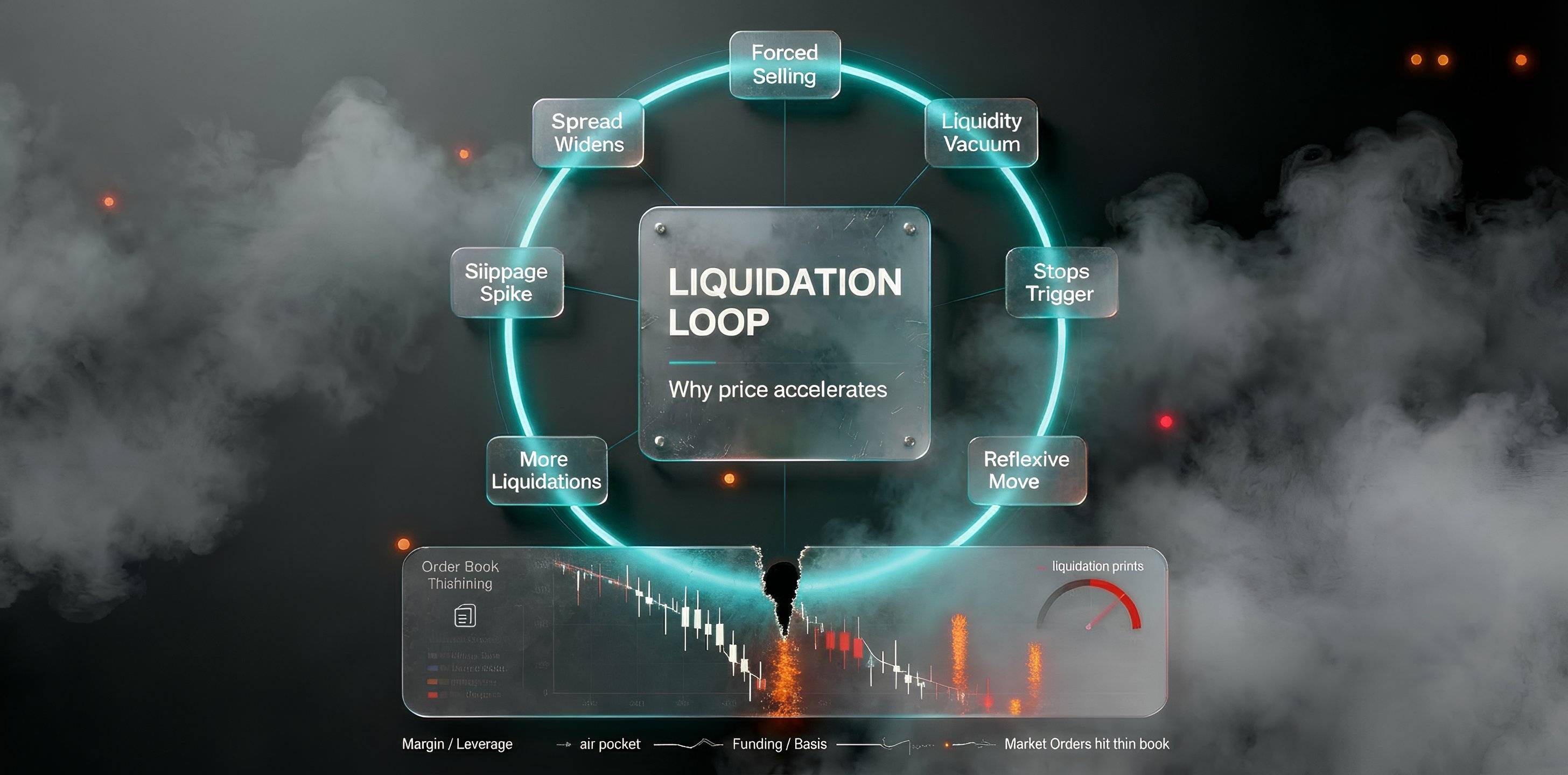
Price accelerates after liquidations when the matching engine executes forced market orders through a thinned order book, and each next order crosses more levels because passive liquidity has disappeared.
This guide breaks down the specific changes in the order book, liquidation mechanism and order-matching algorithm that create self-sustaining price acceleration after mass position closures, and explains why the move can continue while trade volume falls. The focus is deliberately mechanical: which levels are removed, how execution is routed, how mark price and margin checks transmit the move to other positions, what market makers do with quotes after adverse fills, and which data points confirm that the next price step comes from depleted local depth rather than from a new wave of discretionary buying or selling.
📉 What exactly counts as liquidation and how it is executed technically
A liquidation is the forced closure of a specific margin position. The exchange risk engine triggers it when a numerical margin threshold is breached and then executes it through the standard matching engine.
🧾 Liquidation as an event inside the risk engine
In a derivatives exchange trading system, liquidation is recorded as the state of an individual position where calculated equity falls below the required maintenance margin.
The liquidation object is always a specific position in a specific contract, for which the risk engine continuously calculates equity as collateral plus unrealized PnL, recalculated using the exchange's calculated mark price.
The trigger mechanism is an unambiguous check of the condition equity < maintenance margin, fixed in the risk module code and independent of the position owner's actions or decisions.
A calculated contract price is used for that check, so a liquidation can be initiated without matching the last traded price in the tape and without crossing the user's stop-order levels.
The event is recorded in the internal risk-system log and in the position report, while the external market only sees the later trades created by the forced closure process.
⚙️ Liquidation execution through the order book
After the margin condition is breached, the risk engine creates a liquidation order and sends it to the matching engine as an instruction to immediately reduce or fully close the position.
The liquidation order does not contain a user price limit, because its functional purpose is to reduce the exchange's credit risk, not to achieve a particular execution price.
The matching engine matches the liquidation order against limit orders on the opposite side, starting from the best bid or ask and moving to the next price levels when available size is not enough.
Each partial match is recorded as a separate trade in the tape and simultaneously removes the corresponding passive liquidity from the top levels of the order book.
When several liquidation orders arrive in the same time window, the trading engine executes them sequentially, creating a dense series of aggressive matches that mechanically shifts price by consuming the nearest limit levels.
Concept boundary: stop-loss is a user order placed in the system in advance, while a liquidation order is created after the fact by the exchange risk engine when the calculated margin condition is breached.
| Process stage | System action | Where it is recorded |
|---|---|---|
| Equity calculation | The risk engine recalculates position equity from collateral, unrealized PnL and the calculated contract price. | Internal calculation inside the risk module. |
| Threshold check | The condition equity < maintenance margin is checked. | Position status in the risk-management system. |
| Order creation | A liquidation order is generated to reduce or close the position. | Order log of the trading engine. |
| Matching | The matching engine executes the order against available order-book limits. | Trade tape and top-of-book changes. |
| Completion | The position is closed or reduced, and the average price is determined by the actual matches. | Position report and trade history. |
If a liquidation must close a short position of 120 contracts, while the book has 30 contracts at the best ask, then 50 at the next level and 40 at a higher price, the trading engine produces an average closing price above the initial best ask.
The result of this process is a mechanical impact on the top levels of the order book: a series of forced executions can continue the price move even when no new independent market orders appear.
⚙️ How a series of liquidations changes the shape of the order book
A series of liquidations changes price by sequentially removing concrete limit size from the top price levels of the order book, directly reducing execution depth.
- The risk engine detects a maintenance-margin breach for a specific position and calculates the size that must be closed by force.
- A liquidation order is created for that calculated size and sent to the matching engine as an instruction for immediate execution.
- The matching engine executes the liquidation order at the best bid or ask, fully or partly removing limit orders at that price level.
- If size at the current level is insufficient, the remaining part of the order is executed at the next level at a worse price.
- Each following liquidation order begins execution in a book whose top-level depth has already been reduced.
📉 Removing limit levels as a physical process
Execution of liquidation orders changes the order book through direct matching against limit orders at specific price levels.
Each liquidation order executes against limit orders at the top of the book, after which those levels either disappear completely or remain with residual size.
Removed limit levels do not automatically restore, because new orders require actions from passive participants or market-making algorithms.
The removal is visible as a reduction in total size across the first ticks of the book and as a sequence of trades in the tape.
📐 Shift of execution depth in the order book
After a liquidation series, the size able to absorb an aggressive order of fixed size moves farther away from the current price.
Meaningful liquidity becomes concentrated at more distant price levels because the nearest levels were consumed by earlier forced executions.
With the same order size, the matching engine must cross more price levels because top-of-book size has fallen.
That depth shift appears as a higher average execution price and a wider price range affected by one order.
It also appears in the book as the absence of dense size clusters near the current quote.
| Order-book characteristic | State before liquidations | State after a liquidation series |
|---|---|---|
| Size at best bid/ask | Concentrated at the nearest levels | Partly or fully removed |
| Location of main liquidity | Close to the current price | Shifted to more distant levels |
| Average execution price | Forms near top-of-book | Forms across several levels |
| Price effect of a fixed-size order | Limited to several ticks | Increased because depth is lower |
If, before liquidations, each of the first three ask levels held 100 contracts, and after forced executions only 20-30 contracts remain at each level, closing a 150-contract position requires crossing more price levels.
The result of a liquidation series is an order-book rebuild where an aggressive order of the same size moves price farther solely because available limit size at the top levels has been reduced.
🧱 Why price keeps moving without new market orders
After liquidations, price keeps shifting because the matching engine matches even small orders against a sparse order book, not because a new aggressive flow has entered the market.
- A series of liquidation orders removes limit orders from specific top price levels of the book.
- After the liquidations finish, top-of-book contains too little size to absorb a normal market order.
- Any following market order immediately crosses several price levels.
- The average execution price shifts even with a small number of trades in the tape.
- The price move stops only when new limit orders appear at the top levels.
📉 Low order flow and an empty book
The absence of new market orders means low aggressive flow, but it does not mean there is liquidity at the nearest levels of the book.
A market order has a price impact determined by the total limit size along its execution path, not by the number of participants or the number of trades.
After liquidations, the top levels of the order book often contain isolated limit orders or minimal residual size.
This state is recorded in the trade tape as a series of small prints accompanied by a disproportionately large quote change.
📐 Price as the result of a matching algorithm
Trade price is formed by the order-matching algorithm and directly depends on the order-book configuration at the moment of execution.
The matching engine sequentially matches a market order against limit levels in the book until the specified size is fully executed.
If top-of-book does not have enough size, the engine must move to more distant price levels even when the order itself is small.
This process appears as a mismatch between low trading volume and a continuing directional price move, because the visible number of trades no longer describes how much price distance one execution route has to cross.
| Observed parameter | Before liquidations | After liquidations |
|---|---|---|
| Top-of-book size | Enough to absorb the order | Not enough even for small size |
| Number of execution levels | One or two levels | Several price levels |
| Price-volume relationship | Price shift is proportional to size | Price shift is disproportionate to size |
| Condition that stops the move | Aggressive orders are exhausted | New limit size appears |
If, after liquidations, only 15 contracts are available across the nearest two ask levels, a market buy of 20 contracts forces the matching engine to execute part of the size at the next price level even without any other market orders.
So the continuation of price movement after liquidations is a direct consequence of order-book configuration and the matching algorithm, not the appearance of a fresh aggressive trading impulse.
🔁 Liquidation cascade as a self-sustaining process
A liquidation cascade appears when the execution of one group of forced orders changes calculated margin parameters for other positions and automatically triggers new liquidations. The cascade is therefore not just a crowd reaction; it is a chain of formal checks and forced executions linked through the same price data used by the risk engine.
- A liquidation order executes through the matching engine and removes limit size from specific order-book price levels.
- The liquidation trade series changes actual execution prices that are used to update the contract mark price.
- The risk engine recalculates equity for all open positions based on the new mark price.
- Some positions cross the numerical condition equity < maintenance margin.
- For those positions, the risk engine forms new liquidation orders and sends them to the matching engine.
🧮 How feedback forms inside the liquidation system
Feedback in a liquidation cascade forms because forced execution prices are reused in margin-stability calculations for other positions.
Each liquidation is recorded in the trade tape as a series of matches, from which the exchange calculates an aggregate price used to update the mark price.
The risk engine applies mark price to recalculate equity across all positions, regardless of whether they participated in the current trade movement.
For high-leverage positions, even a small mark-price shift can reduce equity below maintenance margin without any action from the position owner.
Verifiable consequence: each liquidation simultaneously removes liquidity from the book and worsens the margin metrics of other positions through a mark-price change.
The risk engine initiates new liquidation orders whenever the formal numerical margin-breach condition is met, regardless of why price changed.
| Chain stage | Parameter that changes | Where it is recorded |
|---|---|---|
| Liquidation execution | Match prices and removal of limit size | Trade tape and order book |
| Mark-price update | Calculated contract price | Exchange risk module |
| Equity recalculation | Margin state of positions | Position reports |
| New liquidation | Forced closing order | Order log of the trading engine |
If the first liquidation wave shifts the contract mark price by 0.4%, a 25x leveraged position loses roughly 10% of equity, crosses maintenance margin and is automatically sent into liquidation while the book is already thin.
The cascade continues until either the number of positions breaching margin becomes zero or enough limit size appears in the order book to restrict the price shift created by each following liquidation order.
🧮 The role of margin requirements and auto-deleveraging
Margin requirements and auto-deleveraging define the formal conditions under which the exchange risk engine creates forced orders and therefore continues the price move after liquidations.
| Mechanism | Input parameters | Recording point |
|---|---|---|
| Initial margin | Position notional and configured collateral ratio | Position creation and available leverage calculation |
| Maintenance margin | Position equity and maintenance-margin threshold | Check of the condition equity < maintenance margin |
| Auto-deleveraging | Coverage deficit and ranking of opposite-side positions | Forced reduction of selected positions |
- The risk engine recalculates position equity whenever mark price is updated.
- The risk engine compares equity with the maintenance-margin threshold and records a breach when equity < maintenance margin.
- For the breached position, a liquidation order is created to reduce or close it.
- The matching engine executes the liquidation order against order-book limit levels and records trades in the tape.
- When coverage is insufficient, auto-deleveraging activates and creates orders to reduce opposite-side positions.
📉 Maintenance margin as the liquidation trigger
Maintenance margin works as a numerical filter that moves a specific position into the liquidation procedure when the defined threshold is breached.
Position equity is calculated by the risk engine as collateral plus unrealized PnL, recalculated by mark price for the specific contract.
The check is performed on every mark-price update, so a position can enter liquidation without a new market order from its owner.
The higher the leverage and the smaller the initial margin relative to notional value, the smaller the price shift needed to satisfy the condition equity < maintenance margin.
⚠️ Auto-deleveraging as forced reduction of other traders' positions
Auto-deleveraging starts when liquidation results do not cover obligations, and the exchange closes part of opposite-side positions according to an algorithmic ranking; ADL mechanics are explained separately in the article about auto-deleveraging.
The algorithm selects opposite-side positions by a ranking that depends on position size and unrealized profit.
Selected positions are reduced through forced orders that the matching engine executes and records in the trade tape.
ADL appears as a forced position reduction in the account report and as a jump in contract open interest.
If liquidation orders close a position at a price that leaves a coverage deficit, auto-deleveraging reduces profitable opposite-side positions, creating new forced executions in an already thinned order book.
The consequence of maintenance margin and auto-deleveraging is that price can continue moving after liquidations because both mechanisms create new forced orders executed by the matching engine against the current order-book structure. In practice this means that a trader can see continued movement after the first wave has passed even if the tape no longer shows a large fresh aggressor entering the market.
🧠 Market-maker behaviour after a liquidation wave
After a liquidation wave, market makers change quoting parameters because order-book data, trade-tape data and their own inventory indicate higher inventory risk and adverse selection.
Actual inputs of a market-making algorithm: the order book provides size and distance between levels, the trade tape shows execution sequence and direction, and the inventory module records the current position and delta exposure.
- Execution risk is observed as a series of trades in the tape moving to worse prices immediately after a fill on the market maker's limit order.
- Inventory exposure is observed as growth of a net position on one side after forced matches.
- The state of the book is observed as reduced size at best bid/ask and disappearance of nearby price levels.
| Quoting parameter | Reason for the change | Where it is observed |
|---|---|---|
| Bid-ask spread | Higher probability that a limit order is filled before a further price shift. | Top-of-book in the order book. |
| Limit-order size | Growth of inventory position after a series of executions. | Total size at the first price levels of the book. |
| Update frequency | Recalculation of risk parameters after directional trade flow. | Add/cancel event flow in the order book. |
| Distance of quotes from mid | Need to reduce the probability of another fill. | Placement of limits relative to current price. |
📦 Inventory risk after forced executions
Inventory risk appears when a market maker is filled on limit orders and is left with a directional position.
During liquidations, the matching engine executes aggressive orders against the market maker's limit orders, creating a position without immediate offsetting size.
If the next trades in the tape keep moving price in the same direction, the current market value of that inventory deteriorates.
The algorithm reduces limit-order size and increases distance from top-of-book to slow down position accumulation.
- Verifiable sign: smaller quoted size on the side where inventory has accumulated.
- Price effect: lower depth near price increases slippage for the next market orders.
🎯 Adverse selection as the reason spreads widen
Adverse selection is observed when execution of a limit order systematically precedes a further price move against the market maker.
After liquidations, a thinned book and directional trade flow increase the probability of that scenario.
The algorithm observes deterioration through the sequence: limit fill -> trades at worse prices -> higher expected negative result from passive quoting.
In response, the spread widens and limit orders move to more distant price levels.
- Verifiable sign: simultaneous spread widening and size reduction at best bid/ask.
- Price effect: a wide spread increases entry and exit cost and supports price acceleration in a sparse order book.
If, after liquidations, best-bid size falls to 10-20 contracts and a trade series keeps pushing price lower, the market maker reduces bid size and moves quotes one or two levels lower; the book records this as spread widening and a drop in depth.
Market-maker behaviour after liquidations is checked through the order book and trade tape: forced executions increase inventory exposure and adverse-selection frequency, after which algorithms reduce quoting, and lower passive liquidity amplifies the next price shift. This is why the same order size can have a different effect before and after liquidations: the quote providers that normally absorb flow have either reduced size, widened spread or moved farther away from mid.
⚙️ Price auto-acceleration through thinning of order-book levels
Price auto-acceleration after liquidations arises from sequential removal of limit orders from the top levels of the order book during serial execution of forced market orders.
Core idea: price accelerates not because of a "new impulse", but because each next order executes in a book whose local depth has already been removed.
- The risk engine forms a liquidation order and sends it to the matching engine as an instruction for immediate execution.
- The matching engine executes the order at best bid/ask and removes limit size from the top levels.
- After that size is removed, the next order faces less depth and moves faster to farther levels.
- The execution route expands: the same notional size touches more price levels.
- Average execution price shifts faster, and the move becomes self-sustaining until limit density is restored.
🧱 What exactly "breaks" in the order book
Auto-acceleration begins when the top of the book can no longer absorb standard market size within one price level.
- Top-of-book size has been reduced by a series of forced matches.
- Intermediate levels are thin or missing, forming price gaps.
- New passive liquidity appears later and often at more distant levels.
Verifiable consequence: an order of the same size begins to cross more levels and creates a larger price shift.
📟 How this appears in execution data
The effect is recorded not by a "feeling of volatility", but by execution-route metrics and the structure of prints in the tape.
- The distance between consecutive prints increases at comparable size.
- One order is distributed across several price levels instead of one or two.
- Average execution price moves away from top-of-book faster, even on small trades.
Verifiable consequence: growth in print price step without growth in aggressive flow points to thinning levels.
| Object | Action | Recording point | Effect |
|---|---|---|---|
| Liquidation order | Removes limit orders | Matching engine | Reduction of local depth |
| Order book | Loses density near best | Order book snapshot | Growth of price gaps between levels |
| Trade tape | Records executions at distant levels | Trade tape | Increased distance between prints |
If, after a liquidation series, only 8-12 contracts remain at best ask and the next levels contain only thin leftovers, even a 20-30 contract market buy must be distributed across several prices, accelerating the shift in average execution price.
Auto-acceleration is visible at the same time in the order book as disappearing limit size at top levels and in the trade tape as increased distance between consecutive prints at comparable size.
🧮 Why price acceleration persists even as order volume falls
Price acceleration after liquidations is supported by the state of the order book, where the matching engine executes orders against residual depth rather than against their notional size. The important variable is not only how large the next order is, but how much executable limit size remains directly in its path.
After the main liquidation series ends, the average market-order size in the tape may fall, yet every new order can still execute with a noticeable price shift.
This happens because cumulative depth near best bid or best ask remains insufficient to execute even small size within one price level.
When limit orders at the first levels are absent or represented by small leftovers, the matching engine must distribute one order across several order-book levels.
| Observed parameter | Actual state | Matching-engine action | Recording point |
|---|---|---|---|
| Market-order size | Smaller than during the liquidation peak | Execution is distributed across several levels | Trade tape and execution report |
| Cumulative depth near best | Insufficient for local absorption | Execution moves to farther levels | Order-book snapshots |
| Price distance between levels | Increased after limit orders were removed | Intermediate levels are skipped | Order book and trade tape |
As a result, the size of the price shift is determined by the number of price levels involved in execution, not by the order's volume.
📉 Small market order in a sparse order book
A small market order creates a significant price shift when nearby order-book levels do not contain enough limit size.
After a series of sweep executions, the first levels of the order book have been cleared, so even a small order immediately executes against distant limit orders.
- Limit size at the best level does not cover the order size.
- Execution crosses several price levels in sequence.
- Average trade price shifts more than it would in a dense book.
Verifiable consequence: reducing market-order size does not reduce the price shift if cumulative depth near best remains low.
📊 How this is recorded in the trade tape
The trade tape shows the persistence of acceleration through the price parameters of individual prints.
Each market order is recorded as a series of trades with an increased price step because execution occurs at thinned book levels.
- Distance between neighbouring prints remains elevated.
- Average trade size can fall without a smaller price step.
- Trades touch levels that were not previously involved in execution.
Verifiable consequence: a persistently increased distance between prints while trade volume falls points to a lack of limit size between book levels.
Price acceleration disappears only after dense limit size returns to the nearest levels, when the matching engine again executes small market orders inside one price level without moving to farther prices.
📉 How to distinguish "movement without aggressive flow" from a real impulse in data
The difference between auto-acceleration after liquidations and an impulse move is recorded not by candle speed, but by the mismatch between weak aggressive flow and an expanded execution route inside the matching engine. A fast candle alone is not enough: the diagnostic question is whether prints become larger and more frequent, or whether the same sparse flow starts jumping over empty levels.
Core idea: visually, both scenarios look like directional movement, but in an impulse price shifts because aggressive orders enter the market, while in auto-acceleration even rare and small trades are forced to execute at distant levels of a sparse book.
⚡ Impulse on aggressive flow
An impulse forms because real market-order pressure increases.
- Trade frequency grows together with the price move.
- Average print size often increases.
- Distance between prints remains close to one tick.
- Opposite-side limits appear closer to current price.
Interpretation: the market "digests" aggression because new liquidity is replaced quickly.
🧱 Auto-acceleration after liquidations
Auto-acceleration forms when local depth is broken, even without dense order flow.
- Trade frequency can fall while the move continues.
- Average print size remains small.
- Distance between prints increases because levels are skipped.
- New limits move farther from mid because of adverse-selection risk.
Interpretation: price shifts because the matching engine cannot find local liquidity.
- Compare price change with trade frequency: acceleration with falling frequency points to structural thinning.
- Check the distance between prints: a larger step without higher volume means levels are being skipped.
- Measure cumulative depth near best: small size explains the shift even on small orders.
- Watch where new liquidity appears: locally or at distant levels.
- Confirm normalization: print series at one level means local execution has returned.
| Data sign | Impulse | Auto-acceleration |
|---|---|---|
| Trade frequency | Rises with the move | Can decline |
| Average print size | Increases | Remains small |
| Distance between prints | Stable near one tick | Increased because of gaps |
| Cumulative depth near best | Restores quickly | Stays low for longer |
| Ending condition | Aggression weakens | Local depth returns |
📟 Practical check on one data window
Auto-acceleration is diagnosed by the combination "low print flow + large price step + thin top of book".
- Distance between prints grows without a rise in trade frequency.
- Top-of-book fails to hold price because cumulative depth is low.
- Liquidity returns first at distant levels.
Verifiable consequence: if price keeps moving while order flow is weak, the cause is recorded in order-book structure and the execution path, not in a new impulse.
Thus, "movement without aggressive flow" is a diagnosable market state where continuing price displacement is confirmed by book configuration and print behaviour, not by growth in aggressive demand or supply.
🧱 When and by what mechanism price acceleration stops
Price acceleration stops when the matching engine begins executing market orders inside one price level because limit size in the order book has been restored.
Before acceleration stops, each market order is matched across several price levels because limit size near best bid or best ask is insufficient for full execution.
The stopping mechanism begins when cumulative depth at the nearest levels exceeds the average size of incoming market orders on the execution side.
This change is recorded not by price direction and not by lower trading activity, but by a change in the execution route inside the matching engine.
Local execution: execution of a market order entirely by limit orders at one price level or adjacent levels without moving to farther prices.
Critical cumulative depth: total limit size at the first order-book levels, sufficient to absorb a typical market order without a price shift.
- During liquidations, limit orders at the nearest levels are lifted and removed from the order book.
- After liquidations finish, new limit orders first appear at distant price levels.
- As price shifts, limit orders begin to appear closer to the current best.
- Cumulative depth at the first levels reaches a value higher than incoming market-order size.
- The matching engine stops carrying execution to the next price levels.
| Order-book state | Market-order execution | Matching-engine action | Data record |
|---|---|---|---|
| Low cumulative depth near best | Order is distributed across several levels | Sequential sweep of price levels | Growth in distance between prints in the trade tape |
| Growth of limit size at first levels | Order executes inside a narrow price range | Local matching | Series of prints at one level |
| Dense order-book structure | Execution without a price jump | No transition to distant levels | Compression of price range in the trade tape |
📉 Verifiable signs that auto-acceleration has ended
The end of auto-acceleration is defined by measurable changes in the order book and the trade tape.
- Distance between neighbouring prints contracts to one price step.
- The trade tape shows series of executions at one price level.
- Limit size at best bid or best ask exceeds the average size of incoming market orders.
Verifiable consequence: if a market order fully executes at one price level, price acceleration has ended regardless of where price goes next.
Therefore, the end of price acceleration is a direct consequence of critical limit size returning to the order book, which changes the execution route inside the matching engine and is recorded in the book and tape. When orders stop sweeping distant levels and begin matching locally again, the mechanical source of acceleration has disappeared even if volatility remains elevated.
🧠 Price auto-acceleration as a consequence of broken local execution depth
The key conclusion of this article is that price acceleration after liquidations is determined not by participant behaviour or a rise in aggressive flow, but by how the matching engine is forced to execute orders in an order book with insufficient local depth.
Interpretive frame: "the market accelerates by itself" is an observable trading-system state where local execution is impossible because limit size near best is deficient.
| Cause in mechanics | What happens inside the engine | What appears in the data | What ends the effect |
|---|---|---|---|
| Local depth is removed | Order moves through several levels | Distance between prints grows | Limit size returns near best |
| Limits are shifted farther from price | The execution route expands | Prints appear at distant prices | Series of prints at one level |
| Cumulative depth stays low | Even a small order creates a shift | Movement continues on low trade volume | Local execution without crossing levels |
- A liquidation series removes limit size at the nearest price levels of the order book.
- Cumulative depth near best bid or best ask becomes smaller than the typical incoming market-order size.
- The matching engine matches each new order against a sequence of levels rather than one dense size cluster.
- The execution route expands, so average execution price shifts faster even while order frequency and order size fall.
- The effect ends when limit orders rebuild local depth and orders again execute within one level.
⚙️ Why the move persists while volume falls
Low trade volume does not mean the market has depth for local execution; the decisive parameter becomes cumulative depth near best.
- Even a small order cannot find enough limit size at top-of-book.
- Execution is distributed across several levels, so the price shift persists despite low activity.
- Price keeps moving until new limits appear near the current best.
Verifiable consequence: if trade volume falls while print price step remains elevated, the cause is low cumulative depth near best.
📌 Verifiable final model
The auto-acceleration model is confirmed by direct comparison of order-book data, trade-tape data and execution parameters.
- Before acceleration, cumulative depth at the first price levels drops sharply.
- During acceleration, each market order touches more than one price level.
- After limit size is restored, market orders execute within one level.
Verifiable consequence: if price continues to shift while trade volume and trade frequency fall, the cause is recorded in order-book state and the matching algorithm.
If, after a liquidation wave, the first two levels of the book contain less size than a typical market order, every next order is forced to "search" for liquidity farther away, creating price acceleration without requiring a new aggressive flow.
Auto-acceleration after liquidations is a market state where
FAQ about the market after liquidations
Why does price keep moving after liquidations even when trade volume falls?
Price keeps moving because the matching engine executes market orders in an order book with insufficient cumulative depth near best bid or best ask.
When limit size at the nearest levels is smaller than incoming market-order size, execution is distributed across several price levels, which the trade tape records as prints at distant prices.
Why can a small market order cause a strong price shift?
A small market order can cause a strong price shift when cumulative depth at the first order-book levels is smaller than the order's size.
In that case, the matching engine sequentially removes limit orders at several levels, and the volume-weighted execution price shifts farther away from the submitted order price.
Do market makers move price after liquidations?
Market makers do not move price with market orders, because their participation is expressed through limit orders in the order book.
After liquidations, market-maker limit orders are often cancelled or moved farther from the current price, so the matching engine executes market orders against residual liquidity.
How can auto-acceleration be distinguished from a normal impulse move?
Auto-acceleration is defined by the order execution route inside the matching engine, not by the speed of the quote change.
If distance between prints in the trade tape increases while volume is stable or falling, and cumulative depth near best remains low, the movement is formed by a sparse order book.
Why does price not stop immediately after liquidations end?
The end of liquidations stops the flow of forced market orders, but it does not restore limit size at the nearest levels of the order book.
Until new limit orders create enough cumulative depth for local execution, the matching engine continues carrying execution to the next price levels.
Where can you see that price auto-acceleration has ended?
The end of auto-acceleration is recorded in the order book as rising limit size at the first levels and in the trade tape as series of trades at one price level.
If a market order fully executes at one level without moving to the next one, the matching engine is operating in local-execution mode.
Can the start of price auto-acceleration be seen in advance?
The start of auto-acceleration is recorded as a sharp drop in cumulative depth near current price below typical market-order size.
If the trade tape then shows prints with an expanding price step, the matching engine is already executing orders across several price levels.
Related breakdown: why price can keep moving without a new wave of selling and where that is visible in order-book data.