📖 KuCoin: real trader reviews and key issues
KuCoin is one of the most discussed crypto exchanges among retail traders. Reviews praise its wide coin selection and low fees. The same reviews criticize withdrawal delays, Risk Control checks (internal transaction monitoring), and weak support.
This material brings together recurring complaints and KuCoin’s strengths over the past 12 months. The review shows which scenarios users praise the platform for, where time and money losses appear most often, which comments repeat, and under which conditions risk becomes higher.
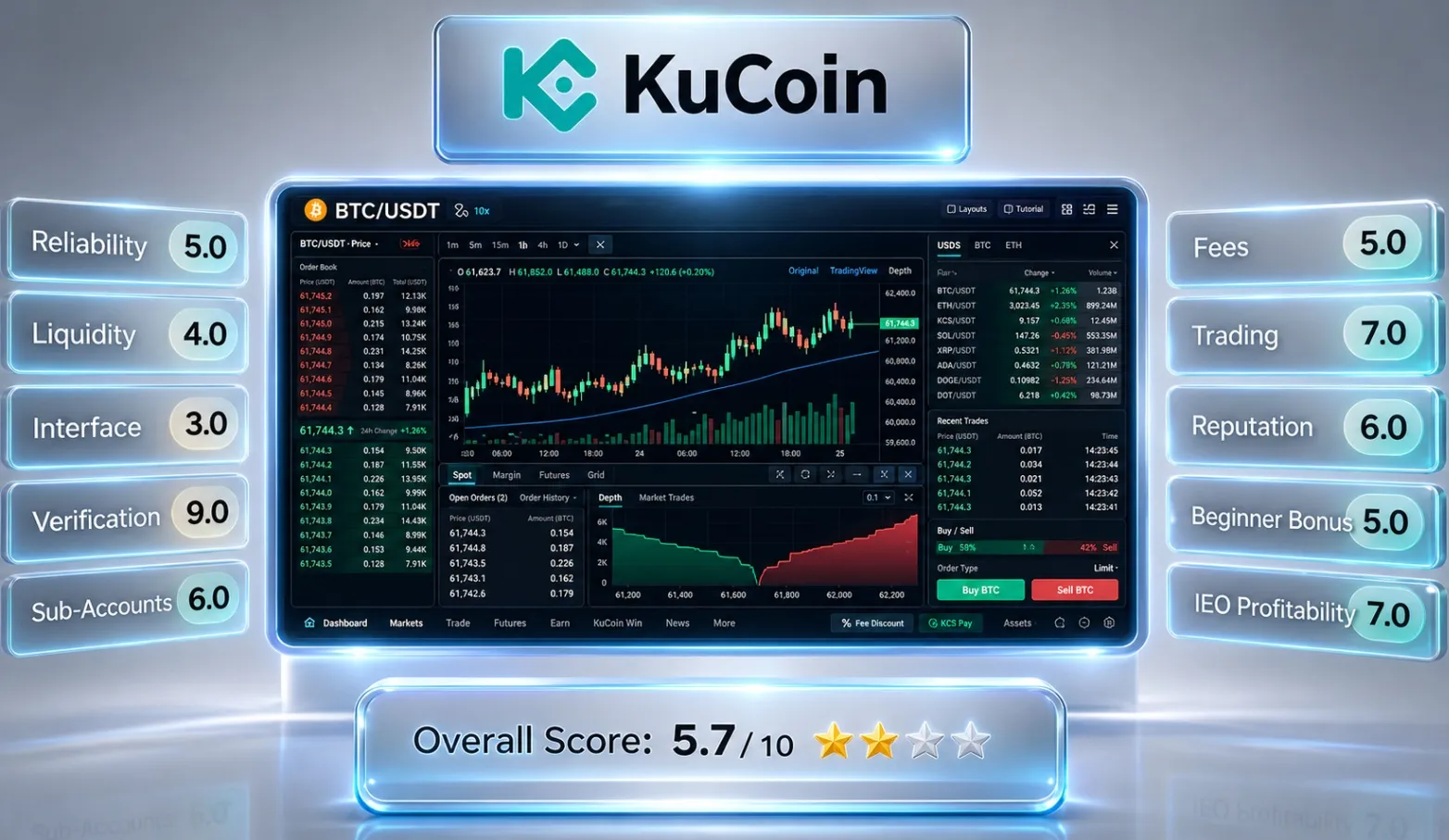
📘 General information about the exchange
The exchange focuses on broad altcoin listings and products for active trading. The platform offers spot, margin, futures, trading bots, and yield products. Users praise KuCoin for this toolset in reviews. They criticize the exchange for withdrawals, checks, and support.
| 🔁 Trading | 🧩 Products | 💰 Coins | 🛡️ Transaction checks | 👥 Support | ⚠️ Regulation |
|---|---|---|---|---|---|
| Spot, margin, futures TradingView charts | Bots, Earn Dual Investment — a product with a preset price, Spotlight | Very broad listing many early-stage altcoins | Risk Control KYC — identity verification and reverification | Tickets, email, social channels slow response to complaints | Offshore registration country-based restrictions |
🔎 Methodology: which reviews were included and how they were grouped
Only reviews from the past 12 months were included. Reviews were grouped by recurring themes: withdrawals, support, P2P (transactions between users through the platform), KYC, complex products, and delistings. This method highlights recurring scenarios rather than a single emotional comment.
KYC: identity verification on the exchange: passport or ID, selfie, and additional documents. Without full KYC, some limits and functions are unavailable.
Risk Control: the exchange’s internal check. It is triggered by suspicious transactions or changes to security settings. During this type of check, withdrawals may be temporarily stopped.
P2P: buying or selling cryptocurrency directly to another user through the platform. The main risks are payment disputes, fake receipts, and slow moderation.
Delisting: removal of a coin from trading and the subsequent closure of withdrawals. If the asset is not withdrawn before the deadline, the coin may remain on the exchange without withdrawal access.
Maker/Taker: two types of trading fees. A maker places an order in the order book. A taker executes an existing order and usually pays the same or a higher rate.
Dual Investment: a yield product with a preset price and settlement in one of two assets. The result depends on where the price is on the settlement date.
Most common: withdrawals, Risk Control blocks, slow support, P2P disputes.
Less common but visible: unexpected results in bots and Dual Investment, delistings of rare tokens, hidden costs in the spread (the difference between buy and sell price) and networks.
Comparatively rare: full website unavailability and serious spot trading failures.
📊 KuCoin review distribution: ratings and reasons
1–2 stars
- 🚫 A withdrawal request is marked as completed, but the funds take a long time to arrive. Alternatively, the transaction goes to an additional check.
- 🚫 The account or withdrawal is blocked after Risk Control is triggered. Reverification takes several days.
- 🚫 Support replies with templates, repeatedly asks for documents, and does not provide a completion timeline for the check.
- 🚫 In P2P, users dispute fake receipts and moderation quality. During delistings, they complain about strict withdrawal deadlines for rare tokens.
3 stars
- 😐 The interface, charts, and basic fees are acceptable, but deposits and withdrawals are sometimes fast and sometimes require another check.
- 😐 Trading works, but withdrawing a large amount does not feel predictable.
- 😐 Bots, Earn, and Dual Investment produce a result that does not match expectations. The reason is visible in the execution terms and settlement currency.
- 😐 Not everyone sees announcements about delistings and restrictions. Some complaints are linked to late notification.
4–5 stars
- 👍 Users praise TradingView charts, order selection, and several interface modes.
- 👍 Basic fees are considered low, especially when paid with KCS (KuCoin’s exchange token) and on liquid pairs.
- 👍 The exchange is valued for its broad listing and access to early-stage altcoins that are unavailable on more conservative platforms.
- 👍 Positive reviews are more often left by users who completed full KYC in advance and did not violate platform rules when depositing and withdrawing.
| ⭐ Rating | 📊 Frequency in the thematic sample | 💬 What usually stands behind the rating |
|---|---|---|
| 1–2 stars | Dominant group | 🚫 Withdrawal delays, Risk Control checks, weak support, P2P disputes, stress caused by delistings |
| 3 stars | Noticeable smaller group | 😐 Trading conditions are acceptable, but deposits, withdrawals, and complex products work inconsistently |
| 4–5 stars | Smaller positive group | 👍 Low fees, broad listing, convenient terminal, normal withdrawal experience with full KYC |
📱 Interface and usability: where KuCoin is convenient and where it gets confusing
Experienced traders value charts, order types, and settings. Beginner scenarios are more often linked to difficulties in the first steps. Problems appear when setting up 2FA (two-factor authentication), finding the right wallet, choosing a network, and trying to withdraw funds to fiat (traditional currency).
“This app is inconvenient. You cannot withdraw money directly to a bank account — first you need to send cryptocurrency to another exchange, sell the coin there, and only then withdraw the money. Even the security setup is too complicated here...”
“KuCoin has earned my trust over several years... Maybe bad reviews are left by people who simply do not understand how the platform works.”
✅ Pros
- Charts and indicators are close in functionality to familiar trading terminals.
- There are several interface modes: from a simplified screen to a full terminal with orders and an order book.
- Security settings are detailed: trading password, anti-phishing phrase, and address whitelists.
❌ Cons
- First actions are spread across several screens. This makes it easy to confuse deposits, withdrawals, and transfers between internal accounts in the initial workflow.
- The fiat path is not obvious. There is no direct bank withdrawal, so users rely on P2P or an external platform.
📈 Trading and tools: what traders like and where complaints appear
KuCoin offers spot, margin, futures, grid and futures bots, as well as products such as Dual Investment. Complaints are not linked to the mere availability of these tools. Complaints appear where entry terms, execution, and costs were not fully understood.
“The futures trading bot worked differently than expected: out of several stop-loss levels, only one was executed, and the position immediately opened with a small loss.”
“KuCoin is often chosen because of rare and promising coins that are difficult to find on more conservative platforms.”
✅ Pros
- Spot, margin, futures, and bots are combined in one account and one interface.
- The listing includes many small-cap and mid-cap coins. These assets interest users who value early ideas.
- On popular pairs, users often note normal order book depth and fast terminal response.
❌ Cons
- Complex products such as Dual Investment are easy to mistake for a “yield deposit.” The final result depends on the asset price on the settlement date.
- Reviews include complaints about bots, stop orders, and slippage (the difference between expected and actual execution price). This is more visible in low liquidity or when the tool’s mechanics are poorly understood.
💰 Fees and hidden costs: where the table rate differs from the real trade cost
The base fee rate looks low. The real trade cost is often higher. This becomes visible because of the spread, network fee, futures mechanics, and low liquidity in rare pairs.
✅ Pros
- The basic trading fee is indeed lower than that of some major competitors.
- KCS discounts and the VIP grid further reduce the rate for active traders.
- Crypto deposits are usually not charged by the exchange. A network fee remains on withdrawal.
❌ Cons
- On low-liquidity pairs, the spread noticeably increases the entry and exit price.
- An unchecked minimum deposit or withdrawal threshold may cause a small amount not to be credited or become impractical to send.
💳 Deposits and withdrawals: why most complaints appear here
Some users describe fast and routine withdrawals. Others face reverification, manual review, and a pending request without a clear completion timeline.
“The withdrawal ticket was closed quickly, and the transaction was completed within 24 hours.”
“Withdrawing part of the funds took several days, and reverification was triggered many times in a row.”
Typical check elements during a large withdrawal
- A test transaction as an indicator of the network, address, and the exchange’s internal filters.
- 2FA settings, trading password, and whitelist as factors for transaction approval.
- Network, memo or destination tag (an additional transfer label), and limits as common sources of errors.
- A large withdrawal as a scenario that more often goes to manual review after automated filters.
The request has already been submitted. Several hours have passed. Instead of a TXID (blockchain transaction identifier) or final status, a transaction review message appears. In these cases, the issue is usually linked not to the network, but to an internal manual review.
🎧 Support: why support reviews are more often negative
A support request usually appears after a stuck withdrawal, a P2P dispute, or a Risk Control block. In these cases, frustration grows because of template replies, repeated document requests, and the absence of an exact resolution timeline.
“Support replies slowly, and the answers often look templated and do not resolve the main question about the transaction.”
“The last support agent really tried to help and understand the situation.”
Support complaints are not linked to a single rude reply. Users describe a systemic issue: complex cases take a long time and often require resending data that has already been provided.
🔐 Security and Risk Control: what protects the account and what blocks transactions
Security settings manage account login and withdrawal confirmation. Risk Control checks the money transactions themselves. The interface only shows the result: the withdrawal is stopped or documents are requested again. This is why users often perceive these checks as a freeze on funds.
“Account access became impossible: an additional smart check appears during login.”
“The 2FA code constantly expires, which makes login and transaction confirmation a problem.”
✅ Pros
- The exchange provides a standard protection set: 2FA, anti-phishing phrase, trading password, and address whitelists.
- Suspicious actions are monitored. If an account is compromised, withdrawals may be stopped until a check is completed.
❌ Cons
- Risk Control checks can take a long time. During this period, it is not always clear which step is still needed to unlock the operation.
- Complaints about 2FA and login are not frequent, but when they occur, they fully block access to funds.
KuCoin’s technical account protection looks standard. The most severe complaints are linked to the opacity of internal Risk Control checks.
📝 Listings and delistings: why a broad coin selection both helps and creates risk
Broad listing is one of the main arguments in favor of KuCoin: coins often appear on the exchange earlier than on larger platforms. The other side becomes visible during delisting. At that moment, rare assets must be withdrawn quickly, and the withdrawal window is time-limited.
“The asset was added to the exchange and removed from trading a few months later. The withdrawal was problematic, and the situation looked extremely negative.”
Broad listing makes KuCoin convenient for early ideas. Delistings turn rare tokens into a separate risk when announcements and withdrawal deadlines are missed.
🚫 Account blocks and freezes: where complaints appear most often
Reviews most often repeat three scenarios: an unusual withdrawal, a disputed P2P transaction, and fund movement across different jurisdictions. In all three cases, users describe the same pattern. The check takes a long time, and the reason is described vaguely.
“The account was suddenly frozen, and I was asked to contact an external contact person by email. For several weeks, there was no clear explanation.”
“After exiting a separate market, account access became limited, and recovering funds became noticeably more difficult.”
🆔 KYC and reverification: why checks can repeat many times
Standard KYC does not always close the question completely: during withdrawal, device change, suspicious activity, or Risk Control triggering, the exchange may request another identity check. This repeated cycle is what irritates users most often.
“Reverification for withdrawals was triggered many times over several days.”
🎁 Bonuses, KCS, and Earn: where the benefit is real and where expectations differ from the result
The positive part of reviews is linked to KCS: token holders mention fee discounts and bonuses. The negative part is linked to Earn and Dual Investment. These products are sometimes perceived as “safe yield,” although the final result depends on the product terms and price movement.
“The KCS bonus helps receive an additional payout within the ecosystem.”
“Dual Investment worked differently than expected: the XRP price rose, but the product result turned out to be unprofitable.”
KuCoin bonuses are perceived as a plus. The most common disappointments appear in yield products whose terms were not fully understood.
🤝 P2P transactions and disputes: where operational risks arise
P2P on KuCoin is a separate market: the transaction participant agrees with a counterparty, waits for payment, and depends on moderation if a conflict arises. Complaints appear where fake confirmations and disputed arbitration decisions exist.
“After payment, the seller provided disputed evidence, and moderation decided in his favor. The situation was perceived as unfair.”
✅ Risk-reduction factors
- Counterparties with a long transaction history and a high completion rate.
- Communication only inside the platform’s official chat.
- Saving receipts, bank confirmations, and screenshots of every step until the dispute is closed.
❌ Typical conflict triggers
- Transfers from third parties and payments where the sender’s name does not match the transaction participant.
- Confirming receipt of funds before the money is actually credited to the account.
- Deals outside escrow and overly favorable rates that speed up the decision and reduce checks.
On KuCoin, P2P remains one of the riskiest scenarios for a new participant. The error is linked not to the trading screen, but to checking the money and the counterparty.
🧭 Withdrawal operating logic
- Test transaction: an indicator of the address, network, confirmations, and the exchange’s internal filters.
- Whitelist: a control factor for the recipient address and a way to reduce the risk of sending funds incorrectly.
- 2FA and trading password: elements that grant access to transaction confirmation and account protection.
- Network and tag: transfer parameters that determine correct fund crediting.
- Documents: a possible manual review factor during a disputed transaction or an unusual fund route.
- Large withdrawal: a scenario where the consequences of an error or manual review become more visible.
An operational model for withdrawing 3,000 USDT can be described through a preliminary 10 USDT transfer to the main wallet, checking the network and crediting, and then one main withdrawal of 2,990 USDT.
A safe KuCoin withdrawal is not built on trust in the interface. It is built on checking the entire chain with a small test transaction before the main withdrawal.
🧩 Who KuCoin suits and who faces extra risks
Beginner trading scenario
Basic spot trading and a clear deposit and withdrawal process. The main risk is confusion around the interface, networks, and the P2P procedure.
- 🔹 Spot and liquid pairs as the base scenario.
- 🔹 Test withdrawals and a minimal balance on the exchange.
- 🔹 Full KYC before an urgent withdrawal is needed.
The scenario works where a broad coin selection is needed and a high level of manual control is acceptable. It does not work where the simplest possible purchase and withdrawal without intermediate steps are important.
Early-stage altcoin scenario
Early listings and low-cap coins. The main risks are delisting, low liquidity, and difficult withdrawal of a rare asset.
- 🔹 Partial profit-taking and regular withdrawals from the exchange.
- 🔹 Constant monitoring of delisting announcements and withdrawal deadlines.
- 🔹 Accounting for spread and slippage before opening a position.
The scenario works where early access to rare coins matters. It does not work for long-term storage of little-known low-liquidity coins on one platform.
KCS and Earn scenario
Fee discounts through KCS, bonuses, and yield products. The main risk is treating these tools as a way to earn income without risk, although the result depends on the asset price.
- 🔹 Calculation of real yield after accounting for product terms and liquidity.
- 🔹 Splitting the amount across terms and tools.
- 🔹 A separate liquid part of capital outside the exchange.
The scenario works where KCS is used as a fee-reduction tool and Earn mechanics are understood in advance. It does not work for expectations based on a deposit-like model without price risk.
⚖️ KuCoin pros and cons: a short practical summary
✅ Pros
- Broad listing and fast access to early-stage altcoins.
- Low basic fees and discounts through KCS.
- Strong trading terminal with margin, futures, and bots.
❌ Cons
- Complaints about Risk Control checks and long withdrawal delays.
- Slow support in complex cases.
- High risk of errors in P2P, withdrawal networks, and yield products.
KuCoin’s strengths are visible in trading and asset selection. Its weaknesses are withdrawals, support, and opaque manual checks.
🧭 Operational factors before depositing and during disputed transactions
Factors before depositing
Factors during a prolonged withdrawal or check
❓ FAQ on KuCoin reviews
Is KuCoin a reliable exchange?
Is it safe to store funds on KuCoin?
Is KYC verification required?
Why can a withdrawal get stuck?
Why is P2P considered the most conflict-prone area?
Are KuCoin fees really low?
Why does delisting create risk for a coin holder?
Why is support perceived as slow?
🧾 KuCoin: strengths, limitations, and a working scenario
KuCoin is most often chosen for trading tools and broad listings. In active trading scenarios, the platform provides access to spot, futures, bots, and early-stage altcoins without a shortage of basic functions.
The main limitations repeat too often in reviews. Users repeatedly write about withdrawal delays, Risk Control checks, prolonged reverification, and weak communication in disputed situations. In beginner scenarios, these processes create the most errors and stress.
KuCoin fits scenarios where a broad coin selection matters and users are ready to complete KYC in advance, use test withdrawals, and separate the trading balance from long-term storage. The exchange does not fit scenarios where fast fiat exit, predictable support, and simple operation without manual checks are critical.