📖 Bybit: real trader reviews and key risks
Bybit is a major crypto exchange with a trading terminal, TradingView charts, high volumes and a broad product lineup: spot trading (standard buying or selling of an asset without leverage), derivatives (contracts based on an asset’s price), P2P (user-to-user trades through the exchange platform), Earn (yield products inside the exchange) and copy trading (copying trades from selected traders).
Reviews of the exchange vary sharply. Some users praise the terminal speed, liquidity (the volume of opposite-side orders in the market) and interface. Others describe P2P disputes, long compliance checks and rare but painful incidents.
Reviews from Trustpilot, TradingView, Reddit, X and YouTube show where Bybit works well for regular trading and where the risk of delays and conflicts is higher.
Purpose of this article: to show how reviews are distributed across the main exchange usage scenarios. The analysis covers the interface and execution speed, liquidity, mobile app, support, KYC checks (identity verification using documents) and AML (anti-money laundering rules), security, fees, withdrawals, bonuses and promo terms. Each section highlights recurring risks, typical complaints and the logic behind disputed situations.
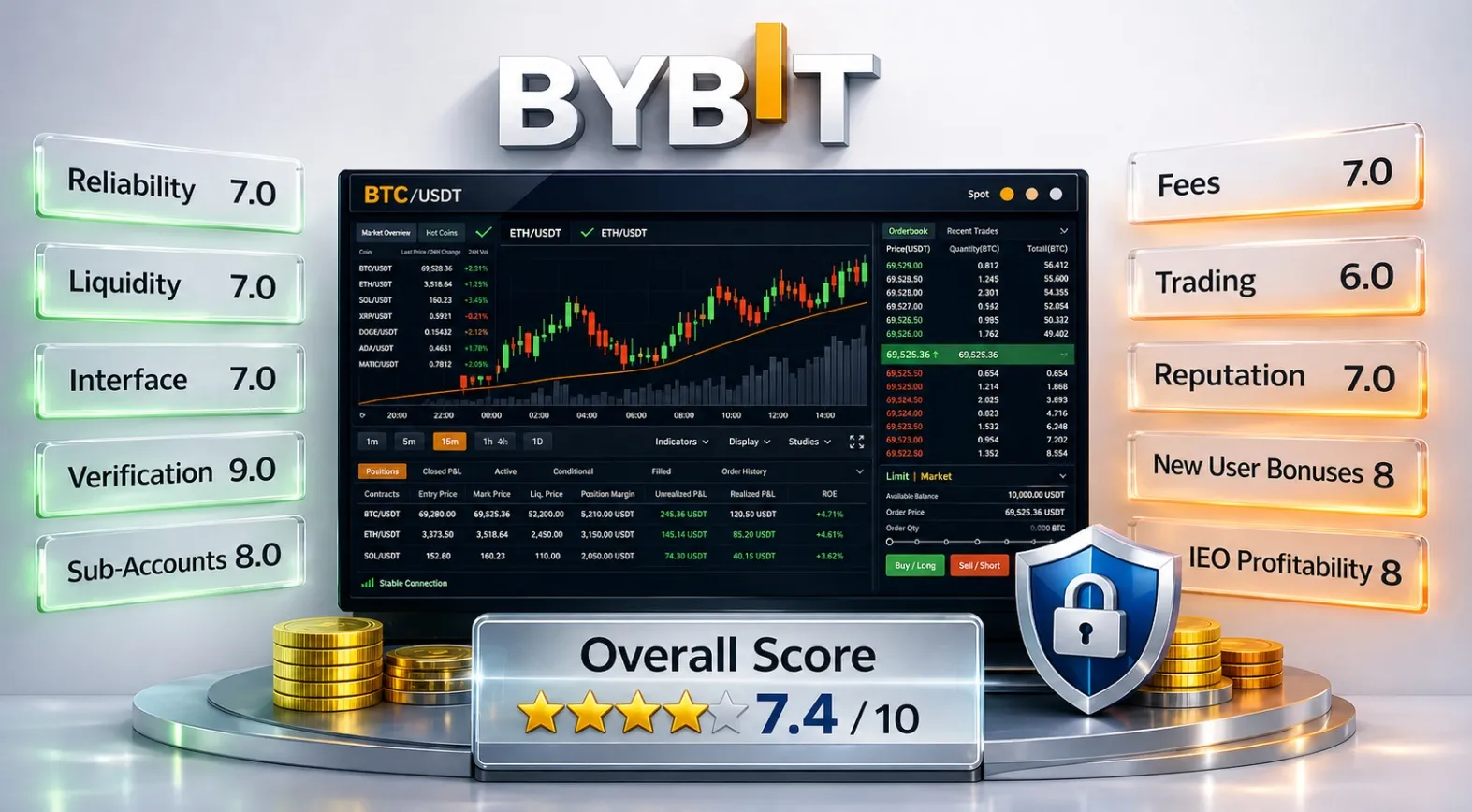
General information about the exchange
Quick profile
- Scale: the exchange has operated since 2018 and serves tens of millions of users worldwide. Official materials cite a “60+ million” figure.
- Products: spot trading, perpetual contracts (derivatives with no expiry date), leveraged futures contracts, options, P2P exchange, Earn, copy trading and related services are available.
- Terminal: the platform offers TradingView charts, advanced order types, customizable panels and quick access to the order book.
- Apps: mobile clients for iOS and Android provide access to trading, notifications, 2FA (two-factor authentication) and the main account operations.
- Fees: on spot, the baseline reference point is around 0.1%. On derivatives, retail tiers most often cite around 0.06% for the taker (the side that executes an existing order) and 0.01% for the maker (the side that adds an order to the order book). Fees are lower on account tiers with higher trading volume.
- Verification: KYC is required for full trading and withdrawals. For disputed operations, the exchange may request additional documents.
Summary of user ratings
Bybit has many extreme ratings on mass review platforms. Some users give 5★ for stable trading and fast withdrawals. Others give 1★ after P2P disputes, withdrawal delays or lengthy checks. Among active traders, ratings are usually higher because discussions more often focus on the terminal, order execution and liquidity rather than conflict cases.
| Platform | Rating | Comments on tone |
|---|---|---|
| Trustpilot | ≈ 3.1/5 (7,142 reviews); 5★ 39%, 1★ 48% | Complaints most often involve P2P disputes, withdrawal delays during checks and weak ticket transparency. There are also many reviews from users whose trading and withdrawals worked without issues for years. |
| TradingView | ≈ 4.8/5; the number of ratings changes | The main focus is terminal usability, execution speed and liquidity. Negative feedback is more often linked to isolated liquidations, local outages or disputed situations in volatile markets. |
| Social media (Reddit/X) | No aggregate score | Social media more often contains detailed cases: how a withdrawal was processed, how a P2P dispute was resolved, what happened during an account restriction and how bonus terms worked in practice. |
| ⭐ Rating | 📊 Approximate share | 💬 Main reason |
|---|---|---|
| 1–2 stars | 1★ 48% (Trustpilot) | 🚫 Withdrawal issues, account restrictions, disputed P2P decisions and slow support response |
| 3 stars | Mid-range ratings with no separate public share | 😐 Mixed experience: trading is convenient, but checks, instability in some services and complex bonus terms hurt the overall impression |
| 4–5 stars | 5★ 39% (Trustpilot) | 👍 Convenient terminal, low fees, liquidity and a positive experience with regular trading and withdrawals |
Review collection methodology
The analysis includes recent reviews from Trustpilot, TradingView, Reddit, X and YouTube. The reviews were then grouped by recurring themes: trading, liquidity, P2P, support, KYC and AML checks, security, fees, withdrawals and bonus programs.
Sources: open review pages, public discussions and the exchange’s own reference materials on products, verification and operating rules were used.
Approach: the text includes not isolated emotional stories, but themes repeated by different users: terminal usability, execution speed, P2P disputes, source-of-funds checks, bonus terms and support performance in complex cases.
Limitations: ratings and rules change over time. Some negative and positive stories depend on a specific platform usage scenario: regular spot trading, large-sum operations or P2P activity.
📊 Review distribution: rating and reason
1–2 stars
- 🚫 Withdrawal delays or temporary withdrawal freezes due to manual KYC and AML checks, when the request has already been accepted but the transfer is not completed.
- 🚫 P2P disputes, including chargebacks (payment reversals after transfer), fake payment confirmations and arbitration decisions that one side considers unfair.
- 🚫 Account restrictions after unusual transactions, a sharp increase in turnover or operations for which the exchange asks to confirm the source of funds.
- 🚫 Slow support replies, template responses and no clear ticket status for several days.
- 🚫 Loss of trust after major security incidents and news that increase concern about fund safety.
3 stars
- 😐 The interface and fees are acceptable, but service stability during certain periods is viewed as unpredictable.
- 😐 Deposits and withdrawals usually go through quickly, but manual checks noticeably increase processing time.
- 😐 P2P is seen as a functional tool when verified merchants are selected, but dispute risk is still perceived as high.
- 😐 Bonuses and promotions help reduce costs, but participation and profit withdrawal terms are not always clear on first reading.
4–5 stars
- 👍 Users praise the convenient interface, deep TradingView integration and fast access to orders and charts.
- 👍 Competitive fees and tight spreads on the most liquid pairs are often mentioned.
- 👍 Users highlight high liquidity, fast order execution and a broad selection of coins and trading instruments.
- 👍 The mobile app and years of experience without trading or withdrawal issues are mentioned separately.
Additional glossary of terms
Escrow: a mechanism that holds cryptocurrency until payment is confirmed or a dispute is resolved.
HFT: high-frequency trading, where the strategy depends on execution speed, trade frequency and the fee model.
Mark price: the calculated price on derivatives used to determine liquidation. It may differ from the last trade shown on the chart.
Address whitelist: pre-approved withdrawal addresses to which funds can be transferred without the risk of accidental sending to an unrelated wallet.
Overall impression from reviews
Bybit reviews almost always reveal two different scenarios.
The first is regular trading. Funds are deposited, trades are opened on spot or derivatives markets, the terminal works consistently and withdrawals pass without conflict with the verification system. In these stories, users most often praise the interface, performance speed and liquidity.
The second is a conflict or non-standard situation. This may be a P2P dispute, chargeback, large withdrawal, suspicious fund route or additional source-of-funds check. These cases most often lead to sharp 1★ reviews and accusations against the exchange. That is why the overall rating on mass platforms looks average, while among active traders it is higher.
What reviews mean for usage scenarios
- A regular trading scenario is more often linked to positive reviews. The terminal, liquidity and order execution are rated highly.
- Scenarios involving P2P, large sums and unusual transactions are more often accompanied by additional checks, delays and disputed cases.
Interface and usability
The Bybit terminal is often praised for its clear layout, fast access to the order book, flexible panel customization and full integration with TradingView. TradingView is a charting and technical indicator service. Users can place orders directly from the chart, switch interface themes and save workspaces for different strategies.
Negative interface reviews also exist, but they usually concern specific details rather than the terminal’s overall architecture. Some users point to the lack of executed order display on the chart and limitations of the mobile version. Across the overall review set, praise for the terminal appears more often than complaints about its structure.
Trading process and liquidity
Bybit has long been associated with derivatives among traders. This is why order book depth, execution speed and instrument selection are most often praised in this area. On the most liquid pairs, users usually report low slippage. Slippage is a small difference between the expected price and the actual execution price.
On spot markets, users also note a broad coin selection and stable activity on top pairs. The main complaint area is different: disputed liquidations with high leverage. In these complaints, the issue usually is not that an order “disappeared”, but that liquidation is calculated using the mark price, which may differ from the last trade shown on the chart.
Mobile app
The Bybit mobile app covers almost the full everyday task set: viewing charts, placing orders, using P2P, confirming actions through 2FA and managing notifications. Users often note that the app works quickly and does not force them to switch to desktop for standard operations.
Limitations are also mentioned. A phone screen offers less space for complex analysis, and during high volatility, some interface elements may be less convenient than in the full desktop version. For this reason, the mobile app is more often used for quick actions rather than deep market analysis.
Support, KYC and compliance
Support is available through chat and email. On public platforms, exchange representatives often respond quickly. Problems begin when the case reaches KYC, AML and source-of-funds confirmation. In such cases, the decision usually depends not on the first-level operator, but on staff who check documents against formal criteria.
Restrictions are not lifted until the confirmation package appears complete. This is why support reviews diverge so sharply: simple questions are resolved quickly, while complex checks may take weeks.
Typical data package for checks
- Basic KYC completed before the first urgent withdrawal operation.
- Source-of-funds documents: bank statements, contracts, receipts and other confirmations of fund origin.
- P2P payment channels where the transfer and origin of funds can be traced more easily.
Security: platform-side and user-side
Account security
- 2FA for confirming logins and operations.
- Anti-phishing code in exchange emails.
- Action confirmations through email.
- Withdrawal address whitelist.
- PIN for critical operations inside the account.
- Action recording in security logs.
Platform-level incidents
- In 2025, one of the platform’s wallets suffered a major breach.
- Part of the funds was stolen from an infrastructure address.
- The company stated that user balances were not affected.
- Trading on the platform continued.
- Some users reported withdrawal delays due to increased load.
- After the incident, the exchange strengthened internal transfer checks.
- Cooperation with analytics and law enforcement organizations was announced.
Security architecture
- Asset custody: hot and cold wallets, multi-signature, internal transfer limits and suspicious transaction monitoring are used.
- Access control: 2FA, anti-phishing code, address whitelists and automatic withdrawal pauses after unusual actions are applied.
- Procedures: security audits, bug bounty programs and blockchain fund movement analysis through external providers are used.
P2P: convenience and risks
Bybit’s P2P platform is valued for fast access to fiat operations through local payment methods. Most trades pass smoothly, especially when a merchant with a long history and high rating is selected.
A significant share of negative P2P cases is linked to specific fraud scenarios: fake payment confirmations, payment reversal after receiving cryptocurrency, attempts to move the trade outside the platform or a dispute where one side could not collect enough evidence. In P2P, the deciding factor is not general “caution” but specific details: where the conversation took place, when the transfer was confirmed and what documents can be shown to arbitration.
Risk reduction factors on P2P
- Verified merchant: high rating, a large number of completed trades and confirmed verification.
- Communication inside the platform: an attempt to move communication or payment outside Bybit is usually treated as a red flag.
- Payment record: receipts, screenshots and, when available, a video of the transfer process.
- Escrow hold until actual receipt: counterparty confirmation alone does not replace money arriving in the account.
- Limiting risky payment methods: relevant in scenarios where a payment can be reversed after the trade is completed.
- Splitting large sums: several smaller trades simplify arbitration and reduce the scale of a single disputed case.
- Complete evidence package: bank statements, timestamps, screenshots and a consistent chronology of events.
P2P dispute review process
- Opening a dispute from the specific order window with the payment disagreement or trade term issue recorded.
- Submitting evidence: bank statements, receipts, chat correspondence and, when available, payment video.
- Responding within the required time frame and keeping all communication inside the platform.
- Additional support escalation and a complaint against the counterparty through the P2P interface during a prolonged conflict.
- Final arbitration decision based on evidence completeness and event sequence.
Fees, deposits and withdrawals
Spot: for the base tier, the reference point remains around 0.1% for maker and taker. At higher statuses, the fee decreases.
Derivatives: for retail users, rates are usually cited at around 0.01% for maker and around 0.06% for taker. The exact rate depends on the product, account tier and fee schedule updates. Some older negative reviews are linked to the exchange discontinuing its previous maker rebates in 2022. This worsened the economics of some HFT and algorithmic strategies.
Deposits and withdrawals: crypto transfers usually go through quickly in normal conditions. But during abnormal activity, large sums or data mismatches, the exchange may move a request to manual review. This is exactly when the most conflict-heavy complaints appear: the operation is not canceled, but the funds do not arrive within the expected time because of an additional compliance check.
Bonuses, promotions and contests
Bybit actively promotes welcome packages, fee coupons, bonus credit and large tournaments for traders. Most complaints in this area appear because of incorrect expectations: a bonus is perceived as “money available for withdrawal”, although under the rules the bonus itself usually cannot be withdrawn. Usually only profit earned with the bonus can be withdrawn, and only if the time, trading volume or minimum result conditions are met.
Metrics and review observations
⭐ Ratings
On Trustpilot, Bybit shows strong polarization: many 5★ and many 1★ ratings. On TradingView, the overall score is higher because users there more often evaluate the trading process itself rather than conflict scenarios around withdrawals and P2P.
💬 Recurring themes
The interface, terminal speed, liquidity and mobile app are praised most often. P2P disputes, long compliance checks and inflated expectations from bonus programs are criticized most often.
🕒 Dynamics
After high-profile news, especially about security issues or withdrawal delays, the number of negative reviews rises sharply. When the acute phase passes, reviews about everyday trading and platform usability begin to dominate the feed again.
Pros and cons from reviews
✅ Pros
- Intuitive interface and strong TradingView integration, which active traders value especially highly.
- High liquidity on major markets and fast order execution in regular trading scenarios.
- Broad toolset: spot, derivatives, options, P2P, Earn and copy trading.
- Competitive base fees and the ability to reduce costs through account tiers and coupons.
- Full-featured mobile apps with notifications, biometrics and quick account access.
❌ Cons
- P2P remains one of the most conflict-prone areas, especially when payment evidence is poorly recorded.
- Compliance checks on the source of funds can take longer, and some functions may be limited during this period.
- The high-profile security incident in 2025 became a serious reputational hit, even though the platform continued operating.
- Bonus marketing creates an expectation of direct withdrawable profit, although the actual participation and profit withdrawal terms are noticeably more complex.
- Fee policy changes, including the removal of old maker rebates, worsened conditions for some professional strategies.
❓ FAQ about Bybit reviews
Is Bybit reliable?
Bybit is a major centralized exchange (CEX) with millions of users and developed trading infrastructure. Trust in any CEX is limited by the platform’s internal rules, its asset custody model and its response process during incidents. In 2025, the exchange experienced a major security incident. That is why reviews often separate trust in trading functionality and trust in capital custody as two different questions.
How do Bybit fees work?
On spot, the base reference point is around 0.1% for maker and taker. On derivatives, starting tiers are around 0.01% for maker and 0.06% for taker. Fees decrease as account status, trading volume and specific coupons increase. In reviews, the fee structure is most often discussed together with post-only mode and the removal of maker rebates in 2022.
Is verification (KYC) mandatory?
Yes. KYC is required for full access to products and withdrawals. For large sums, unusual transfers or disputed fund routes, the exchange may request additional confirmations even from an already verified account if the operation falls under an AML review scenario.
What determines risk on P2P?
P2P risk depends on counterparty quality, payment method, completeness of communication inside the platform and the volume of evidence that can be shown to arbitration. The most conflict-heavy cases in reviews are linked to chargebacks, fake payment confirmations, moving communication outside the platform and weak recording of the transfer fact.
How do Bybit bonuses work?
In the typical Bybit model, the bonus itself cannot be withdrawn. Only profit generated with its help becomes withdrawable if the promotion terms are met: time limits, trading volume, minimum result or other restrictions specified in the promo rules. The difference between the bonus and withdrawable profit is the most common source of negative reviews.
Why can liquidation trigger away from the last chart price?
In the derivatives market, liquidation is calculated using the mark price, not the last trade shown on the chart. Therefore, it may appear that the market has not yet reached the liquidation point, although the calculated price has already reached the required level.
Why can an account be restricted or withdrawals paused?
Such restrictions are usually linked to an additional KYC and AML check, data mismatch, unusual fund route, large amount or an operation that requires confirmation of the source of funds. In reviews, these cases are most often described as the most stressful because the decision depends on document completeness and the duration of the internal review.
What role do bonuses and tournaments play in Bybit’s product model?
Bonuses and tournaments are part of the platform’s product model. They increase engagement, reduce part of the costs and stimulate activity in specific products. Reviews rate this area positively when the terms are clear in advance and negatively when the bonus is perceived as a directly withdrawable balance.
🧾 Bybit: key observations from reviews
Bybit looks strongest in active spot and derivatives trading scenarios. Users often praise the terminal, liquidity, performance speed and mobile app. The exchange receives the strongest reviews in regular trading mode.
The main risks are concentrated not in the interface, but in conflict scenarios: P2P disputes, manual withdrawal checks, source-of-funds requests and inflated expectations from bonuses. The larger the amount, the more complex the transfer route or the weaker the P2P evidence package, the higher the probability of delay and conflict with support.
Bybit is primarily a trading platform. Long-term capital storage on a centralized exchange remains a separate risk scenario. This distinction is the pattern most often visible in user reviews.