Contradictory reviews of crypto exchanges appear when one user sees a completed operation with a final status in the order or withdrawal history, while another user records that the same kind of action has stopped because of a verification status or a restriction assigned by the system to that account.
Crypto exchange reviews are contradictory because each user evaluates a specific recorded result inside the exchange system: the price and sequence of trades in the order report, the presence or absence of a txid in the withdrawal log, the request status in the compliance module, and active restrictions assigned to the account by the risk module.
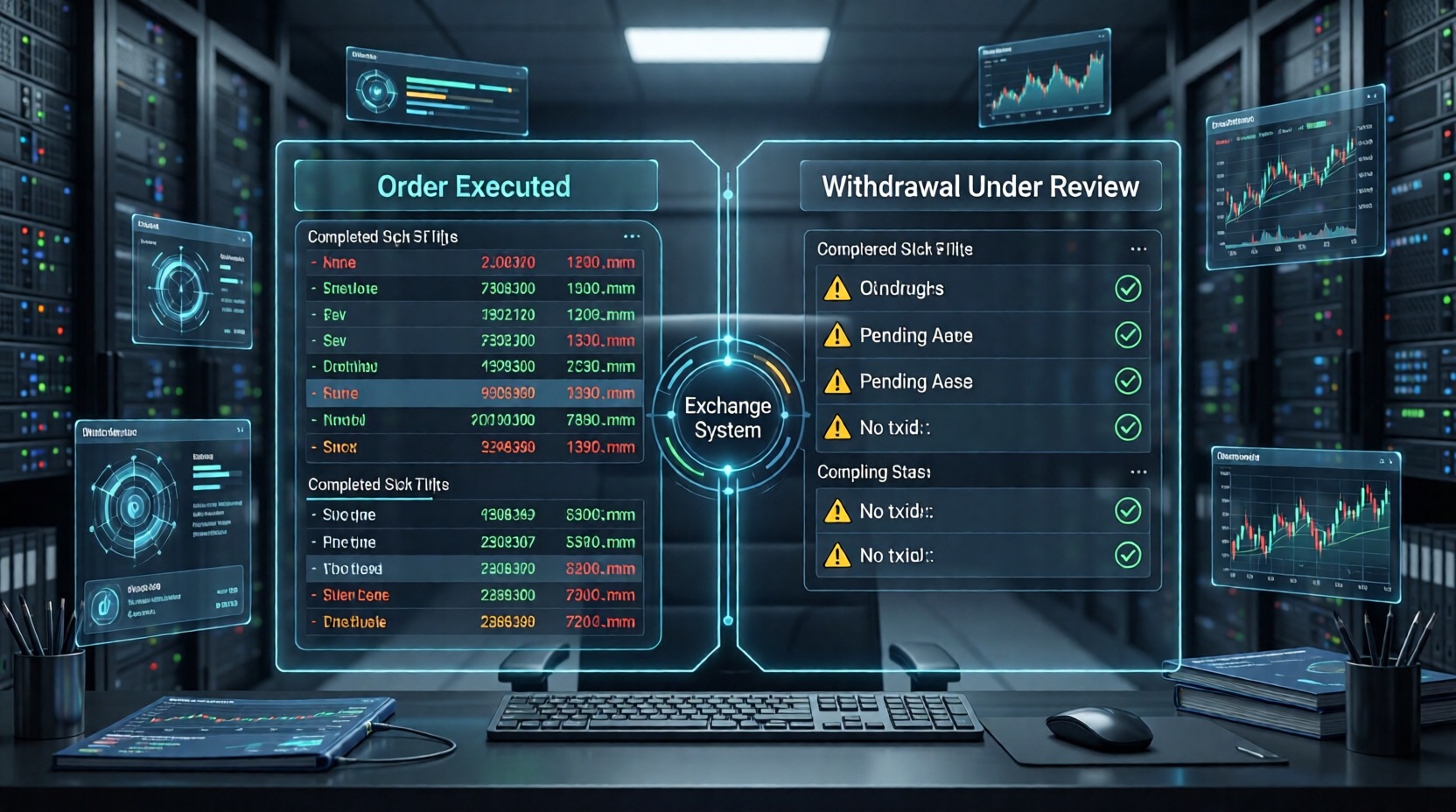
⚙️ Why the same trade gives different results in reviews
Contradictory crypto exchange reviews appear when the trading engine executes orders of the same type while the order book is in different states and records different results in the final order report.
🧩 Execution across levels
A market order is matched against limit orders in the order book, and when there is not enough volume at the first level, the unfilled remainder is moved step by step to the next price levels.
Every move to the next level is recorded as a separate trade and changes the final average execution price of the order.
Record: the order report contains several trades with different prices, volumes and timestamps, showing the sequence of execution across order book levels.
🧩 Execution as a single trade
If the volume of limit orders at the best price fully covers the size of the market order, the trading engine closes the order with one trade without moving to the next levels.
In this scenario, the execution price is recorded at the best available order book level at the moment when the order is matched.
Record: the order history contains one trade with a single price and execution time, without additional entries for partial trades.
Both scenarios are checked through the order report and the trade history, so opposite reviews reflect different order book states at the moment of execution.
🔒 Why account restrictions create the harshest negative reviews
Sharp negative crypto exchange reviews appear when the system blocks a specific account action and records the block as an operation status or profile flag visible in the interface.
| Control module | System action | Record point |
|---|---|---|
| Risk module | Blocks execution of a set of account actions | Security section and list of restrictions |
| Compliance module | Moves the operation into review status | Operation status in the activity log |
| KYC module | Stops execution until the required step is completed | KYC page and list of requirements |
| Withdrawal system | Does not pass the request to blockchain sending | Withdrawal log and absence of a txid |
A negative review is formed when the user treats a recorded system status of an operation or account as a characteristic of the entire crypto exchange, although the cause is fully checked through operation logs and profile control statuses.
🧩 Why KYC and compliance create opposite reviews of one crypto exchange
Contradictory reviews appear when the same operation receives different statuses because of the KYC state and compliance flags recorded in the account profile.
🟢 KYC completed
The system allows the operation to complete automatically without holds or intermediate states.
Record: the operation has a final status in the activity log.
🟠 KYC not completed
Creating the operation is blocked, or the action is held in the compliance review queue until the profile status changes.
Record: the review or block status is displayed in the KYC profile.
The contradiction in reviews appears when these different system statuses are interpreted as an evaluation of one crypto exchange.
🔎 How to read crypto exchange reviews through operation statuses
Every review of a crypto exchange records the result of a specific action, so correct reading requires identifying the operation object and the status recorded in the system.
The check follows one logic: first identify the object, then read the status, and after that look for the final record of the result.
🧭 Algorithm for reading a review as a status check
🧩 Tie the review to an object
A review becomes verifiable when a specific object can be isolated in it: an order, a withdrawal request, a KYC step or an account restriction.
If the object is not defined, the text cannot be matched to the operation log.
Record: the object is always displayed as a separate entry in order history, the withdrawal log or the KYC profile.
🧾 Read the status and the type of hold
The status shows whether the action has completed or is held by the system: final, review, blocked, waiting for confirmation.
The type of hold is determined by the interface point where the status is displayed.
Record: the time of the last status update points to an active intermediate state.
✅ Find the final sign of completion
A final status means the action is complete; an intermediate status means the action is held until the next system step.
For a withdrawal, the final sign is the transition to blockchain sending and the appearance of a txid.
Record: the absence of a txid while the request is active indicates a hold before the sending stage.
🔒 Identify the restriction module
If an action is blocked or held, the reason is recorded as a KYC flag, a compliance queue or a risk restriction.
The module is identified by the interface section where the restriction is displayed.
Record: a block is always tied to a specific control module and is shown as a status or flag.
🧪 How to distinguish a verifiable fact from wording
| Review wording | Classification | Why it does not match the logs | What is needed for verification |
|---|---|---|---|
| “The withdrawal is stuck” | Not verifiable | The object and current request status are not specified | Request entry and status in the withdrawal log |
| “Withdrawal request without txid” | Verifiable | The object and observable sign of a hold are specified | Withdrawal log: request status and txid field |
| “Execution is bad” | Not verifiable | There is no data about trades or execution price | Order report and prices of partial trades |
| “The order executed across several levels” | Verifiable | The matching mechanism and execution result are described | Order report: list of trades and level prices |
Record: a review is considered verifiable when it can be rewritten in the format “object + status + record point”.
Contradictory reviews appear when different statuses of different objects are compared, rather than the same state of one operation.
➡️ Where review analysis runs into withdrawal hold mechanics
Contradictory crypto exchange reviews most often concentrate around withdrawals because a withdrawal passes through several internal statuses before the request is handed to the blockchain.
The critical point appears when the request has been created but the txid has not yet been formed: the user sees the fact of a hold but does not see the stage where the system stopped the request.
🧱 Which withdrawal statuses create conflicting reviews
🧾 Request created but not sent
The user sees the request in the withdrawal log, but the operation has not moved to blockchain sending and has not received a txid.
This means the request is held by an internal module before the transaction creation stage.
Record: the withdrawal log has an entry, but the txid field is empty and the status is not “Sent/On-chain”.
🔍 Review status holds completion
Compliance moves the action into review status and does not allow the request to move into the final execution stage.
The user records this as a “stuck” operation, although the system shows an intermediate status and an update time.
Record: the operation status updates but does not become final until the review is closed.
🧩 Which facts are extracted from reviews without interpretation
| Recorded fact | System object | Record point |
|---|---|---|
| Withdrawal not completed | Withdrawal request | Request status and absence of txid in the withdrawal log |
| Action unavailable | Account with a restriction | List of prohibited actions in the security profile |
| Documents requested | KYC step | Verification status and list of requirements |
| Review not closed | Compliance queue | Operation status and time of the last update |
Record: until a withdrawal request receives a txid, the reason for the hold is always displayed as an operation status or a profile restriction.
The mechanics of holding a request before it receives a txid and the reasons for a withdrawal freeze are explained in the article why an exchange freezes withdrawals.